Saint of the day
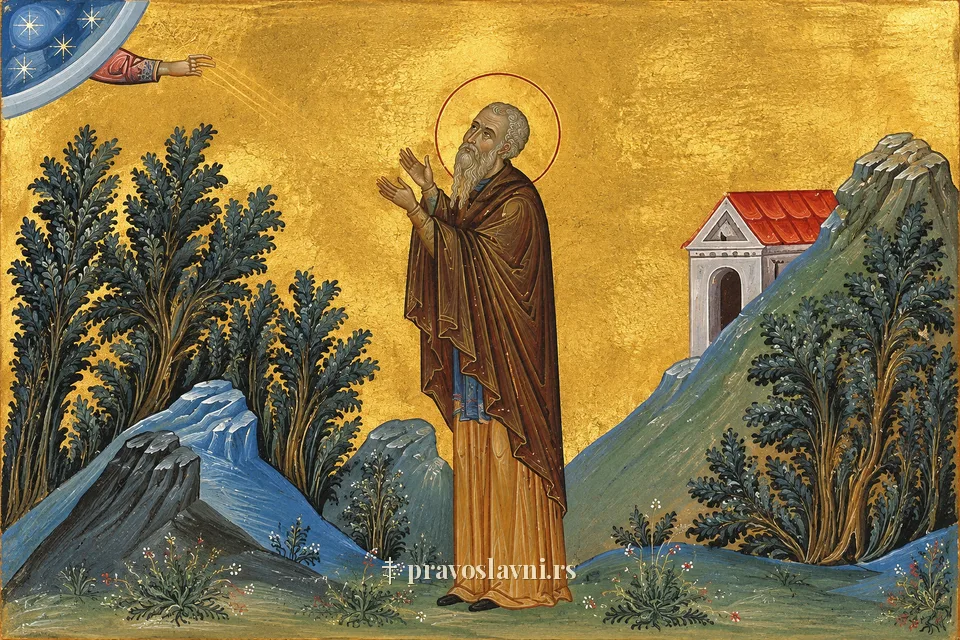
Venerable Joannicius the Great
What happenedThe former soldier Joannicius, having repented of iconoclasm, spent more than fifty years in ascetic struggle, healing the sick and foretelling the future.
Read the LifeOrthodox Calendar · 4 November according to the Julian calendar
Wednesday, 17 November 20274 November (according to the Julian calendar)What happenedThe former soldier Joannicius, having repented of iconoclasm, spent more than fifty years in ascetic struggle, healing the sick and foretelling the future.
Read the Life
No meat, dairy products, eggs, fish or oil — food cooked in water.
This is a recommendation — for your own fast, consult your priest or spiritual father.More about the fast →
Today the Church keeps the commemoration of a saint · not a Red Letter day.
More about the feast →
“You therefore must endure hardship as a good soldier of Jesus Christ.”
— 2 Tim 2:3Joannicius the Great was an iconoclast when he was a young soldier of the imperial guard, and he died a zealous defender of the icons.
A child from the Bithynian village of Marycata, without school or book, he was wiser than many who were more learned. He tended cattle and prayed a great deal.
Because of his strength and good looks he was taken into the guard of the Emperor Leo. There he accepted iconoclasm. His Life says that on the road beside Olympus a certain clairvoyant monk stopped him, called him by name and rebuked him; Joannicius then knelt down, repented, and from that hour defended the icons. For twenty-five years he was a soldier — a brave one in the war with the Bulgarians — and then he left the world.
The Prologue says that he withdrew to Olympus in Asia and spent more than fifty years in the ascetic life. According to his Life, he learned the monastic rule in various monasteries, mastered his letters and the psalms only as a monastic novice, and lived for years in the mountains and in caves; he was tonsured a monk only in the twelfth year of that life.
The Prologue credits him with almost all the gifts that we remember in the great ascetics — from healings and the casting out of demons to clairvoyance; snakes and wild beasts obeyed him, water bore him up, and when he wished it, people did not see him. His Life adds that he set captive Greeks free and foretold the death of emperors, and that not even the envious monk Epiphanius, who set the forest on fire around him, was able to harm him. The Prologue points out in particular that, although built like a giant, he was humble and meek.
He was a friend of Patriarch Methodius and, according to his Life, he knew beforehand that Methodius would restore the veneration of icons. When the Patriarch, as his Life goes on, visited him in his old age, he told him that he would soon follow after him. He reposed three days later, on 4 November, in his ninety-fourth year, and the Prologue gives the year 846. Both sources record that the monks on Olympus then saw a sign in the heavens, and that his relics afterwards healed the sick.
Joannicius teaches us that repentance can turn even a great error into the beginning of holiness, and that humble prayer and faithfulness to the Church overcome every temptation.
The man whom the Church calls Joannicius the Great was for a time an opponent of the holy icons. He served as an excubitor in the guard of Emperor Leo, the son of Constantine Copronymus; the imperial recruiters, according to both sources, chose him for his youth, good looks and strength. Among the soldiers, under the devil's influence, he became an iconoclast and rejected the icons completely.
The turning point, according to his Life, came when as a soldier he was passing by Olympus: an unknown clairvoyant monk came out to meet him, addressed him by name and rebuked him for despising the icon of Christ. The soldier knelt before the elder, asked forgiveness and promised that he would venerate the icons. He kept that promise to the end of his life and became an ardent defender of the veneration of icons.
He was born in the village of Marykaton, in Bithynia, the son of Myritricius and Anastasia. As a boy he was a shepherd; his wisdom did not come from books, for he had not studied them. He would often withdraw into solitude to pray.
In the war against the Bulgarians, who had invaded Thrace, he showed himself brave. His Life compares him to David. He snatched a Greek nobleman from captivity among the Bulgarians, and he also killed a Bulgarian of gigantic stature. The Emperor, according to his Life, wanted to reward him with a rank, but Joannicius cared nothing for honours. After twenty-five years of soldiering he turned to the monastic life.
The Prologue says that he went to Asian Olympus and remained there in ascetic struggle until his death. His Life follows a longer wandering. On the advice of Abbot Gregory he first learned the monastic rule among experienced monks; being illiterate, it was only then that he mastered his letters, and at Antidium in two years he learned thirty psalms by heart. Then came years in the mountains and in caves — three of them in a narrow cave near the Hellespont, which he never left. He was tonsured a monk, only in the twelfth year of that life, by Abbot Stephen in the monastery of Eristes, at the command of a voice from heaven.
In the Prologue all of this is gathered into a short list: he healed, cast out demons, tamed beasts and snakes, saw things beforehand, walked on water and vanished from sight whenever he wished. And yet, according to the Prologue, he remained humble and gentle, although in stature he was a giant.
His Life preserves the details. To set free a nun who wanted to leave her monastery and marry, he said to her: “Child, put your hand on my shoulder.” Her temptation vanished, but it passed over to him; so as not to fall, he sought out a poisonous snake to bite him. The snake died, the temptation passed, and from then on, according to his Life, snakes could do Joannicius no harm. He freed captive Greeks both in Bulgaria and among the Ishmaelites, and he foretold the deaths of the Emperors Nicephorus and Leo the Armenian. To the monk John, who complained that he could not see him when he became invisible, he replied: “Brother, we have no will of our own.”
The desert-dwellers, according to his Life, had long before foretold to him that in his old age envious men would attack him and that their evil would return upon them. And so it was: his Life says that the monk Epiphanius set fire to his forest, and then, when Joannicius himself came to ask forgiveness, struck him with a staff — and both times the saint remained unharmed.
He was close to Methodius, Patriarch of Constantinople, and took part in the life of the Church. When his disciple Eustratius asked him how much longer the persecution of the icons would last, according to his Life he answered that he should wait, for Methodius would govern the Church — which indeed came true: as Patriarch, Methodius restored the veneration of icons. Joannicius defended him against the heretics by letters, and then in person as well.
He spent his last years in a cell at Antidium. When Methodius visited him, Joannicius, according to his Life, told him that he would soon follow after him. Three days after that meeting, on 4 November, in his ninety-fourth year, he reposed; the Prologue records the year 846. Both sources record a sign which the monks on Olympus saw that day. His relics went on healing the sick after that as well.
Joannicius teaches us that even an error of youth need not be the end: repentance turned him from an opponent of the icons into their defender. Humble prayer, faithfulness to the teaching of the Church and trust in the power of God overcome temptations, enemies and heresy, and God glorifies His saints both in their lifetime and after death.
The holy Apostle Titus brought Nicander and Hermas to the faith and ordained them — the first as Bishop of Myra, the second as a presbyter. Their zeal opened the way to Christ for many pagans, but it also brought an accusation against them before Libanius. Libanius's long attempts to persuade them to renounce Christ bore no fruit. The torture left them barely alive, and the prison into which they were thrown gave them neither bread nor water. Yet neither hunger nor wounds finished them off: the Lord, according to their Life, sent them food from heaven and healed them; the Prologue says that He also appeared to them, in various ways. Their Life records new tortures at a second trial. Not even fire was able to destroy them: in the furnace an angel of the Lord kept them safe. Their end came in a grave into which they were lowered alive. Neither the Prologue nor their Life gives the year or the place of their suffering, apart from the fact that Nicander was Bishop of Myra. The Prologue says of all this: “But in vain do men kill, when the Lord gives life” — “and in vain do they dishonour him whom the Lord glorifies”. Their example shows that faithfulness to Christ, even in the greatest persecution, is upheld by the Lord Himself.


