Tuesday16November 20273 November (according to the Julian calendar)‹›
Illustration
Feast of the day
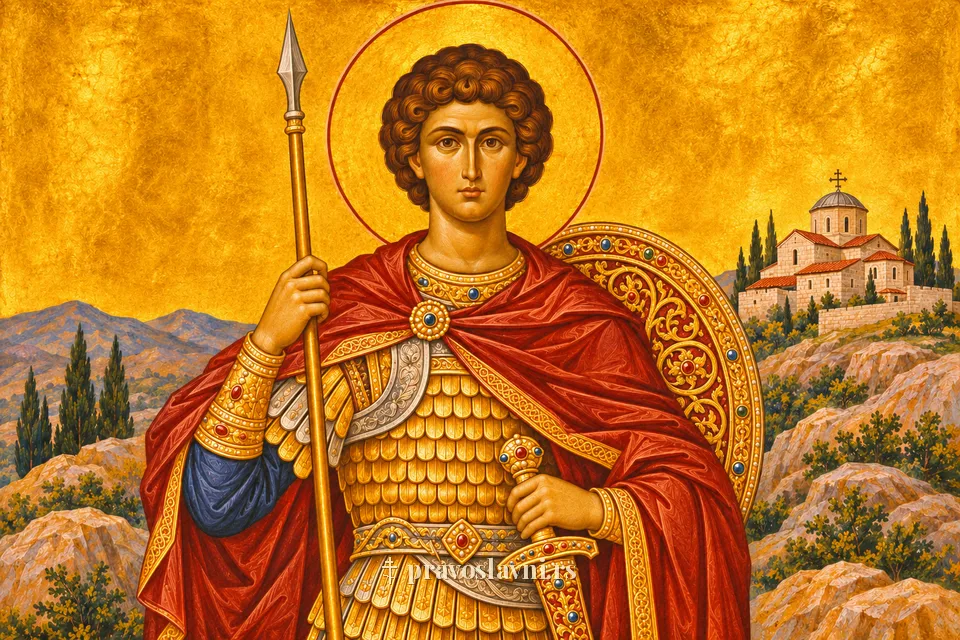
Đurđic — Dedication of the Church of the Great Martyr George in Lydda
Dedication of the Church of the Great Martyr George in Lydda
What happenedĐurđic (the autumn feast of St George), popularly called Little Đurđevdan (Little St George's Day): the commemoration of the translation of the relics of St George from Nicomedia to Lydda, to the church built in the time of the Emperor Constantine.
Sung at the Slava (family patron saint's feast) and on the saint's feast day.
As liberator of captives and defender of the poor, physician of the sick, champion of kings, O victorious Great Martyr George, entreat Christ God that our souls be saved.
Đurđic — Dedication of the Church of the Great Martyr George in Lydda
Đurđic is the autumn feast of St George. In the calendar it is recorded as the Dedication of the Church of St George, but also as the Translation of the Relics of the holy Great Martyr George, while Đurđic is its folk name.
On that day the Church celebrates the arrival of the relics of St George in Lydda in Palestine, to which they were brought from Nicomedia.
“For many this is their Krsna slava” (family patron saint's day), and St George on Đurđic is also listed among the Serbian Slavas. The faithful turn to him in prayer for help. When the Slava falls on a fasting day, the Slava table is also a fasting one; for more on fasting, see the guide “Fasting — simply explained”.
Đurđic, or Little Đurđevdan (St George's Day), is the autumn feast of the holy Great Martyr George. On that day we remember the translation of his relics from Nicomedia to Lydda in Palestine, as he himself had wished before his death. In our calendar the feast is called the Dedication of the Church of the Great Martyr George in Lydda, while the Prologue and his Life speak of the translation of the relics. Both names speak of the same thing: the relics were laid in the church at Lydda when it was consecrated, and on this day the Church also remembers the renewal of that church.
Of the martyrdom of St George, which took place under Diocletian, the Church speaks at length on 23 April. This day follows his body after death. The servant to whom George left his last wish before he died fulfilled it: he took the body to Palestine. His roots on his mother's side drew him there, and the poor of that land had in their day received his great estate.
The relics found their resting-place in the beautiful church of St George at Lydda, which devout Christians had built in the time of the Emperor Constantine: they were laid in it on the day of its consecration, the year of which the sources do not give. The church was later destroyed and rebuilt several times. The miracles that come from the relics, according to both sources, are beyond number.
The kontakion in his Life sees in George's death for his neighbours a following of Christ, and the prayer that comes after it calls upon him as an intercessor for mercy, strength and salvation. In many of our homes Đurđic is the Krsna slava (family patron saint's day), although the sources do not describe the customs. This feast reminds us that the saint who in his lifetime gave his estate to the poor and his life to Christ remains close, after death too, to those who turn to him.
Full Life
Little Đurđevdan
The holy Great Martyr George has two days in the calendar. The Church speaks at length about his suffering on 23 April, to which both the Prologue and his Life refer. The autumn day, 16 November, our people call Đurđic or Mali Đurđevdan (Little St George's Day). On that day we remember how the body of George was translated from Nicomedia to Lydda in Palestine, by which his last wish was fulfilled, and the church that was built for him in Lydda.
That is why the feast has two names. In our calendar it is called the Dedication of the Church of the Great Martyr George in Lydda, while the Prologue and his Life call the same day the translation of the relics; the Prologue begins with the words: “On this day the translation of the relics of St George is celebrated”. The one does not contradict the other: the relics were placed in that church at its very consecration, and on this day the Church also remembers its renewal.
A Charge to a Faithful Servant
George was tortured under the Emperor Diocletian; the Prologue gives Nicomedia as the place. The last wish that he spoke to his servant concerned his grave: his body was to go to Palestine. Two things bound him to that land. It was from there, as his Life says, that his mother's family came. There, too, George gave up a great estate: he made a gift of it to the poor.
Of the servant his Life says only: “The servant did so.” Thus the martyr, after his death, rested where he himself had wished.
The Church in Lydda
When the turn of the Emperor Constantine came, whom his Life calls the Great, devout Christians in Lydda built a church for George, and a beautiful one. Its consecration was also the day when the martyr's relics were translated into it and buried there. The year of that event is not known, because neither of the two sources records it.
That church did not remain untouched: over the centuries it was pulled down and raised again several times. And the miracles that have taken place since then beside the relics of George, according to both sources, no one has been able to count.
A Hymn and a Prayer
Along with the story, his Life also gives the kontakion, a hymn that sees George's complete self-offering and his death for his neighbours as a following of Christ's sacrifice. At the end stands a prayer before his icon, in which the faithful ask of him, as their intercessor, mercy and salvation, strength in the faith, protection in dangers and deliverance from eternal torments.
Đurđic is the Krsna slava (family patron saint's day) in many of our homes, but the sources do not describe the customs of this day.
Neither the Prologue nor his Life states a particular lesson, but the feast speaks for itself. A man who gave his property to the poor and his life to Christ does not cease to help even after death. St George teaches us that what we give to God and to people is not lost, but becomes a blessing for those who come after us as well.
Other saints of the day
Holy Martyrs Acepsimas and those with him
The eighty-year-old bishop of Naesson in Persia, Acepsimas, knew in advance what was awaiting him. The prophecy, according to both sources, was spoken by a boy filled with the Spirit of God (according to the Life, his young servant), with a kiss and the words: “blessed is this head, for it will receive martyrdom for Christ!” The old man answered: “Let it be to me, my child, according to your word.” When Shapur moved against the Christians throughout the whole of Persia, he too was among those who were seized. As they were leading him away from his house, he said: “this is no longer my home; I am departing, never to return, for the home on high.” At the trial he spoke of the one God, confessed Christ and mocked those who bow down to fire and the sun. The same fate was shared by the deacon Aithalas and the seventy-year-old presbyter Joseph. The prison held them for three years; hunger and beatings were their daily lot, and help came to them, secretly and seldom, only from the occasional guard. In the end Acepsimas was beheaded, just as the child had foretold, and his body was afterwards found by Christians. Joseph and Aithalas were stoned, and Joseph's body, according to both sources, God hid from men. By Aithalas a tree grew up — over his body according to the Prologue, at the place of his death according to the Life — from which the sick received healing, until after five years the envy of the pagans put an end to it. These martyrs teach us to bear suffering for Christ with patience and joy, for eternal life is worth more than the life that passes.