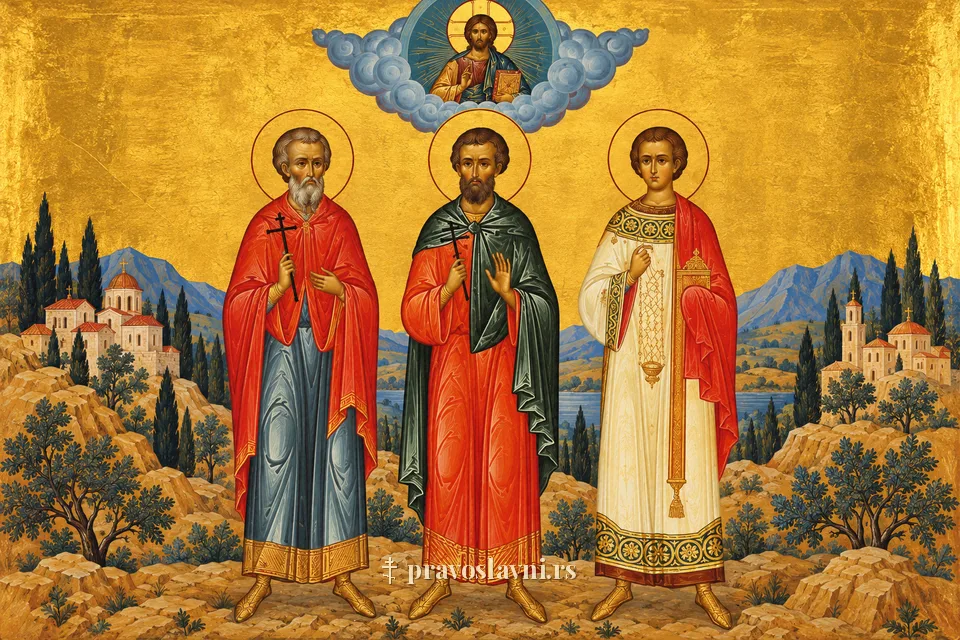
Fasting and prayer filled the days of Gurias and Samonas during the persecution, which they spent outside their own city, Edessa. These respected and devout men gave counsel to the faithful, and they brought many pagans to Christ. About the time of their suffering the sources differ: their Life names the Emperors Diocletian and Maximian, while the Prologue gives the year 322 and Licinius.
When they were arrested and summoned to offer sacrifice, they answered, as the Prologue records: “If we submit to the emperor's command, we shall perish, even if you do not kill us.” Tortures followed, and then more than three months in a dungeon without the light of day, where, although hungry and thirsty, they gave thanks to God. On the morning of 15 November they were set before a choice — incense or the sword — and for Christ they gave their heads.
The deacon Abibus, who, according to his Life, was converting pagans in Edessa many years later, did not wait for them to find him, but presented himself to the soldiers of his own accord. He went to the pyre rejoicing, after he had comforted his mother. The Prologue and his Life say that the fire did not harm his body; he rests beside Gurias and Samonas, where his mother buried him, and he suffered on the same day of the year as they did.
The Prologue and the Life also remember a miracle connected with a deception. Euphemia, the only daughter of the widow Sophia, married a Goth from the army that was defending Edessa; he concealed that he had a wife and children at home, and by the oath which he swore over the reliquary before setting out, he made the martyrs the guarantors of her safety. In the Goth's house Euphemia had to serve his wife, and when that woman died, the relatives, who blamed Euphemia for her death, shut her up alive in the dead woman's tomb. There, according to the Prologue and the Life, the martyrs appeared to her, and the Life hands down their words: “Take courage, daughter, and do not be afraid; you will soon be saved.” After only one hour she was in their church in Edessa, from where she returned to her mother, and the perjurer, as the Life records, was later exposed and punished.
Sts Gurias, Samonas and Abibus teach us to stand firm in the faith until death. God and His saints do not abandon the innocent even when people turn their backs on them.
Full Life
Two men from Edessa
“If we submit to the emperor's command, we shall perish, even if you do not kill us.” That, the Prologue records, is how Gurias and Samonas answered the judge who was threatening them with death. Both of them were respected in Edessa as devout men. Their Life says that they suffered in the persecution in the time of the emperors Diocletian and Maximian, while the Prologue places their execution in the year 322, under Emperor Licinius.
They spent the persecution outside the city, fasting and praying. The faithful sought them out for advice, and many pagans came to know Christ through them. Their Life says that the Roman commander Antoninus arrested them together with their followers. Their companions were released after a beating, but the two of them were kept. When they were ordered to renounce Christ and offer sacrifice to Zeus, they refused, and Gurias recalled the words of Christ that He will confess before the Father the one who confesses Him before men.
Stronger than fear
The imperial governor Musonius came to Edessa to put the Christians to death and threatened them with heavy torments. According to their Life, those threats did not frighten Samonas: the eternal fire, he said, is more terrible than any torment, and Gurias called for steadfastness in the face of the devil's assaults. After being tortured they were shut up for long months in a dark dungeon, hungry and thirsty, yet their thanksgiving to God did not cease.
The Prologue and their Life say that at dawn on 15 November Musonius offered them a choice: life in exchange for a little incense to Zeus, or death by the sword. They chose death for Christ. Their Life says that they were taken secretly, while the city slept, to the hill of Bethelabicla near Edessa. They asked for time to pray and called upon the God and Father of the Lord Jesus Christ to receive their souls in peace. Samonas told the executioner to do his work, and both were beheaded.
The deacon Abibus
Their Life says that many years later Emperor Licinius broke his agreement with Constantine the Great and began to persecute the Christians in the East. At that time Abibus, a deacon from Edessa, was preaching from house to house and converting pagans, so the governor reported him and an order was issued for him to be put to death. When the soldiers were looking for him, Abibus came out of his own accord and gave himself up to the officer Theotecnus. He would not offer sacrifice, and so, after being tortured, he was condemned to be burnt. He met death in the fire with joy, comforting his own people to the last moment. The Prologue and their Life say that the flames spared his body; he rests beside Gurias and Samonas, where his mother buried him. He suffered on the same date as they did. Their relics, gathered into one reliquary, healed the sick in the church which the faithful built for them as soon as the persecution stopped.
An oath over the relics
The Prologue and their Life also remember one miracle. When the Hephthalites laid siege to Edessa, a certain Goth also arrived in the city with the army, and he lodged with the widow Sophia. She had an only daughter, the beautiful Euphemia. The Goth concealed the fact that he had a wife and children at home and asked for Euphemia as his wife. Sophia's fear of a foreign land was nevertheless overcome by his oaths. Before the journey the mother brought the Goth before the reliquary of the martyrs: there he had to swear that he would honour Euphemia as his lawfully wedded wife, and the saints were called upon as witnesses and guarantors.
On the road he showed his true face: he took away her jewellery, left her wretched clothing and threatened her with death if she said a word about the marriage. In the Goth's house Euphemia, presented as a captive, had to serve his real wife. She gave birth to a son, and their Life says that the Goth's wife poisoned the child out of jealousy, and then herself died of the same poison, which Euphemia had kept. The relatives blamed Euphemia for that death and, seven days after the funeral, shut her up alive in the same tomb.
From the tomb to the church
In the tomb Euphemia prayed, remembering the Prophet Jonah, and called upon the martyrs. There appeared to her, according to the Prologue and their Life, three radiant men — Gurias, Samonas and Abibus — and they said: “Be brave, daughter, and do not be afraid; you will soon be saved.” Sleep overcame her, and only an hour later she was in Edessa, in the church of the martyrs, beside the reliquary. “Rejoice, daughter,” they said to her, and sent her to her mother. The presbyter who opened the church found her at prayer and sent for Sophia, and mother and daughter embraced.
Their Life says that after some time the Goth returned with the army and lied to Sophia that Euphemia was well. The mother exposed him, Bishop Eulogius laid the whole matter before the commander, the Goth confessed and was condemned to death.
Sts Gurias, Samonas and Abibus teach that one must stand firm for Christ even under the threat of death, for true perishing is to renounce Him. God and His martyrs hear prayer and protect the innocent and the wronged, while deceit and perjury do not remain hidden.