Saint of the day
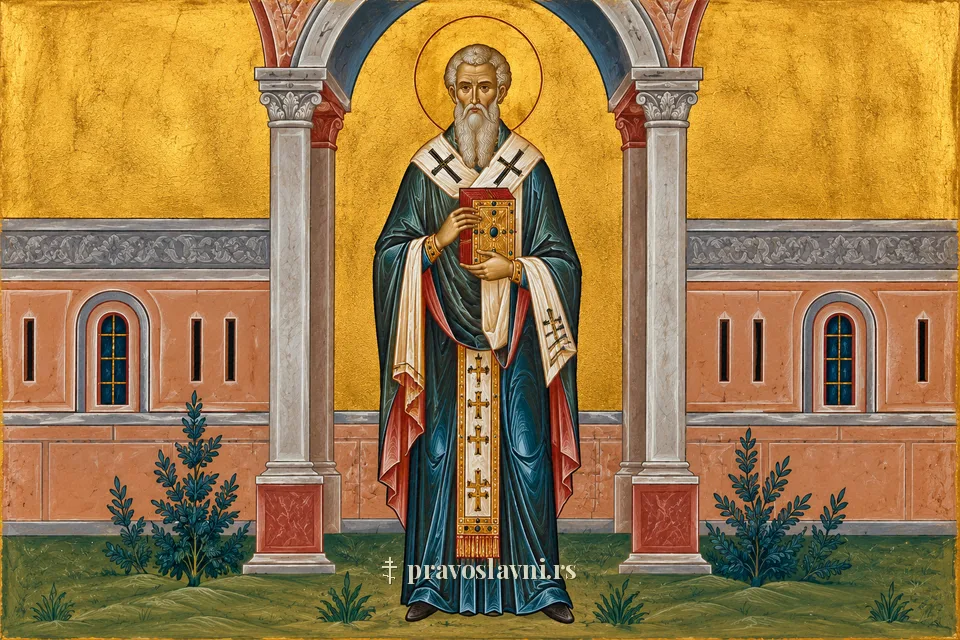
Hieromartyr Clement
What happenedIn exile in Chersonesus Clement prayed, and a lamb showed him the place where a spring gushed forth for the thirsty Christians.
Read the LifeOrthodox Calendar · 25 November according to the Julian calendar
Wednesday, 8 December 202725 November (according to the Julian calendar)Save your slava — you'll get a reminder a week and a day before.
Send a greeting card →What happenedIn exile in Chersonesus Clement prayed, and a lamb showed him the place where a spring gushed forth for the thirsty Christians.
Read the Life
No meat, dairy products, eggs or fish — oil and wine are allowed.
This is a recommendation — for your own fast, consult your priest or spiritual father.More about the fast →
Many families celebrate their Krsna slava (family patron saint's day) today
More about the feast →
“I am the good shepherd. The good shepherd gives His life for the sheep.”
— Jn 10:11St Clement was born in Rome, into a distinguished family which traced its descent from emperors, and he lived in the time of the apostles. A storm at sea carried away his mother and his brothers, and his father too disappeared, when he set out in search of them. Clement, as his Life records, became learned in philosophy, but he carried the sorrow for his family in his heart.
When he heard about Christ, he sailed to the east. He met Barnabas in Alexandria, and in Caesarea he was baptised and from then on followed Peter; among Peter's companions there were already Faustinus and Faustinian — his own brothers. Their mother Matthidia was afterwards found by Peter begging on an island, and Faustus on the road, while he was arguing that there is no God; once they had recognised one another, they were baptised.
The apostle ordained him a bishop, and after Linus and Anacletus (the Prologue calls him Cletus) Clement became Bishop of Rome. Every day he converted many to the faith — his Life records that at one Pascha he baptised 424 people of noble birth — and the sufferings of the martyrs were written down by seven scribes, each in the part of the city which he had assigned to him.
Emperor Trajan ordered him to offer sacrifice to the idols, but Clement chose rather to go into exile in Chersonesus. Among the stone quarries there he found over two thousand exiled Christians, who were short of water. He prayed, a lamb showed him the place, and there a spring burst forth which became a river. The conversions were so many that more than five hundred people were baptised each day, and in just one year seventy-five churches sprang up. In exile too he would not agree to sacrifice, and so, with an anchor tied to him, they drowned him in the sea. The Prologue states that this was in the year 101. Centuries passed before his relics were brought out into the light again, in the ninth century, in the days of Sts Cyril and Methodius.
His life bears witness that God leads a man even through misfortunes, and that the faith which an exile carries reaches to the ends of the empire.
Rome was Clement's native city, and his noble family traced its descent from emperors; he lived in the time of the apostles. His Life records that his father was Faustus, a distinguished pagan, and his mother Matthidia, a kinswoman of the Emperors Augustus and Tiberius. He had two older brothers, the twins Faustinus and Faustinianus, and he was the youngest.
According to his Life, Faustus's wicked brother desired Matthidia. She did not reveal this to her husband, in order to preserve the honour of the family, but said that an old man had appeared to her in a dream and warned her that she and the twins must leave Rome for ten years or they would perish. Faustus sent them by ship to Athens to be educated, and Clement remained with his father. A storm wrecked the ship, and the mother and the brothers vanished at sea.
Faustus sent servants to look for them, and then set out on the search himself. For a full twenty years or so he lived as a beggar, without any honour, until all trace of him too was lost. Clement, according to his Life, became learned in philosophy in Rome, but he grieved for those who were lost.
When he heard of Christ, Clement sailed to the east. According to the Prologue, he was then twenty-four years old, and his aim was also to find his own family. Because of the winds he put in at Alexandria, where he came to know the Apostle Barnabas. In Caesarea Stratonis he met the Apostle Peter and was baptised. Faustinus and Faustinianus were already with Peter. The two of them, as his Life says, had once been captured by pirates and sold in Caesarea to a certain Justa; in her house they were educated, heard the Gospel and followed Peter.
According to his Life, Peter sent the twins ahead to Syria, while he himself sailed with Clement and heard his story. On a certain island he met a woman who was begging. It was Matthidia, who, according to his Life, had lived on that island for twenty-four years. Peter said to her: “I know your youngest son, Clement.” His Life adds that he healed her paralysed hands, and Clement gave a thousand drachmas for her upkeep. In Laodicea the twins recognised their mother and brother, and Peter baptised Matthidia.
Near Antandros Peter met on the road an old man who claimed that there is no God. Peter answered him, and the old man recognised his family. It was Faustus, and he too was baptised. And so the family which the sea had scattered was together once more. According to his Life, the emperor brought them to Rome with honours, and the parents lived devoutly into old age and gave away their property to the poor.
From then on Clement accompanied the Apostle Peter everywhere, sharing with him both his journeys and his sufferings. Even before he suffered under Nero, Peter ordained him bishop. After Peter and Paul the Church in Rome was governed for a short time by Linus and Anacletus (Cletus in the Prologue), and then by Clement. Every day he converted many, among them Sisinnius and the relatives of Nerva. His Life records that one Pascha he baptised four hundred and twenty-four people of noble birth. So that no martyrdom should remain unrecorded, he entrusted one part of the city to each of seven notaries.
Emperor Trajan ordered him to offer sacrifice to the idols or to go into exile. Clement chose exile in Chersonesus. Among the quarries there he found more than two thousand banished Christians, who were short of water. His Life relates that he said to them: “I am not worthy of such grace from my Lord.” He prayed, and a lamb showed him the place; when they dug there, a spring flowed out and became a river. Both sources speak of a great number of converts — more than five hundred baptised each day — and of seventy-five churches built in only a year.
Trajan, according to his Life, sent Aufidianus, who killed many Christians and tried to force Clement to sacrifice. Because he refused, he was condemned to death in the sea: they tied an anchor to him and drowned him. The Prologue states that this was in the year 101. At the prayer of his disciples Cornelius and Phoebus, according to his Life, the water drew back and uncovered the place where his body lay. Centuries passed before his relics were brought out into the light again — that was in the ninth century, in the time of Sts Cyril and Methodius — and according to his Life they were translated to the Church of the Holy Apostles in Chersonesus, where healings followed.
Clement's life shows that God's providence works even through misfortune, and that faithful endurance in exile spreads the faith to the ends of the empire.
St Peter of Alexandria was a disciple of Archbishop Theonas from his youth. The Prologue also mentions that he was a teacher in Origen's school, and he came to the head of the Church of Alexandria in the year 299, at the time of the persecution under Diocletian and Maximian. He had to defend the Church both from persecutors and from heretics. He supported his faithful with epistles and prayed without ceasing for those who were enduring torments, and he did this, according to his Life, from hiding places in Tyre, Phoenicia and Palestine. He excommunicated the presbyter Arius, who denied the divinity of Christ. While Peter was in chains, Arius tried to obtain forgiveness by a false repentance, sending the presbyters Achillas and Alexander to plead for him, but Peter remained unbending. Christ, according to the Prologue and his Life, appeared to him at night in prison as a young boy and showed him that Arius was the one who had torn His white garment. A great crowd gathered in front of the prison, and so Peter, according to his Life, secretly called the tribune to lead him out by night and in that way spare the people, saying: “It is better that one man should die than that all the people should perish”. He was beheaded at the tomb of the Apostle Mark, according to the Prologue in the year 311. His Life records that a certain virgin heard a voice from heaven: “Peter, the first of the Apostles; Peter, the last of the martyrs of Alexandria”. He is remembered as a shepherd who was faithful both in persecution and in guarding the true faith, and who gave his life for his flock.


