Saint of the day
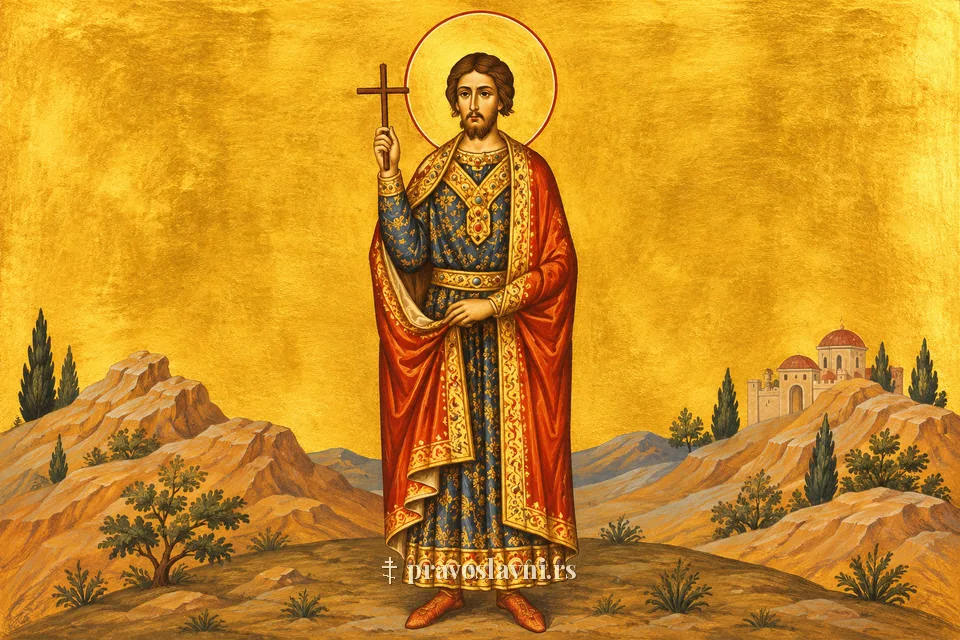
Holy Martyr James the Persian
What happenedJames the Persian, who had denied Christ for the sake of the king's favour, repented and, as his limbs were being cut off, gave thanks to God at every blow.
Read the LifeOrthodox Calendar · 27 November according to the Julian calendar
Friday, 10 December 202727 November (according to the Julian calendar)What happenedJames the Persian, who had denied Christ for the sake of the king's favour, repented and, as his limbs were being cut off, gave thanks to God at every blow.
Read the Life
No meat, dairy products, eggs, fish or oil — food cooked in water.
This is a recommendation — for your own fast, consult your priest or spiritual father.More about the fast →
Today the Church keeps the commemoration of a saint · not a Red Letter day.
More about the feast →
“If we confess our sins, He is faithful and just to forgive us our sins and to cleanse us from all unrighteousness.”
— 1 Jn 1:9The holy martyr James the Persian, whom the Church celebrates on 10 December (27 November, Julian calendar), is remembered as a man whom a single letter brought back to Christ. He was born in Persia, into a Christian family — the Prologue says in the city of Klapa, also called Vilat, and his Life says in Elapa — and he married a Christian woman. King Yazdegerd valued his ability and took him among the nobles of his court. The king's favour flattered him, and so together with the king he offered sacrifice to the idols and renounced Christ.
His mother and his wife did not keep silent. They wrote to him that, ever since he had forsaken Christ, it was to them as if he had died; they reminded him of God's wrath and of eternal punishment and implored him not to remain on that path. Those words made him weep. He repented and resolved never to cease begging God for mercy. His Life says that the pagans saw his tears, recognised him as a Christian and reported him to the king.
Before the king he concealed nothing. Asked whether he was a Nazarene or a magus, he said that he was a Christian, and not a magus. The king ordered that he should not be put to death quickly, by the sword, but that his body should be cut up piece by piece, so that the other Persians who might wish to forsake the idols would be frightened. James, according to the Life, answered: “I am not afraid of death”. For him it was not an end, but a rest, and it is terrible only to one who does not believe.
At the place of execution, as the Life tells, he asked to pray for strength and for forgiveness of his denial, and he was shaken neither by the promise of life nor by the friends who, in tears, urged him to think of his wealth and his family. Both sources bear witness to two things: James did not cease to give thanks to God, and a fragrance spread from his wounds. According to the Life, the torture lasted from morning until the ninth hour, and for each finger he found an image from Scripture and from the faith; at the fifth he said: “My joy has come, as at the wedding of the five wise virgins.” In the end they cut off his head and he gave up his soul to God. The Life says that the faithful gathered up his body by night and buried it. The Prologue adds that this took place around the year 400 and that the relics of James are kept in two places: his head in Rome, and one part in Portugal, which keeps his feast on 22 May.
James shows us that a fall is not the end: sincere repentance brings a man back to God, and the voice of a faithful mother and wife can bring him back from the wrong road.
James was a Persian, a Christian from birth: his parents brought him up in the faith, and his wife too was a Christian; his Life calls his native city Elapa, and the Prologue Klapa or Vilat. At court he advanced quickly: King Yazdegerd, valuing his abilities, drew him close to himself and gave him the rank of a nobleman. His Life adds that the same favour was shown to him by Varahran, Yazdegerd's successor, who appointed him to manage the royal court, so that James lived in splendour and wealth. This closeness to the ruler became a snare for him: in order to remain in favour, he offered sacrifices to the idols together with the king and thereby denied Christ.
The news of this reached his mother and his wife, and they sent him a letter full of sorrow over his apostasy, with a warning of God's wrath and of eternal punishment and with a plea that he return to Christ as soon as possible. His Life says that the letter found him outside the city, in the king's retinue. Over those lines James wept bitterly and repented, resolving to beg God for mercy with perseverance.
According to his Life, it was precisely his tears that gave him away: the king was soon informed that one of his nobles was a Christian. Asked whether he was a Nazarene or a magus, James said without hesitation that he was a Christian and confessed Christ before the king. His Life also relates that to the king, who reproached him with ingratitude, he replied that the king's father was suffering torments in hell, as well as his words: “I am a sheep of Christ's flock”.
In order to deter other Persians from abandoning the idols, the king decreed a slow death — not by the sword, but by cutting the body apart piece by piece. James, according to his Life, replied: “I am not afraid of death”, for to the righteous man it is only sleep and rest, and a torment only to the unbeliever.
A great crowd of people followed him to the place of execution, among them men from the court and soldiers. According to his Life, he obtained a little time to pray and asked God for strength and for forgiveness for having denied Him. Neither the executioners, who promised him life if he would obey the king, nor his weeping friends, who reminded him of his wealth and his family, could shake him.
His Life relates that the torture lasted from morning until about the ninth hour, while the Prologue describes how they took away his limbs one after another and records that James gave thanks to God for every blow. His words in those hours are preserved by his Life: he saw himself as a vine that is pruned so that it may bear fruit; at the fifth finger he said: “My joy has come, as at the wedding of the five wise virgins.”, and at the others he called to mind the Holy Trinity, the wounds of Christ, the ten commandments and the eight people saved in Noah's ark. At his right hand he recalled Christ's saying about the hand that causes one to sin, and at his right shoulder a verse from the psalm about praising the Lord all the days of one's life.
His Life says that myrrh flowed from him to the very end, and the Prologue too mentions a sweet fragrance. In his last prayer, according to his Life, he asked God for one thing only — not to forsake him, for he no longer had anything with which to stand, kneel or lift up his hands. Then he was beheaded and gave up his soul to God, and the faithful, according to his Life, gathered up his body by night and buried it. The Portuguese, who keep a part of his relics, celebrate him on 22 May, and his head is in Rome — so records the Prologue, which places his suffering around the year 400.
James teaches us that sincere repentance brings back to God even one who has denied Christ for the sake of earthly honour.
St James of Rostov was a native of the Rostov region and became a monk while still a young man. His ascetic life brought him to the see of Rostov, in the time of Metropolitan Pimen and Grand Prince Dimitry Ivanovich Donskoy, but he did not remain in it for long. His Life tells of a woman whom the prince and the boyars had condemned to death for her sin, and who sought his help by falling down at his feet. Remembering Christ and the woman who was brought before Him, he spared her and appointed lifelong repentance for her. This angered both the prince and the city, and so he had to leave his see. He went away across Lake Rostov, according to his Life, upon his own mantle, crossing about two kilometres in this way, to the astonishment of the prince and the people. Repentant, they begged him to come back; he forgave them, but he left his episcopal ministry for ever. He lived in a hut on the shore of the lake, where disciples gathered around him, he built cells and the Church of the Conception of St Anna, and there he reposed. He publicly refuted the teaching of the heretic Marcian, who called icons idols, and so Marcian, put to shame, left Rostov. In the monastery which he himself founded, and which is called Yakovlevsky after him, his relics also rest. His life teaches that mercy stands above strict judgement and that humility and forgiveness overcome injustice.
Separate page: St James of Rostov →
Venerable Palladius was a native of Thessalonica. He lived the ascetic life in Alexandria, at the turn of the sixth and seventh centuries. His memory is kept on 10 December, which is 27 November (according to the Julian calendar).


