Saints of the day
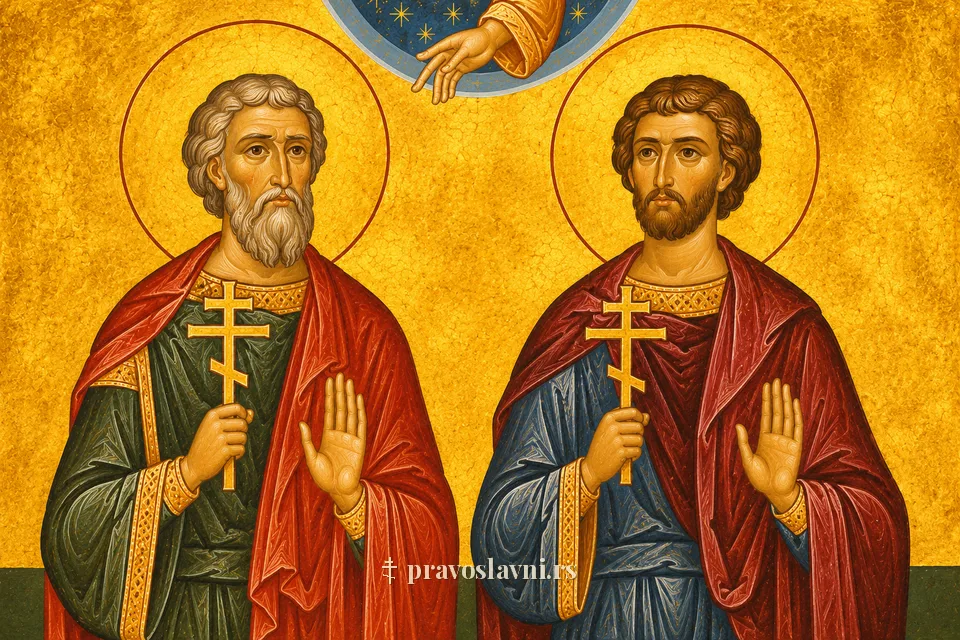
Holy Martyrs Paramon and Philumenus
What happenedSt Paramon, passing by the temple of Poseidon, could not keep silent before the killing of 370 innocent Christians, and so he too suffered with them.
Read the LifeOrthodox Calendar · 29 November according to the Julian calendar
Sunday, 12 December 202729 November (according to the Julian calendar)What happenedSt Paramon, passing by the temple of Poseidon, could not keep silent before the killing of 370 innocent Christians, and so he too suffered with them.
Read the Life
Fish, oil and wine are allowed — no meat, dairy products or eggs.
This is a recommendation — for your own fast, consult your priest or spiritual father.More about the fast →
Today the Church keeps the commemoration of a saint · Sunday — a festive day · 25th Sunday after Pentecost.
More about the feast →
“And you will be hated by all for My name’s sake. But he who endures to the end will be saved.”
— Mt 10:22On the same day the Church celebrates two martyrs who did not suffer together: Paramon, who gave his life in Bithynia, and Philumenus, who suffered in Ancyra.
In the time of Emperor Decius, as the Life records, the prince Aquilinus was persecuting Christians in Asian Bithynia. He was holding 370 Christians in chains, and at the temple of Poseidon, as the Life says, he tried for a long time, by kindness and by force, to compel them to sacrifice, but in vain.
Just then Paramon was passing that way. He could not keep silent, but publicly, in front of everyone, he condemned the godless prince for the blood of so many innocent people. According to the Life, after that he simply continued on his way. The prince sent servants after him, who caught up with him and tortured him severely, and he died in prayer. The 370 martyrs also suffered by the sword in front of the temple of Poseidon at the same time. The Prologue states that this happened in the year 250.
Philumenus, according to the Life, was a Lycaonian who traded in grain in Ancyra in Galatia during the reign of Aurelian. Before the governor Felix, to whom he had been denounced, he openly confessed that he was a Christian. Not even fire, according to the Life, harmed him, because Christ was guarding him. In the end they drove him on a long and exhausting journey, on which he breathed his last. So he too became a martyr of Christ.
Both are celebrated on 29 November by the Julian calendar, that is, on 12 December by the Gregorian calendar.
Paramon raised his voice for the innocent, and Philumenus did not hide his faith; both of them show that faith in Christ is stronger than fear.
In the time of Emperor Decius, as the Life says, the governor Aquilinus persecuted Christians in Asian Bithynia. From the 370 Christians whom he held in chains, according to the Life, he demanded that they offer sacrifice to an idol when, on the way to the Balsatian warm springs, they reached the temple of Poseidon. Neither words nor force were of any use, though he tried for a long time: no one consented.
Paramon then happened to come that way — the Prologue calls him an upright man, and the Life a Christian. When he saw how many people had been condemned, he did not keep silent, but cried out before everyone, as the Life relates: “Oh, how many righteous men the impious governor is killing without any guilt”. The Life adds that after that he went on his way.
The governor's fury was not long in coming: servants set out after Paramon with orders to kill him, and they caught up with him while he suspected nothing. They tortured him cruelly, and he remained in prayer to his last breath. While he was dying, all 370 confessors were also put to the sword before the temple of Poseidon, and so Paramon, who had not been among the condemned, became one of them in death. The Prologue dates his suffering to the year 250.
Philumenus did not suffer with them, nor in the same place — the Church simply celebrates them on the same day. A native of Lycaonia, he traded in grain, according to the Life, in Ancyra in Galatia during the reign of Aurelian. The governor Felix, before whom he was accused, heard from him an open confession that he was a Christian. They subjected him to cruel tortures. The Life also mentions a miracle: the fire did not harm him, because Christ was guarding him. The torture nevertheless continued, and his end, according to the Life, was brought by a long road along which they drove him, until he breathed his last. The year of his death has not been recorded.
Both are celebrated on 29 November according to the Julian calendar, that is, 12 December according to the Gregorian calendar. Paramon raised his voice for the innocent, and Philumenus did not hide his faith — and both gave their lives for Christ.
The story of Venerable Acacius was written down by St John Climacus in his Ladder. Acacius was a young monk on Sinai, simple-hearted and pure, but he had a lazy and cruel elder. For a full nine years not a day went by without scolding, insults and blows. Yet he bore it in silence, seeing in it the path of his salvation. John the Sabbaite, according to his Life, often met him and noticed on him the marks of beatings. To every enquiry of John's, Acacius, according to the Prologue, had the same answer: “well, as before the Lord God!”; John, for his part, encouraged him to persevere for the sake of his salvation. In the ninth year, after a short and light illness, Acacius died and was buried. The holy ascetic to whom the elder reported, five days after the burial, that Acacius was dead, would not believe it. The ascetic stood with him beside the grave and called the departed by name. The Prologue records his answer from the grave: “I have not died, father; it is impossible for an obedient man to die”. From then on the cruel elder, weeping and repentant, lived beside the grave of Acacius, in prayer, right up to his own death. Acacius teaches us that obedience and the patient bearing of injustice bring the grace of God, and his patience led to repentance even the one who had tormented him.
Separate page: Venerable Acacius →
St Mardarije — by baptism, performed in the village chapel of St George, Ivan Uskoković — was a native of Kornet in the Lješanska nahija, where he was born on 2 November 1889. He began his church and missionary work in Russia. The Holy Synod of the Russian Church sent him on 3 July 1917, as the young syncellus Mardarije, to America to lead the Serbian mission. He received the rank of archimandrite in the same year in Philadelphia. St Nikolaj of Ohrid and Žiča proposed him as the first bishop of the Diocese of America and Canada. At the beginning of 1923 he returned to America to organise the Serbian Orthodox diocese, whose temporary seat was in Chicago. As early as August 1923, for 15,000 dollars, he acquired an estate of about ten hectares on the Des Plaines River in Libertyville, some forty miles north of Chicago. There he founded the Monastery of St Sava as the spiritual centre of the diocese and built it in spite of the economic crisis and the divisions in the diaspora. His Life also records a saying about him: “He builds a church, and is dying of hunger”. He reposed in his 46th year, on 12 December 1935, and his grave is in the monastery which he built in Libertyville. His memory is celebrated on 29 November according to the Julian calendar, that is, 12 December according to the Gregorian calendar. He was a self-sacrificing missionary bishop, who in poverty and division laid the foundations of Serbian church life in America, and his monastery in Libertyville is a spiritual centre to this day.


