Saint of the day
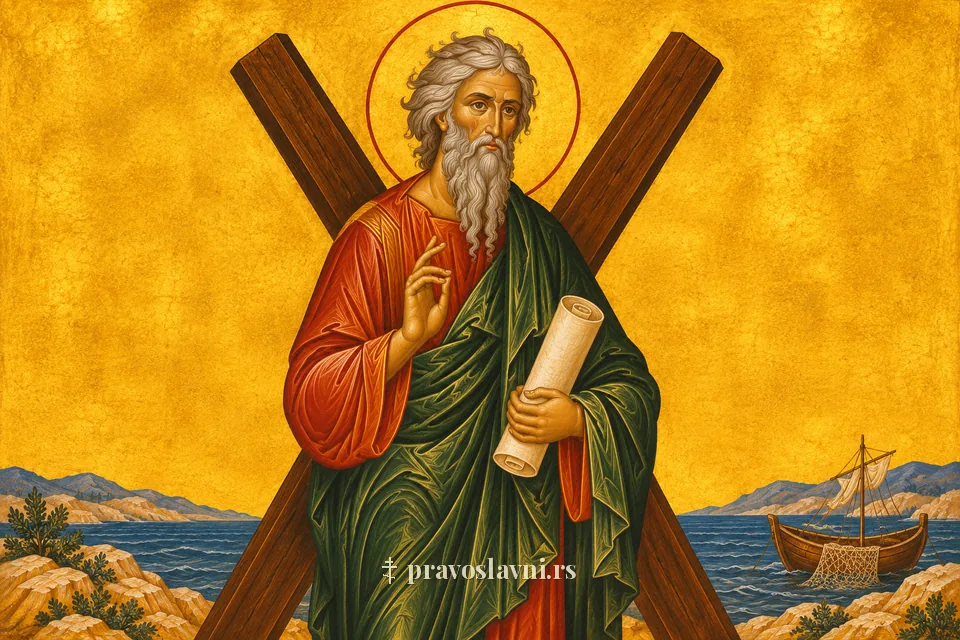
Holy Apostle Andrew the First-Called
What happenedThe Apostle Andrew, the first to follow Christ, brought his brother Simon Peter to the Lord, and in Patras he went willingly to the cross.
Read the LifeOrthodox Calendar · 30 November according to the Julian calendar
Monday, 13 December 202730 November (according to the Julian calendar)Save your slava — you'll get a reminder a week and a day before.
Send a greeting card →What happenedThe Apostle Andrew, the first to follow Christ, brought his brother Simon Peter to the Lord, and in Patras he went willingly to the cross.
Read the Life
Fish, oil and wine are allowed — no meat, dairy products or eggs.
This is a recommendation — for your own fast, consult your priest or spiritual father.More about the fast →
Many families celebrate their Krsna slava (family patron saint's day) today
More about the feast →
“We have found the Messiah” (which is translated, the Christ).
— Jn 1:41Sung at the Slava (family patron saint's feast) and on the saint's feast day.
As the first-called of the Apostles and brother of their chief, O Andrew, entreat the Master of all to grant peace unto the world and great mercy unto our souls.
Translation: pravoslavni.rs
The Holy Apostle Andrew the First-Called was born in Bethsaida. He was the son of Jonah and the brother of Simon Peter. The Prologue says that he was a fisherman, and his Life that he did not marry. His path towards Christ began at the Jordan, in the circle of the disciples of John the Forerunner; on the day when John called Jesus the Lamb of God, Andrew, according to the Gospel of John, went over to the disciples of Christ. Since he came to Christ before all the other apostles, he is called the First-Called.
He passed the news of the Messiah on to Peter and brought him to the Lord. Later, on the Sea of Galilee, Christ called both brothers away from their work as fishermen, and they set out after Him.
When the apostles had received the Holy Spirit, many regions fell to Andrew by lot. He preached in Byzantium, where he appointed Stachys as the first bishop, in Thrace, around the Black Sea, in Epirus, in Greece and in the Peloponnese. Above the Dnieper, where Kiev would later stand, he left a cross and a prophecy: that the whole Russian land would be baptised, and that on that spot there would arise a great city full of churches, illumined by grace.
In Patras too, calling upon Christ, he healed and worked miracles. According to the Prologue, he also brought the governor's family to Christ — the brother and the wife of Aegeates — on account of which Aegeates had him put in chains and tortured. His Life quotes his words before Aegeates: “I am a servant of the cross of Christ, and I desire death on a cross.” And so it was: they crucified him. Not even on the cross did he cease to teach, and to the people who wanted to take him down he said that they should not do so while he was alive. He died after a prayer, when the light from heaven which had surrounded him disappeared.
The Church celebrates him as the apostle of Byzantium — where his relics also arrived in the time of Constantine — of Thrace and of the Russian land. Andrew teaches us that the cross, once an instrument of shame, has become the path of renewal and salvation, and that it is better to endure a passing torment than to lose eternal joy with Christ.
Andrew at first listened to John the Forerunner at the Jordan. The day when John said of Jesus “Behold the Lamb of God!”, as the Prologue records it, became a turning point for him: from then on he was a disciple of Christ (Jn 1:36). Because he recognised the Lord before all the other apostles, the Church gave him the name First-Called.
Andrew was born in Bethsaida. He was the son of Jonah and the brother of Simon Peter. The Prologue records that he was a fisherman, and his Life adds that he did not marry, but lived in virginity.
His Life says that when he left John, one more disciple went with him after Jesus. The first news that he carried to his brother, according to his Life, was: “We have found the Messiah — the Christ”, and then he brought Simon also to the Lord (Jn 1:41–42).
Later Jesus called them beside the Sea of Galilee. According to the Gospel of Matthew, at that call both brothers set out after Him without hesitation, leaving their work as fishermen (Mt 4:18–20).
Andrew, according to his Life, received the Holy Spirit at Pentecost, together with the rest of the Twelve, when Christ had already risen and ascended. The Prologue lists the regions that fell to him by lot: first Thrace and Byzantium, then the lands along the Danube, Russia and the shores of the Black Sea, and finally the Peloponnese, Greece and Epirus. In his Life this list is longer: there are also Achaia and Hellas, Thessaly and Macedonia, Chalcedon on the Propontis and Bithynia, and then Trebizond, Heraclea and Amastris.
Sinope, according to his Life, brought him a severe trial: there the apostle was beaten and pelted with stones, and the grace of God healed him on the spot, leaving not a single wound. He went on preaching in Neocaesarea and Samosata, in Pontus, along the coast of the Black Sea, in Scythia and Chersonesus.
The Church of Byzantium received from him priests and its first bishop, Stachys, whose name is also found in the Epistle to the Romans (Rom 16:9).
On the Dnieper, by the hills where Kiev would later arise, Andrew set up a cross on one of the heights and foretold the future of that place: the baptism of the whole Russian land, a great city, many churches and the grace that would shine upon it. His Life says that he also visited the northern Russian regions, where Great Novgorod would later stand, and that he was in Rome as well.
After that he again travelled through Epirus and Thrace, strengthening the Christians there; in those regions, as in Greece and the Peloponnese, he baptised many and left them shepherds — bishops and priests.
The last stopping place was Patras. According to his Life, the conversion of the whole city began in the house of the devout Sosius, with whom the apostle was staying: the master of the house lay at the point of death, and Andrew raised him up. The same Life says that by the laying on of hands he healed Maximilla, the wife of the governor Aegeates, Aegeates' brother Stratocles and many other sick people.
Because of this Aegeates turned upon the apostle: he ordered him to be arrested and put to torture. Before the governor Andrew, according to his Life, explained that the cross is the way by which man is renewed, that the Eucharist is the unceasingly offered sacrifice of the Lamb, and how man fell and was redeemed. To the threat of crucifixion he replied: “I am a servant of the cross of Christ, and I desire death on a cross.” To the assembled multitude, which wanted to take him out of prison by force, the apostle sent word to remain calm and patient.
According to his Life, he met the cross with a greeting and went up to it himself. Some twenty thousand people watched as he was bound to it with ropes instead of nails. Even from the cross he spoke to the faithful gathered around him, and to those who wanted to take him down he replied that he did not wish to come down alive. His Life adds that in the end Aegeates too set out to take him down, but the hand of everyone who touched the cross went numb. Both accounts end with the same sign: Andrew prayed, a light from heaven shone around him, and when it vanished, he breathed his last. His Life says that this was on the last day of November, and the Prologue gives the year 62.
The body, according to his Life, was taken by Maximilla, and, having anointed it, she laid it in the tomb which she had for herself. In the time of Constantine the relics came to Constantinople, and the translation, according to both sources, was carried out by the martyr Artemius. His Life adds that their place was in the altar of the Church of the Holy Apostles, where the relics of Luke and Timothy also rested. The Prologue also mentions that parts of the relics were later found still farther away: Andrew's head in Rome, and his hand in Moscow.
Andrew was the first to follow Christ, and he brought his brother to Him. He gladly accepted the cross and showed that the instrument of shame becomes the way of renewal and salvation, and that it is better to endure a passing torment than to lose eternal joy with Christ. The Church honours him as the apostle of Byzantium, Thrace and the Russian land, whose prayers and relics bring grace to this day.


