Saint of the day
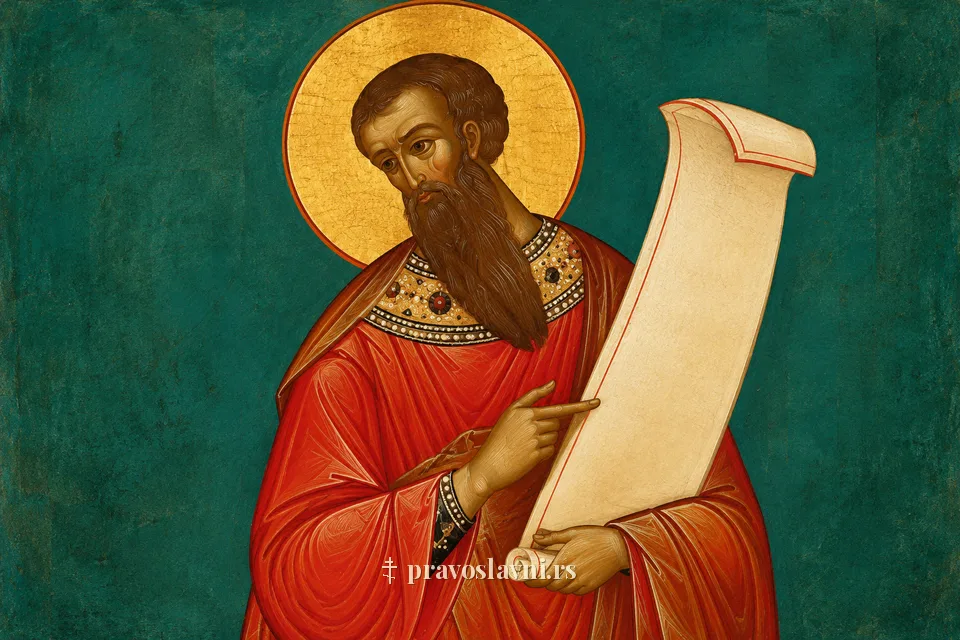
Holy Prophet Zephaniah
What happenedThe Prophet Zephaniah warned Jerusalem and the surrounding nations of the day of God's wrath, and with joy he foresaw the coming of the Messiah.
Read the LifeOrthodox Calendar · 3 December according to the Julian calendar
Thursday, 16 December 20273 December (according to the Julian calendar)What happenedThe Prophet Zephaniah warned Jerusalem and the surrounding nations of the day of God's wrath, and with joy he foresaw the coming of the Messiah.
Read the Life
No meat, dairy products, eggs or fish — oil and wine are allowed.
This is a recommendation — for your own fast, consult your priest or spiritual father.More about the fast →
Today the Church keeps the commemoration of a saint · not a Red Letter day.
More about the feast →
“The LORD your God in your midst, The Mighty One, will save.”
— Zeph 3:17The holy Prophet Zephaniah and the Prophet Jeremiah shared the same age — the seventh century before Christ and the reign of the good King Josiah. By descent he was of the tribe of Simeon, and his homeland was Mount Sarabatha. His Life gives two virtues as the reason for his gift of foresight: humility and purity of mind.
To Jerusalem he foretold nothing milder than to Nineveh, to Egypt and to the cities of Gaza, Ashkelon, Ashdod and Ekron: the day of God's wrath, he said, would reach it too. His heaviest reproaches he addressed to those who led the people — the princes, the judges, the prophets and the priests.
Yet Zephaniah did not see darkness alone: he called on Zion and Israel to sing and shout for joy, for he rejoiced in the Messiah, whose coming he had beheld beforehand. He died in his homeland.
Zephaniah teaches us that sin, and especially the corruption of those who lead the people, brings the day of God's wrath, but he also points to hope in the Messiah, whom he saw beforehand.
The Prophet Zephaniah lived at the time when Judea was ruled by the pious King Josiah, and his message still sounds sharp today: when those who ought to guard the people become corrupt — rulers, judges, prophets and priests — the day of God's wrath comes upon the people.
Mount Sarabatha was his homeland, and the tribe of Simeon his lineage. His prophetic ministry fell in the seventh century before Christ; Jeremiah was his contemporary. As the reason for his revelations and predictions his Life names two virtues — humility and purity of mind.
The chief theme of his preaching was the day of God's wrath. Punishment, in his words, awaited Gaza, Ashkelon, Ashdod and Ekron, then Nineveh and Egypt — but Jerusalem itself as well. Concerning Jerusalem the Prologue quotes the prophet's words: “the city rebellious, polluted, oppressing” (Zeph 3:1). From the same prophecy the Prologue also quotes the words about the mighty: “Her princes in her midst are roaring lions.” Neither the judges, nor the prophets, nor the priests escape a heavy rebuke in those verses (Zeph 3:3–4).
The same prophet, however, also looked beyond the punishment. He foresaw the coming of the Messiah and rejoiced in it, and so he called Zion and Israel to song, in the words quoted by his Life: “Sing, O daughter of Zion! Shout, O Israel!” (Zeph 3:14).
He died in his native region; about the year of his death, miracles or relics the sources are silent.
Zephaniah warns that sin, and especially the corruption of those who lead, judge, teach and serve, brings on the day of God's wrath, but he also points to the joyful hope in the Messiah.
Venerable John the Silent was born in Nicopolis in Armenia as the son of Encratius and Euphemia; according to his Life, on 8 January in the fourth year of the reign of Marcian. He divided up his inheritance, and with the share that fell to him, his Life says, he built a church of the Theotokos in Nicopolis. He received the monastic tonsure as an eighteen-year-old, and afterwards about ten monks lived under his guidance. In his twenty-eighth year, a decade later, he became Bishop of Colonia — according to his Life against his will, for he was brought by a ruse to the Metropolitan of Sebaste and ordained there. His brother Pergamius and Theodore, both of them close to the Emperors Zeno and Justinian, were converted as they watched his holy life, and about ten years later he secretly left his bishopric and set out for Jerusalem. His Life says that the way was shown to him by a bright star in the shape of a cross; and so, as a thirty-eight-year-old, he arrived at the Great Lavra of St Sabbas and there, without revealing his rank, he carried food and water to the builders and welcomed the guests. When Sabbas brought him to Patriarch Elias to be ordained priest, Elias, in a private conversation, learnt that a bishop was standing before him. There followed years which he spent in a closed cell, without talking to people, in prayer. In his fiftieth year he withdrew to the desert of Rouba, where he lived for nine years on wild plants, and his Life adds that, when the Arabs under Alamundarus invaded, a lion defended him and drove the attackers away. He did break his silence, however, when the faithful had to be protected from the heresy of Origen, and his voice helped to have it condemned; God also gave him the gift of clairvoyance and the power to heal the sick and to overcome demons. His life came peacefully to its end when he was more than one hundred and three years old, and the Prologue records 558 as the year of his death. His life bears witness that God values humble and hidden service more than rank and honours.


