Saint of the day
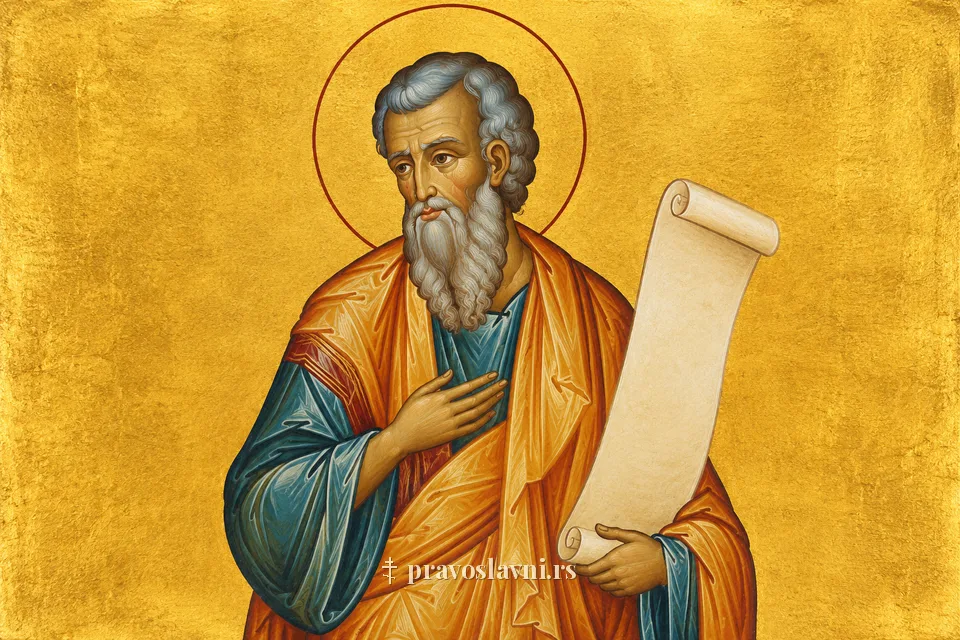
Holy Prophet Nahum
What happenedThe Prophet Nahum foretold the destruction of Nineveh, which had forgotten God's mercy, and the city vanished so completely that even its site was no longer known.
Read the LifeOrthodox Calendar · 1 December according to the Julian calendar
Tuesday, 14 December 20271 December (according to the Julian calendar)What happenedThe Prophet Nahum foretold the destruction of Nineveh, which had forgotten God's mercy, and the city vanished so completely that even its site was no longer known.
Read the Life
No meat, dairy products, eggs or fish — oil and wine are allowed.
This is a recommendation — for your own fast, consult your priest or spiritual father.More about the fast →
Today the Church keeps the commemoration of a saint · not a Red Letter day.
More about the feast →
“The LORD is good, A stronghold in the day of trouble; And He knows those who trust in Him.”
— Nah 1:7The holy prophet Nahum foretold the fall of Nineveh. That great city, two centuries before Nahum's prophecy, had repented at the preaching of Jonah and been spared, but the descendants of those who repented did not remember that pardon and went back to evil. Whoever does not repent cannot count on being spared — that was Nahum's warning, and it came true: the earth shook, water flooded the city, fire finished off the rest, and of Nineveh nothing was left by which one might know where it had stood.
Little is known about the prophet himself. He was of the tribe of Simeon, from Elkosh beyond the Jordan; about seven centuries separate him from the birth of Christ, and he reposed in the Lord in his forty-fifth year. His prophecies have been preserved in a short writing — the Book of the Prophet Nahum.
The fate of Nineveh is a warning that God's patience must not be abused: whoever forgets His mercy and goes back to sin brings ruin upon himself, while repentance brings pardon.
Nineveh was a city that had already been shown mercy once, and then squandered that mercy. Its ruin was foretold by the Prophet Nahum, and after its destruction not a trace remained on the spot where it had stood by which it could be recognised.
Nahum comes from the tribe of Simeon; his homeland was Elkosh, in the regions beyond the Jordan. About seven centuries separate him from Christ, and roughly two from the Prophet Jonah. He died in the Lord in the forty-fifth year of his life. The Prologue and his Life know nothing more about him.
Two hundred years earlier Jonah had preached to the Ninevites, they repented, and God did not punish the city. But the descendants of those who had repented did not remember that pardon, and so the city sank into evil once again.
Nahum proclaimed that Nineveh would fall: a city that had not repented could not expect God to spare it a second time as well. And so it was. Three calamities then befell Nineveh — earthquake, flood and fire — and nothing was left of it by which one might know where it had stood. From Nahum there remains a short prophetic book, which bears his name and whose predictions came true.
The fate of Nineveh is a warning that forgetting God's mercy and returning to sin bring ruin, while repentance brings pardon; God's patience must not be taken for granted.
St Philaret the Merciful was from the village of Amnia in Paphlagonia, the son of George and Anna, and he grew up in piety. His Life says that he married the noble Theoseba and that they had the children John, Hypatia and Evanthia. His great estate — flocks, villages, fields, servants — he did not regard as his own, but as a loan from God, and so he fed the hungry and took in travellers. After the Ishmaelites, according to his Life, had plundered the region and carried off his livestock and slaves, while he still went on giving alms, all that he had left was a house, a field, two servants, a horse, a cow and a pair of oxen. His wife and children protested, but he went on giving, convinced that God will not forsake the one who puts his trust in Him. A peasant whose ox had died received from him, while he was ploughing, one ox from his own yoke, and afterwards the other as well; to a poor man he gave a calf, and when his wife demanded that the calf be brought back, he gave him the cow together with the calf. To Musilius, who had been called up into the army, went Philaret's last horse as well, with the words that his Life records: “Take my horse, brother, and go in peace.” The envoys of the Empress Irene and the young Emperor Constantine, who were looking for a bride, lodged — not without God's providence — at Philaret's house of all places; their choice fell on his granddaughter Maria, who became the emperor's wife, and Philaret's family moved to Constantinople and lived in honour and plenty. His Life says that there he seated about two hundred beggars at his table and refused imperial robes and titles, calling himself only Philaret of Amnia. Not even in Constantinople did he lose his humility, and he did still more good; like Jacob of the Old Testament, he too at the end, at about ninety, blessed his children and revealed to each one what awaited him. He reposed in the Rodolphia Monastery in Constantinople, and the sources remember the radiance on his face before his death and the fragrance that filled the room; the Prologue gives the year 797. The Prologue quotes the words of Scripture about him: “Blessed are the merciful, for they shall obtain mercy”, for what is given to a poor man is not lost, but God returns it many times over.


