Save your slava — you'll get a reminder a week and a day before.
Monday21June 20278 June (according to the Julian calendar)
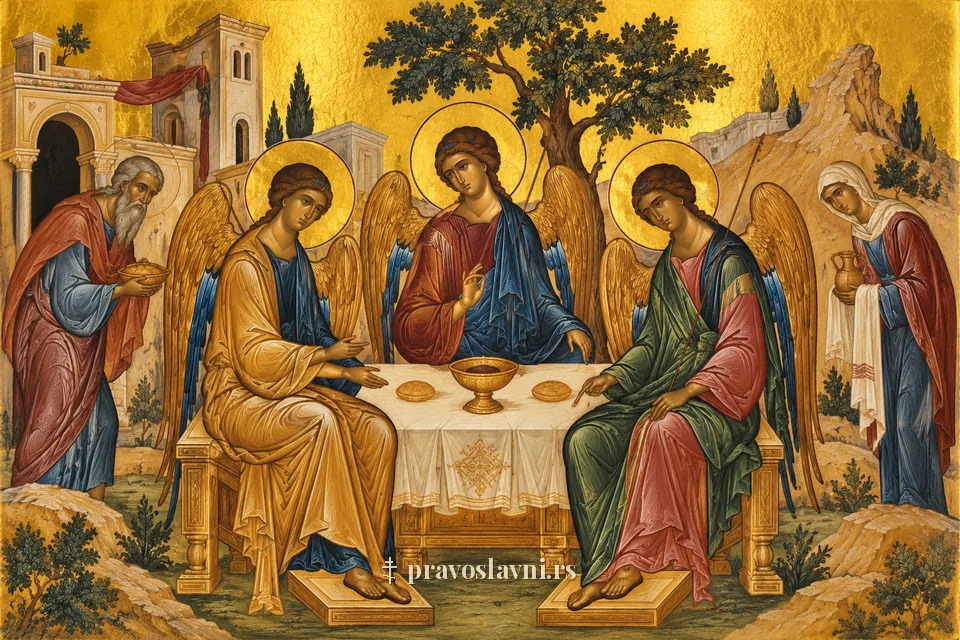
Illustration
Great feast
Monday of the Holy Spirit
What happenedThe Monday of the Holy Spirit, the day after Pentecost, is dedicated to the Holy Spirit, the third Person of the Holy Trinity, Who is worshipped together with the Father and the Son.
“For the fruit of the Spirit is in all goodness, righteousness, and truth.”
— Eph 5:9
About this day
By the custom of Duhovi (Pentecost, Holy Trinity Day), on the feast of the Descent of the Holy Spirit grass and flowers are brought into the church, and little wreaths are woven from them. In the calendar the Monday of the Holy Spirit is a Red Letter day (great feast) and a non-fasting day. The whole week after Duhovi remains festal, so there is no fasting even on Wednesday and Friday, and the festal joy of Duhovi, by custom, continues on the Monday as well.
About the feast
The Monday of the Holy Spirit received its name because, according to the “Liturgics” handbook, it is dedicated to the Holy Spirit. The Spirit, Life-giving and Almighty, is the third Person of the Holy Trinity and is honoured equally with the Father and the Son. And so, on the day after the feast of the Descent of the Holy Spirit, the Church glorifies the Holy Spirit Himself.
The service begins on Sunday evening with Small Vespers and the canon to the Holy Spirit, because Great Vespers has already been served after the festal Divine Liturgy. At Matins the Great Doxology is sung, and at the Liturgy, in place of the antiphons, the Beatitudes are sung with special hymns.
Christ promised His disciples power when the Holy Spirit came upon them, and at Pentecost “they were all filled with the Holy Spirit”. The day is a Red Letter day (great feast) and there is no fasting. The day of Pentecost is regarded as the birthday of the Church of Christ. The feast of Pentecost is celebrated for the whole week, and so neither Wednesday nor Friday is a fasting day then.
Full Life
A day dedicated to the Holy Spirit
The day after Pentecost, according to the Liturgics, bears the name Monday of the Holy Spirit, “because it is dedicated to the All-holy, Life-giving and Almighty Spirit”. The Holy Spirit is the third Person of the Holy Trinity and receives the same worship as the Father and the Son. Since His descent on the apostles and the Holy Trinity were glorified on Sunday, on Monday the Church addresses her praise to Him in particular. The calendar marks this day as a Red Letter day (great feast) and as a day with no fasting.
The service
The service of the Monday of the Holy Spirit begins already on Sunday evening. Great Vespers was served immediately after the festal Liturgy, so in the evening only a short Small Vespers is served, with the canon to the Holy Spirit, to whom the Monday itself is dedicated. At Matins the Great Doxology is sung, although there is no Polyeleos. On that day the antiphons at the Liturgy are replaced by the Beatitudes, with which special hymns are sung.
The promised power
Before the Ascension Christ said to the disciples: “But you shall receive power when the Holy Spirit has come upon you” (Acts 1:8). At Pentecost this was fulfilled: “And they were all filled with the Holy Spirit and began to speak with other tongues, as the Spirit gave them utterance” (Acts 2:4).
The story of Pentecost begins on Zion, where the apostles waited in prayer for the Comforter; then tongues of fire come down upon them, they preach in unknown languages, and three thousand people receive baptism. The day of Pentecost is regarded as the birthday of the Church of Christ.
The feast, however, does not last only one day. According to the Liturgics, “The feast of Pentecost is then celebrated for the whole week, and therefore the fast is relaxed on Wednesday and Friday”. The Monday of the Holy Spirit is thus the second day of the festal week in which the Church rejoices in the descent of the Holy Spirit and glorifies Him Himself.
Other saints of the day
Great Martyr Theodore Stratelates
Before his suffering St Theodore Stratelates asked his servant to carry his body to Euchaita and lay it on the estate of his forefathers. This is what the Church remembers on this day: according to the June Prologue and his Life, his relics were translated from Heraclea to Euchaita. The Prologue for 8 February (according to the Julian calendar), when his main commemoration is kept, also records a later translation, from Euchaita to Constantinople, to the church at Blachernae.
Theodore, according to that Prologue, was a commander and the governor of the city of Heraclea in the army of the Emperor Licinius. He renounced his rank, his youth and the Emperor's favour, broke the gold and silver idols in pieces and gave the pieces away to the poor. He called on Licinius to believe in the one living God, and for this he was tortured, raised upon a cross and at last beheaded in the year 319, glorifying God without ceasing. The Prologue preserves his words from the midst of his torments: “Glory to Thee, my God, glory to Thee!” Soldiers regard him as their protector.
St Anastasius of Sinai wrote down, as the Prologue and the Life relate, that in the Church of St Theodore at Karsat near Damascus, in which Saracens had settled, one of them struck the saint's image on the wall with an arrow. The image bled, and not long afterwards not one of the settlers was left alive. Anastasius says that he saw the traces of the blood with his own eyes.
St Theodore teaches that faithfulness to Christ is greater than any earthly honour.