Tuesday after Pentecost (Third Day of the Holy Trinity)
2 June 2026 · 22 June 2027
Tuesday after Pentecost (Third Day of the Holy Trinity)2 June 2026 · 22 June 2027
Dates and fasting
Tuesday, 2 June 2026no fast · Red Letter day · 20 May (according to the Julian calendar)
Tuesday, 22 June 2027no fast · Red Letter day · 9 June (according to the Julian calendar)
Tuesday22June 20279 June (according to the Julian calendar)
Illustration
Great feast
Tuesday after Pentecost (Third Day of the Holy Trinity)
What happenedThe Tuesday after Pentecost, the third day of the feast of Pentecost, continues the festal week in which the Church celebrates the descent of the Holy Spirit on the apostles.
“There are diversities of gifts, but the same Spirit.”
— 1 Cor 12:4
About this day
By custom, for the feast of the Descent of the Holy Spirit the church is decked with grass and flowers, and little wreaths are woven from them. Since Pentecost lasts the whole week, the festal joy of Duhovi (Pentecost, Holy Trinity Day) continues on the third day too, and there is no fasting on the Wednesday and Friday of that week either. The festal week ends with the leavetaking on Saturday.
About the feast
The Tuesday after Pentecost is the third day of the feast of Pentecost. In the calendar it is marked as a Red Letter day (great feast) and it is a day with no fasting. According to the “Liturgics” handbook, Pentecost is celebrated for the whole week, and so there is no fasting then either on Wednesday or on Friday, and the leave-taking of the feast is on Saturday.
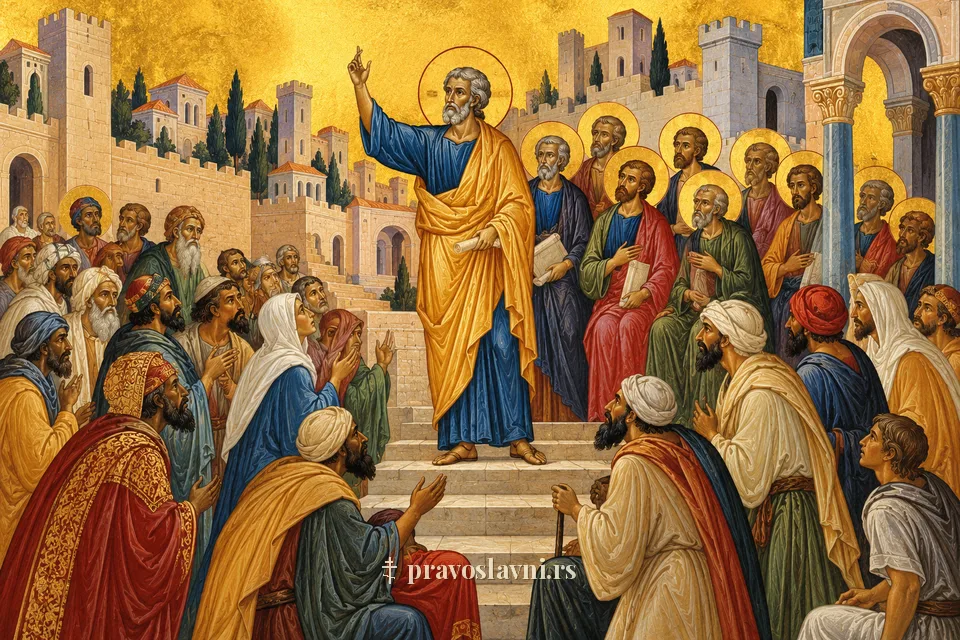
Before the descent of the Spirit the apostles continued with one accord in prayer, together with the women, and after the Ascension they used to gather on Zion and wait for the promised Comforter. The number of the Twelve was made complete again when, in place of Judas Iscariot, the lot fell on Matthias. Then the Holy Spirit came down upon the apostles in the form of tongues of fire. Peter called those gathered to repent and be baptised, with the promise: “and you shall receive the gift of the Holy Spirit” (Acts 2:38). On that day about three thousand people believed and were baptised, and the day of Pentecost is regarded as the birthday of the Church.
The festal week shows that the gift of the Spirit is not a single moment, but a joy which the Church lives from day to day.
Full Life
The third day of the feast
The Tuesday after Pentecost is marked in the calendar as a Red Letter day (great feast) and it is a day with no fasting. The feast of Pentecost itself, according to the Liturgics, does not end on Sunday: “The feast of Pentecost is then celebrated for the whole week, and therefore the fast is relaxed on Wednesday and Friday”. The leave-taking of the feast is on Saturday, and Tuesday is the third day of the same festal joy. So on Tuesday too the same event is still celebrated: the descent of the Holy Spirit on the apostles and the birth of the Church.
The story of Pentecost
Before the descent of the Spirit the apostles all continued with one accord in prayer, together with the women (Acts 1:14). After the Ascension they used to meet on Zion and wait for the Comforter, whom Christ had promised them. At that time the number of the Twelve was made complete: “The place of Judas Iscariot among the Twelve was filled by lot with Matthias.” So the apostles met the descent of the Spirit as twelve, gathered together and in prayer. Then the Holy Spirit came down upon them, in the form of tongues of fire, as Christ had promised them.
The gift of the Holy Spirit
Peter preached to those who were listening to him that they should repent and be baptised, “and you shall receive the gift of the Holy Spirit” (Acts 2:38). Those who received his word were baptised, “and that day about three thousand souls were added to them” (Acts 2:41). The day of Pentecost is regarded as the birthday of the Church.
The gift of the Spirit did not remain tied to a single moment. The first Christians received it on the day when they were baptised, and the Church rejoices in the descent of the Spirit for the whole week, until the leave-taking of the feast on Saturday.
Other saints of the day
St Cyril, Archbishop of Alexandria
“Great is the Most Pure Virgin Mary, the Theotokos!” — so, according to his Life, the people of Ephesus cried out when the Third Ecumenical Council confirmed that we rightly call the Mother of God the Theotokos. The Council, at which about two hundred bishops gathered, was presided over by St Cyril, Archbishop of Alexandria, who at the same time also represented Pope Celestine of Rome.
Cyril was born into a distinguished family and was a close relative of Patriarch Theophilus, whom he succeeded on the see of Alexandria. The Life says that he was learned both in secular studies and in Scripture, and that he was a disciple of St Isidore of Pelusium. The Prologue records that he waged three hard struggles; one of them was against the Novatians, whom he removed from the city.
The greatest challenge came from Nestorius, Patriarch of Constantinople, who called Mary “Christotokos” and not Theotokos. According to the Life, Cyril wrote to him gently at first and then sternly, and appealed to the imperial court, to the pope, to the patriarchs and to the monks, until Nestorius was removed. At Ephesus in the year 431 Nestorius was condemned, and it was confirmed that Christ is true God. Even after that Cyril had no peace: according to the Life, his opponents accused him falsely and the Emperor imprisoned him for a short time, until his innocence was established. The Prologue also ascribes to him the hymn “Rejoice, O Virgin Theotokos”, and the Life says that he wrote many books profitable to the soul.
Yet even this defender of the faith carried an injustice in his heart. From his uncle he had inherited an ill will towards St John Chrysostom and he could not free himself from it, although Isidore of Pelusium admonished him with the words: “Partiality is not far-sighted, and hatred sees nothing at all.” Then the Theotokos appeared to him in a vision with Chrysostom, who at her request forgave Cyril. Cyril repented, and according to the Life he honoured Chrysostom as a great saint to the end of his life.
His last years he spent in peace, caring for his flock, and he reposed in the year 444.
St Cyril teaches that the truth of the faith is precious, but that not even the most zealous may keep hatred in their hearts.