Tuesday02June 202620 May (according to the Julian calendar)‹›
Illustration
Great feast
Tuesday after Pentecost (Third Day of the Holy Trinity)
What happenedThe Tuesday after Pentecost, the third day of the feast of Pentecost, continues the festal week in which the Church celebrates the descent of the Holy Spirit on the apostles.
“There are diversities of gifts, but the same Spirit.”
— 1 Cor 12:4
About this day
Tuesday after Pentecost (Third Day of the Holy Trinity)
By custom, for the feast of the Descent of the Holy Spirit the church is decked with grass and flowers, and little wreaths are woven from them. Since Pentecost lasts the whole week, the festal joy of Duhovi (Pentecost, Holy Trinity Day) continues on the third day too, and there is no fasting on the Wednesday and Friday of that week either. The festal week ends with the leavetaking on Saturday.
The Tuesday after Pentecost is the third day of the feast of Pentecost. In the calendar it is marked as a Red Letter day (great feast) and it is a day with no fasting. According to the “Liturgics” handbook, Pentecost is celebrated for the whole week, and so there is no fasting then either on Wednesday or on Friday, and the leave-taking of the feast is on Saturday.
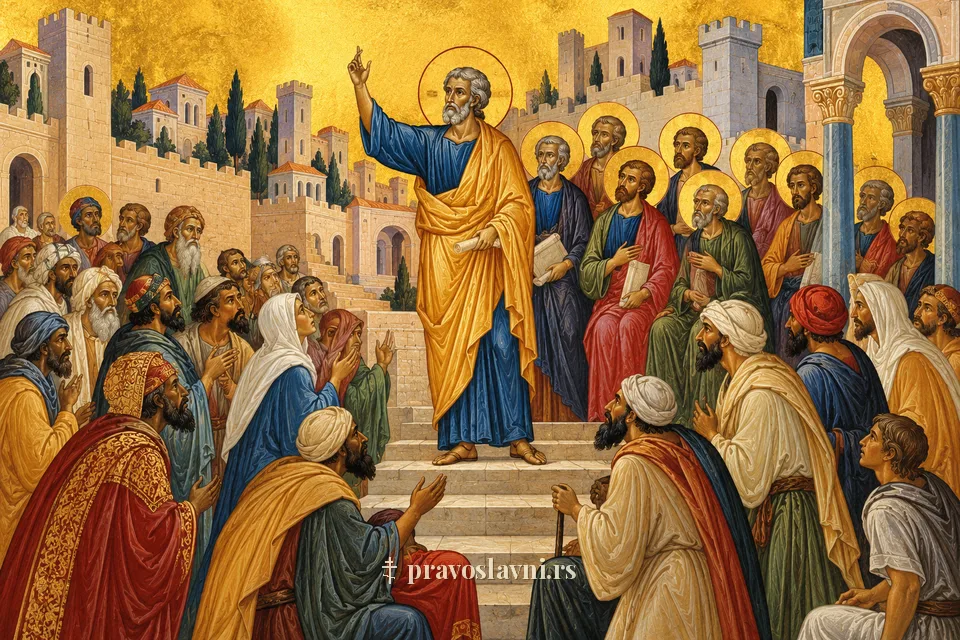
Before the descent of the Spirit the apostles continued with one accord in prayer, together with the women, and after the Ascension they used to gather on Zion and wait for the promised Comforter. The number of the Twelve was made complete again when, in place of Judas Iscariot, the lot fell on Matthias. Then the Holy Spirit came down upon the apostles in the form of tongues of fire. Peter called those gathered to repent and be baptised, with the promise: “and you shall receive the gift of the Holy Spirit” (Acts 2:38). On that day about three thousand people believed and were baptised, and the day of Pentecost is regarded as the birthday of the Church.
The festal week shows that the gift of the Spirit is not a single moment, but a joy which the Church lives from day to day.
Full Life
The third day of the feast
The Tuesday after Pentecost is marked in the calendar as a Red Letter day (great feast) and it is a day with no fasting. The feast of Pentecost itself, according to the Liturgics, does not end on Sunday: “The feast of Pentecost is then celebrated for the whole week, and therefore the fast is relaxed on Wednesday and Friday”. The leave-taking of the feast is on Saturday, and Tuesday is the third day of the same festal joy. So on Tuesday too the same event is still celebrated: the descent of the Holy Spirit on the apostles and the birth of the Church.
The story of Pentecost
Before the descent of the Spirit the apostles all continued with one accord in prayer, together with the women (Acts 1:14). After the Ascension they used to meet on Zion and wait for the Comforter, whom Christ had promised them. At that time the number of the Twelve was made complete: “The place of Judas Iscariot among the Twelve was filled by lot with Matthias.” So the apostles met the descent of the Spirit as twelve, gathered together and in prayer. Then the Holy Spirit came down upon them, in the form of tongues of fire, as Christ had promised them.
The gift of the Holy Spirit
Peter preached to those who were listening to him that they should repent and be baptised, “and you shall receive the gift of the Holy Spirit” (Acts 2:38). Those who received his word were baptised, “and that day about three thousand souls were added to them” (Acts 2:41). The day of Pentecost is regarded as the birthday of the Church.
The gift of the Spirit did not remain tied to a single moment. The first Christians received it on the day when they were baptised, and the Church rejoices in the descent of the Spirit for the whole week, until the leave-taking of the feast on Saturday.
Other saints of the day
Holy Martyr Thalelaeus
The Prologue records that St Thalelaeus prayed to God not to cut short his torments all at once. The attempts of his torturers remained without success. The water into which they threw him did not drown him, and the beasts before which he was brought out — according to his Life, a she-bear, a lioness and a lion — did not harm him.
Yet the greatest miracle took place in the hearts of others. Two executioners, Alexander and Asterius, were supposed to hang him on a tree, but God darkened their eyes, so that instead of the martyr they lifted up a log. When they were scourged for this, both of them confessed Christ and were beheaded. The judge, who set upon the martyr himself, remained unable to move until Thalelaeus prayed for his healing.
Thalelaeus was a young man from Lebanon, eighteen years old, the son of Beroukios and Romylia, and by profession a physician. His Life says that he learned medicine from the chief physician Macarius and that he took no payment for healing. He suffered in the time of the Emperor Numerian. According to his Life, this was not his first trial: he had already been seized and tortured earlier, but had managed to escape. He ended his life in the year 284, beheaded by the sword.
The verses of the Prologue sing of the joy with which he bore one torment after another. He who had healed bodies without payment became a physician of souls, for by his patience he brought even his torturers to Christ.
Venerable Stefan of Piperi
Venerable Stefan of Piperi was born in the region of Nikšić. As a young man, according to his Life, he went to the Morača Monastery, whose church is dedicated to the Dormition of the Most Holy Theotokos, and there he became a monk, and afterwards a hierodeacon and a hieromonk. Later he became abbot of Morača. The Turks drove him out of there; his Life says that in the seventeenth century Turks and Albanians attacked the monastery and threatened to kill him, so he withdrew, and the brotherhood chose a new abbot. He found shelter in Rovca; that place bears the name Ćelište to this day, and his Life says that his cell was a small cave. His Life says that he spent seven years there; his food, nothing but dry bread, was brought to him by shepherds, and the apparitions which the demons sent him he overcame by faith, fasting and prayer. Then he moved to Piperi and lived there in his cell until his death. According to his Life, he built the Church of the Nativity of the Most Holy Theotokos and gathered a few monks, and he spent thirty-seven years in Piperi teaching the people and calling them especially to repentance. He reposed on 20 May (according to the Julian calendar) in the year 1697 and was buried, according to his Life, beside the altar. Four years after his death, in 1701, as his Life says, a light shone upon the grave; when they opened it, the body was without any trace of decay and was fragrant. His relics rest in Piperi, where many miracles take place; his Life says that not only Orthodox Serbs but also Albanians and Turks came to venerate them.