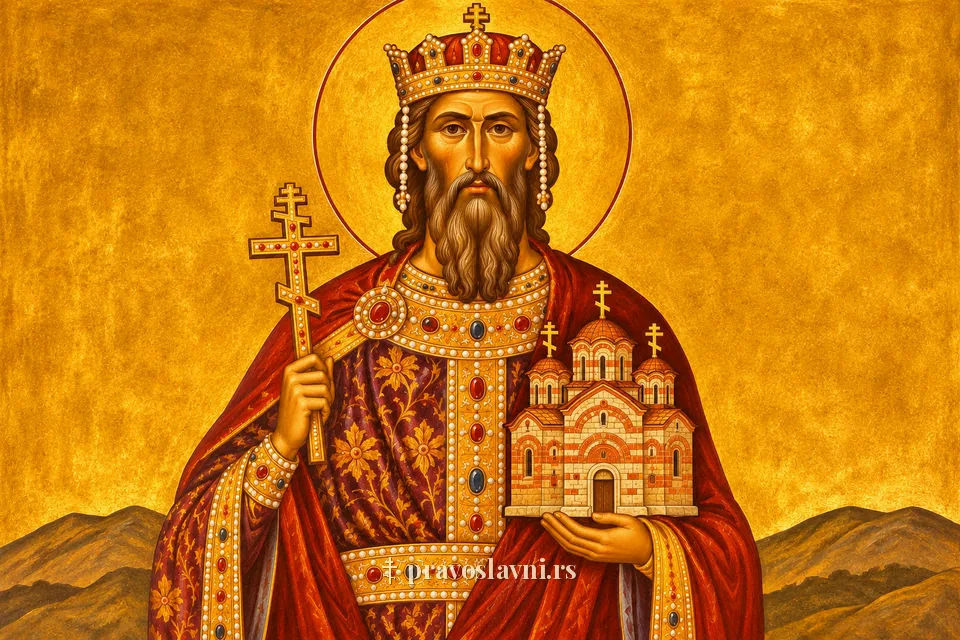
Vidovdan — Holy Martyr Prince Lazar and all the Holy Martyrs of Serbia
28 June 2026 · 28 June 2027
Vidovdan — Holy Martyr Prince Lazar and all the Holy Martyrs of Serbia28 June 2026 · 28 June 2027
Dates and fasting
Sunday, 28 June 2026fast, fish allowed · Red Letter day · 15 June (according to the Julian calendar)
Monday, 28 June 2027fast, fish allowed · Red Letter day · 15 June (according to the Julian calendar)
Monday28June 202715 June (according to the Julian calendar)
Illustration
Great feast
Vidovdan — Holy Martyr Prince Lazar and all the Holy Martyrs of Serbia
Holy Martyr Prince Lazar and all the Holy Martyrs of Serbia
What happenedThe holy Prince Lazar, ktetor (founder) of Ravanica and many other churches, suffered in the Battle of Kosovo on 15 June 1389 (according to the Julian calendar).
“Then the LORD took me as I followed the flock, And the LORD said to me, ”Go, prophesy to My people Israel.”“
— Amos 7:15
About this day
Vidovdan is the feast of the Holy Martyr Prince Lazar and all the Holy Martyrs of Serbia. The name of the day comes from St Vid, or Vitus, the boy martyr whose commemoration fell on the day of the Battle of Kosovo, just as Petrovdan or Savindan bear the name of the saint of their day. Together with Prince Lazar, the Church on that day also remembers the Prophet Amos and the Martyrs Vitus, Modestus and Crescentia. Many families celebrate this day as their Krsna slava (family patron saint's day).
Prince Lazar suffered in the Battle of Kosovo.
The faithful, by folk custom, go to church on Vidovdan, light candles and have a memorial served for the fallen. By folk custom, no merrymaking or weddings are held on that day, there is no loud music and there are no celebrations, and the day is spent quietly. Among the people Vidovdan is interpreted as the day when everything is seen, when the truth comes to light.
The holy Prince Lazar Hrebeljanović was born, according to his Life, around the year 1329 in Prilepac near Novo Brdo. He learned the affairs of state at the court of Tsar Stefan Dušan, and after Dušan he was one of the Serbian rulers, with his seat in Kruševac. With Milica, of the Nemanjić line, he had five daughters and the sons Stefan and Vuk.
His greatest care for the Church was to bring to an end the schism with the Church of Constantinople: he sent the monk Isaija to Constantinople, the anathema was lifted from the Serbian people, and according to the Life the Serbian Patriarchate was recognised as well. He built Lazarica in Kruševac and Ravanica, restored Gornjak and Hilandar, and gave gifts to many churches and monasteries, among them the Russian Monastery of St Panteleimon on the Holy Mountain (Mount Athos).
Before the Battle of Kosovo, according to the Life, he called on his army to suffer for the faith, and the army received Holy Communion. According to popular tradition, he chose the Heavenly Kingdom instead of the earthly one. He suffered in the battle on the Field of Kosovo on 15 June 1389 (according to the Julian calendar), on the feast of the Prophet Amos, who, according to the Life, was his Krsna slava (family patron saint's day).
According to the Life, his body was found incorrupt and was translated to Ravanica; later the relics were translated to Srem, and in 1942 to the Cathedral Church in Belgrade. According to the Life, the nun Jefimija embroidered a Praise for him, and the monks of Ravanica composed a service to him. On this day all the holy martyrs of Serbia are commemorated together with him.
Full Life
From Prilepac to Kruševac
Lazar Hrebeljanović was born, according to his Life, around the year 1329 in Prilepac near Novo Brdo, as the son of the nobleman Pribac Hrebeljanović. Tsar Stefan Dušan took him to his court in Skopje and introduced him to the affairs of state. Around 1353 he married Milica, of the lineage of the Nemanjić family; they had five daughters and the sons Stefan and Vuk, while a third son, Dobrovoj, died young. The Prologue counts him among the Serbian nobles who ruled after Tsar Dušan. His seat was Kruševac, which he built and fortified, and the Life records that he bore the title of Grand Prince.
Peace with the Church of Constantinople
Prince Lazar's most important care for the Church was to bring an end to the schism with the Church of Constantinople. For this reason he sent an embassy to Constantinople with the monk Isaija, so that the anathema might be lifted from the Serbian people. According to the Life, in 1375 he summoned a council in Kruševac; Isaija obtained the lifting of the anathema from Patriarch Philotheus of Constantinople, Jefrem was then elected patriarch, and the Serbian Patriarchate was recognised.
Endowments and Mercy
In Kruševac he built Lazarica, according to the Life the Church of St Stephen and his first great endowment (zadužbina). He also built Ravanica, the Church of the Ascension of the Lord, for which the Life gives 1381 as the year of its founding. He built or restored Gornjak, according to the Life in 1379, for the monks who had gathered there, and he restored Hilandar and endowed it with gifts: the Life mentions a new narthex, villages and a yearly gift. The Prologue calls him the ktetor (founder) of the Russian monastery of St Panteleimon on the Holy Mountain (Mount Athos) and of many other churches and monasteries, and the Life adds gifts to Sinai, to Wallachia and to the Holy Land as well. According to the Life, he also founded schools, orphanages and hospitals.
The Battle of Kosovo
The Prologue records that the prince fought against the Turkish power more than once. Before the Battle of Kosovo, according to the Life, he addressed the army, calling on it to suffer for the faith; that speech was preserved by Patriarch Danilo III. On the day before the battle the army received Holy Communion in the church of Samodreža. According to folk tradition, an angel appeared to him before the battle and offered him the choice between an earthly kingdom and the Kingdom of Heaven, and the prince chose the Kingdom of Heaven. The battle on Kosovo Polje took place on 15 June 1389 (according to the Julian calendar), on the feast of the Prophet Amos, who, according to the Life, was also Lazar's Krsna slava (family patron saint's day). According to the Prologue, the prince was cut down in the battle, while according to the Life he was captured and executed, and many of his commanders with him. According to the Life, his fellow warriors wished that they might meet death before the prince did.
Incorrupt Relics and His Commemoration
According to the Life, monks from Priština took his body and buried it in the Church of the Saviour in Priština. A year later, on the advice of the patriarch, his sons opened the tomb and found the body incorrupt and fragrant. Then the prince's relics were carried to Ravanica near Ćuprija, the monastery which he himself had built; the Life gives the year as 1391 and records that Milica met the procession on the road. Later the relics were translated to Ravanica in Srem: according to the Life, in the Great Migration of 1690 to Szentendre, and in 1697 to the monastery of Vrdnik on Fruška Gora. During the Second World War, in 1942, they were translated to Belgrade and laid in the Cathedral Church; the Life gives 14 April and names Archpriest Radoslav Grujić. The Prologue bears witness that his body is incorrupt and that it heals those who pray to him.
According to the Life, the nun Jefimija embroidered the Praise to Prince Lazar on the pall of his reliquary, Patriarch Danilo III wrote a Homily about him, and the monks of Ravanica composed a service to him. After his death, according to the Life, Milica ruled until their son Stefan came of age, handed over power to him in 1393 and received the monastic tonsure at Ljubostinja with the name Eugenia. This commemoration is called Vidovdan: on it Prince Lazar is glorified together with all the holy martyrs of Serbia, and the Life also mentions the martyrs of Kosovo who fell with him.
Other saints of the day
Holy Prophet Amos
The holy Prophet Amos was born in Tekoa near Bethlehem, in Judea, into a poor family. He was a shepherd: according to the Prologue he tended the flocks of rich men, and according to his Life he also gathered the fruit of the wild fig tree (Am 7:14). According to his Life, God called him from the flock, as He had once called Moses and David, and sent him from Judea to Israel to call the idol-worshipping people to repentance. He prophesied in the days of Uzziah, King of Judah, and Jeroboam the Second, King of Israel, according to the Prologue in the eighth century before Christ. He rebuked the worship of idols and called the people to return, instead of to the golden calves in Bethel, to the one living God. He was persecuted by Amaziah, the priest in Bethel (Am 7:10–17). Amos foretold the fall of Israel and the fate of the house of Amaziah, and this came to pass. Amaziah's son struck him on the forehead with a staff; mortally wounded, he was carried to Tekoa, where he died and was buried with his fathers. His prophecies are preserved in the Book of the Prophet Amos.