“Brethren, if a man is overtaken in any trespass, you who are spiritual restore such a one in a spirit of gentleness, considering yourself lest you also be tempted.”
— Gal 6:1
About this day
Duhovske zadušnice (Pentecost Memorial Saturday) are also called the summer ones, and they fall on the eve of the feast of Pentecost, Duhovi. They have no fixed date but depend on Pascha, like the feast of the Descent of the Holy Spirit itself. The commemoration on this day is found from the twelfth century.
The prayer of this day embraces all who have departed this world in faith and piety, from Adam to our own days, regardless of their calling and of whether death found them in the city, in the desert or at sea. Prayers for the departed are brought into the canon of Matins. According to the “Liturgics” handbook, the service is the same as on Meatfare Memorial Saturday, with the difference that on this day the sixth tone is always sung. When a saint with a polyeleos or the patronal feast of the church is celebrated on that day, the service for the departed is served a few days earlier, in the same week.
In the commemoration we remember the good that the departed did and how much they believed, and we pray to God to forgive them their sins. Such prayer benefits the living too, for in the Lord it unites the living and the departed.
By folk custom, Serbs have always attached great importance to the summer zadušnice. In some regions people go to the cemetery already on the evening before zadušnice, but, by custom, they most often go on the day of zadušnice itself.
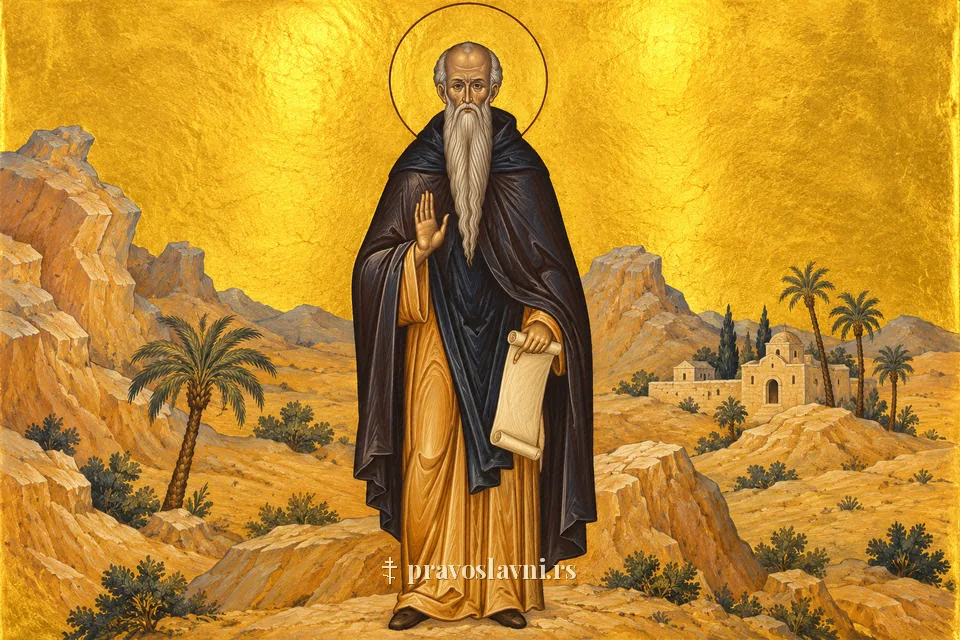
St Bessarion, an ascetic from Egypt, according to the testimony of his disciples did not lie down to rest for forty years: he slept only briefly, sitting or standing. This is how his Life remembers a man who gave his whole life over to prayer.
From childhood he loved God and kept the purity of his baptism, as the Prologue and his Life say. He visited St Gerasimus at the Jordan and learned from St Isidore of Pelusium. His Life says that he gave away the inheritance from his parents to the poor, received the monastic tonsure and withdrew into the desert. He fasted long and strictly, and both sources record that he spent forty days in prayer without food or sleep; according to his Life, he stood motionless among thorns at that time, like the angels. He had a single garment for both summer and winter, and he lived without a cell or a roof, on mountains and in groves.
God endowed him with the gift of working wonders. His Life relates that by prayer he turned bitter sea water into drinking water for a thirsty disciple, held back the sun from setting until they reached their destination, obtained rain by prayer in a time of drought, and crossed rivers, even the Nile, as though he were walking on dry land. The walking on water and the halted sun are also mentioned in the Prologue's hymn. According to the Prologue, many sick people recovered through him. Yet he kept his gift hidden: according to his Life, he drove a demon out of a certain man only when they had seated the sick man in his place.
His Life and the Prologue also remember an incident in church. When a certain monk was led outside on account of a sin, Bessarion stood up and went out together with him, saying that he too was a sinner. His Life also preserves his teaching that a monk should be always watchful and should guard his humility precisely when there is no temptation; temptations, according to his teaching, sometimes keep a man from something worse.
He reposed peacefully in deep old age, according to the Prologue in the year 466.
The Prologue teaches us that joy over another's fall is a stain on the soul, and that faith makes us brothers. St Bessarion did not look down on the sinner from above, but stood beside him.
Full Life
He went out with the sinner
A certain monk had sinned and was sent out of the church — the Prologue says that the abbot dismissed him, and the Life that it was the presbyter who did so. St Bessarion did not then remain in his place. He stood up and went out after him. The Life records his brief explanation: “I too am a sinner.” In the Prologue those words read: “I too am just such a sinner!”
By this event the Prologue teaches that joy at another's fall is filth upon the soul, and that the bond among Christians is stronger than kinship by blood. Bessarion did not set himself above the fallen brother, but beside him.
The schooling of an ascetic
Bessarion was born and brought up in Egypt. The Prologue and his Life bear witness that while still a child he came to love God, and that he did not impair the grace of baptism in anything.
He gathered spiritual knowledge from those who were experienced. The Prologue mentions that he visited St Gerasimus at the Jordan and listened to St Isidore of Pelusium. The Life says that he also went through the holy places in Jerusalem, where he met Gerasimus, who was served by a lion, and that he gained much from his conversations with the ascetics. When he returned to his homeland, according to the Life, Isidore became his spiritual father, and Bessarion often went to him. He gave away his inheritance to the poor, received the monastic tonsure and went off into the wilderness, to pray in solitude and silence.
A life under the open sky
From that time on Bessarion had neither a cell nor any shelter whatsoever. Both sources say that he lived on the mountains and in the groves; the Life adds the rocks as well. One and the same garment, according to the Life a torn one, served him both in summer and in winter. His disciples, as the Life records, used to tell that for four decades he did not lie down to sleep, but rested only briefly, sitting or on his feet.
Fasting and vigil were his weapons against the body. According to the Life, it would happen that for seven days he tasted nothing, and sometimes for forty days he took neither food nor drink. Both the Prologue and the Life remember his prayer of forty days, without food and without sleep; the Life says that at that time he stood motionless and without a word in the open, among thorns, after the example of the angels. The Prologue notes that he hid his labours from people as much as he possibly could. The Life also remembers him for his constant tears and sighs.
The gifts of the ancient prophets
God, both sources say, endowed him with the power of working miracles, and the Life recognises in his miracles the deeds of the Old Testament prophets. According to the Prologue, through him many who were sick received their health, and God was glorified.
The Life lists those miracles one after another as echoes of the Scriptures. Like Moses of old, he gave water to his thirsty disciple Doulas: on the seashore he prayed and with the sign of the cross made the bitter water drinkable and cold, and then said to him: “In the name of the Lord, draw and drink!” He explained to him that God is not bound to any one place. Like Joshua the son of Nun, he held back the sun in the sky until he and his disciple had reached a certain elder. Like Elijah, many times in a season of drought he obtained rain by his prayers. Like Elisha, he crossed rivers, among them the Nile, on foot over the water, without even getting wet. The walking on water and the sun that was stopped are also mentioned in the Prologue's hymn.
Yet he did not want people to look upon him as a wonderworker. The Life tells how the clergy in the skete, powerless before a demon that was tormenting a certain man, seated the sick man in Bessarion's usual place, because the elder would not have come if they had called him. When he came, he said to the man: “Get up, and move away from there.” — and the demon left him in an instant.
Watchfulness and humility
According to the Life, he taught that a monk must be completely watchful, like the cherubim and the seraphim. The greatest caution, he used to say, is needed precisely when life is peaceful and without temptations; and temptations themselves, he taught, can be God's protection against a greater fall.
So he lived until deep old age and reposed in peace; the Prologue gives the year 466. He left behind the example of an ascetic who had power over water and the sun, and yet before a sinful brother he stood up and took his place beside him.
Other saints of the day
Venerable Hilarion the New
Venerable Hilarion the New was, according to his Life, the son of Peter, a Cappadocian who was in charge of the bread at the Emperor's table, and of a devout mother, and in his youth he studied the Holy Scriptures thoroughly. At the age of twenty he left his home and riches and became a monk in the Monastery of Hesychius near Constantinople, and he received the great schema in the Monastery of Dalmatus. He was a disciple of Gregory of Decapolis and imitated Hilarion the Great, whose name he bore, and for that reason he was called the New. He accepted the priesthood, according to his Life, unwillingly, and when the brethren wanted to make him abbot he slipped away in secret under cover of darkness; only at the urging of Patriarch Nicephorus and the Emperor did he agree to lead the Monastery of Dalmatus in Constantinople. The Prologue points out his power in prayer, his perseverance and his courage in troubles. For the sake of the holy icons he suffered much from the iconoclast Emperor Leo the Armenian and from others, and his Life says that he openly denounced the Emperor, and so he was beaten and imprisoned. Leo, according to both sources, was cut down by his own soldiers in the same church in which he had reviled the holy icons. Hilarion had the gift of clairvoyance: at the hour of prayer he heard wondrous voices and sensed a sweet fragrance, and he saw angels carrying the soul of St Theodore the Studite, on the day when the latter died in exile. According to his Life, under the Emperor Theophilus he again refused iconoclasm, received one hundred and seventy blows with rods and was banished to the island of Aphousia. The torture and imprisonment lasted until the Orthodox Empress Theodora, who, according to his Life, restored the veneration of icons, and so Hilarion returned to his office as abbot. He reposed in the year 845, according to the Prologue in the seventieth year of his life.