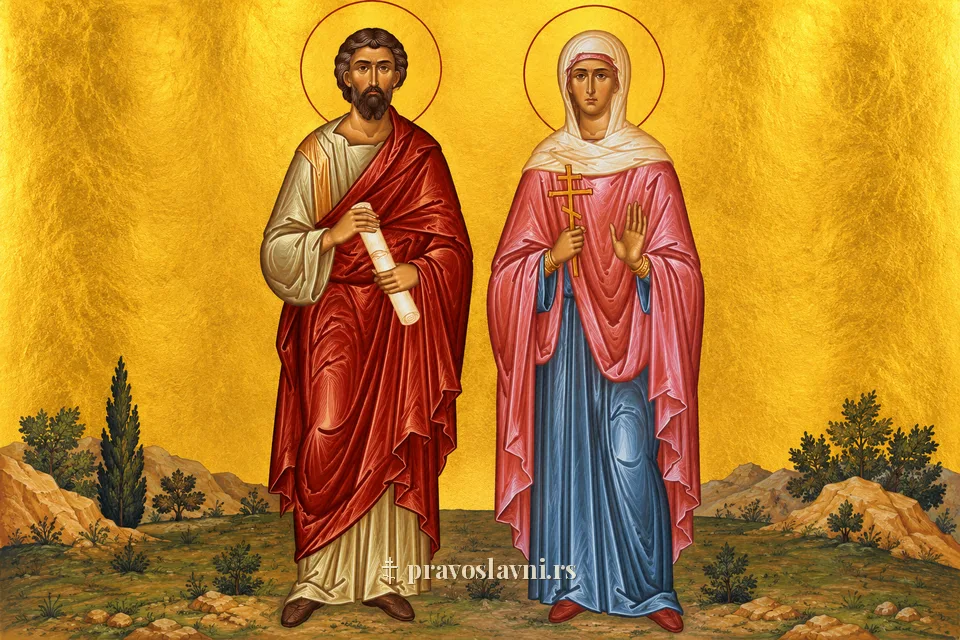
“Greet Andronicus and Junia, my countrymen and my fellow prisoners, who are of note among the apostles, who also were in Christ before me.”
— Rom 16:7
About this day
Zadušnice (summer) — Memorial Saturday before Pentecost
Duhovske zadušnice (Pentecost Memorial Saturday) are also called the summer ones, and they fall on the eve of the feast of Pentecost, Duhovi. They have no fixed date but depend on Pascha, like the feast of the Descent of the Holy Spirit itself. The commemoration on this day is found from the twelfth century.
The prayer of this day embraces all who have departed this world in faith and piety, from Adam to our own days, regardless of their calling and of whether death found them in the city, in the desert or at sea. Prayers for the departed are brought into the canon of Matins. According to the “Liturgics” handbook, the service is the same as on Meatfare Memorial Saturday, with the difference that on this day the sixth tone is always sung. When a saint with a polyeleos or the patronal feast of the church is celebrated on that day, the service for the departed is served a few days earlier, in the same week.
In the commemoration we remember the good that the departed did and how much they believed, and we pray to God to forgive them their sins. Such prayer benefits the living too, for in the Lord it unites the living and the departed.
By folk custom, Serbs have always attached great importance to the summer zadušnice. In some regions people go to the cemetery already on the evening before zadušnice, but, by custom, they most often go on the day of zadušnice itself.
Andronicus and Junia preached the Gospel in Pannonia. Andronicus was bishop there, but, according to the Prologue and his Life, he travelled without ceasing and preached throughout the whole province, and Junia was his fellow worker. Together they converted many and pulled down the temples of the idols; the Life also says that they built churches. God gave them the gift of working wonders: they cast out demons and healed the sick.
Andronicus was one of the Seventy and a kinsman of the Apostle Paul, who mentions him together with Junia in the Epistle to the Romans as his kinsmen and fellow prisoners (Rom 16:7). The Life says that he came to believe in Christ before Paul did.
Both suffered as martyrs, and so the Church honours them both as apostles and as martyrs; where and when, the sources do not record. Their relics were found at Eugenius by a revelation from God, and the Prologue refers to the commemoration of 22 February (according to the Julian calendar), according to which this took place in the days of Emperor Arcadius.
Andronicus and Junia show that the Gospel is not carried by individuals alone: a man and a woman, shoulder to shoulder, preached Christ and suffered for Him.
Full Life
Kinsmen of Paul
St Andronicus is numbered among the Seventy Apostles. He was a kinsman of the Apostle Paul, and his Life says that he came to know Christ even before Paul did. In the Epistle to the Romans Paul greets him together with Junia: “Greet Andronicus and Junia, my countrymen and my fellow prisoners” (Rom 16:7). According to his Life, in the same greeting Paul numbers them among the apostles of note, who were in Christ before him.
Junia was Andronicus's fellow worker. The Life praises her as a woman who left the world and gave her life to Christ.
Preaching throughout Pannonia
Andronicus received the office of bishop in Pannonia, but, as the Prologue and his Life record, he did not stay in his see: he travelled through the whole province and proclaimed the Gospel everywhere. His Life says that his mission had no bounds and that everywhere he put down idolatry.
The converts were many. The Prologue and the Life say that Andronicus and Junia together brought people to the faith and pulled down the temples of the idols, and the Life adds that they built churches. According to the same sources, God endowed them with the gift of working miracles: the demons had to withdraw, and the sick recovered, according to the Life even those whose illness was considered incurable.
A martyr's end and the relics
According to the Prologue and the Life, both of them sealed their preaching with a martyr's death, so that the Church honours them both as apostles and as martyrs. The sources state neither where nor when they suffered.
Of their relics it is known that they were found in Eugenius thanks to a revelation from God. For that story the Prologue refers to 22 February according to the old calendar: at that time, in the days of the Emperor Arcadius, a multitude of relics of martyrs was uncovered at Eugenius near Constantinople, and the cleric Nicholas Calligraphus learned by revelation that Andronicus and Junia rest among them.
Andronicus and Junia, fellow workers of the Apostle Paul, together spread the Gospel through Pannonia and bore witness to it by their death. The Prologue also gives a thought of St John Chrysostom: when God allows an upheaval, He does so like a mother rocking a cradle, in order to wake a person up; therefore we should thank Him both for gifts and for trials.