Saint of the day
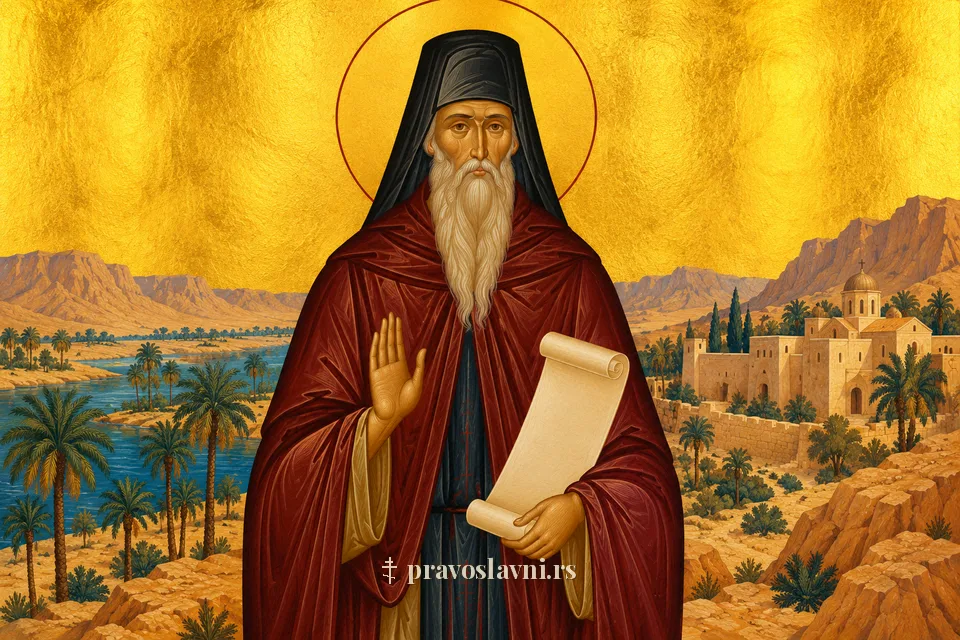
Venerable Theodore the Sanctified
What happenedTo a philosopher who asked him who had died without being born, Theodore answered: Adam — and called on him to leave idle questions and come to Christ.
Read the LifeOrthodox Calendar · 16 May according to the Julian calendar
Friday, 29 May 202616 May (according to the Julian calendar)What happenedTo a philosopher who asked him who had died without being born, Theodore answered: Adam — and called on him to leave idle questions and come to Christ.
Read the Life
No meat, dairy products, eggs or fish — oil and wine are allowed.
This is a recommendation — for your own fast, consult your priest or spiritual father.More about the fast →
Today the Church keeps the commemoration of a saint · Leavetaking of the Ascension.
More about the feast →
“And whoever of you desires to be first shall be slave of all.”
— Mk 10:44St Theodore, a disciple of St Pachomius, came to the monastic life as a young man. His Life says that at the age of fourteen he felt the emptiness of worldly abundance and for two years trained himself in fasting. He left home in secret, and, according to his Life, it was the elder Pecusius who brought him to Tabennisi. Pachomius, according to the Prologue, tonsured him and valued him for his zeal and obedience. Not even his mother could bring him back: he would not come out to see her, yet he prayed for her, and she stayed and became a nun. His brother Paphnutius became a monk as well.
According to his Life, when he was only about twenty years old Pachomius already set him to teach the brethren and appointed him steward of Tabennisi, and then entrusted him with founding a monastery at Panopolis, at the request of the bishop of that place.
There a certain philosopher put to him three riddling questions about birth and death. Theodore answered with the names of Adam, Enoch and Lot's wife, and advised him to leave useless questions alone and to seek the forgiveness of sins in Christ.
His Life says that he nursed his teacher in his last illness. When Pachomius died, Theodore became abbot of all his monasteries, and, according to his Life, Athanasius the Great also held him in esteem. He reposed in peace, in deep old age, in the year 368.
His strength was obedience: he left his home for the sake of Christ and became a worthy successor to his teacher.
When St Pachomius died, the care of all his monasteries was taken over by his disciple Theodore. His Life explains that this happened after Petronius, the successor of Pachomius, died early, and it adds that Theodore nursed his teacher in his last illness. He guided many monks for a long time, right up to his old age, and his Life records that Athanasius the Great knew him and valued him. He reposed in peace, at a great age, in the year 368.
He came to this by the road of obedience. His Life says that at the age of fourteen, on the feast of Theophany, he understood how empty worldly abundance is, that he withdrew to pray and for two years trained himself in fasting. He left home in secret. According to his Life, he first lived among God-fearing monks, and when he heard there of the teaching of Pachomius, the elder Pecusius took him to Tabennisi. The Prologue says that Pachomius tonsured him and valued him for his zeal and obedience.
Not even those closest to him brought him back. His mother, who according to his Life also brought a letter from the bishop, he would not receive, but he prayed for her; she stayed and became a nun in the women's community of the sister of Pachomius. His brother Paphnutius also followed him; his Life says that at first Theodore did not want to receive him, but on the advice of Pachomius he accepted him and guided him spiritually.
According to his Life, when he was about twenty Pachomius appointed him to speak to the brethren and rebuked the elders who complained that a young man was teaching them; later he entrusted to him the governance of Tabennisi. The Prologue and his Life say that he also entrusted to him the new monastery in Panopolis, for which the bishop of that place, Varus according to his Life, had asked Pachomius, because many people wanted to become monks.
In Panopolis a certain philosopher wanted to test Theodore with three questions — about a man who died without being born, about one who was born and did not die, and about one whose body did not decay after death. In answer Theodore named Adam, Enoch and Lot's wife, and the Prologue records his words about the first in this way: “Adam was not born, yet he died.” He advised the philosopher to leave off empty speculations and to seek from Christ the forgiveness of sins. The Prologue draws a lesson from this: life lies in care for God and for the salvation of the soul, and not in idle reasoning.
Theodore left his home for the sake of Christ and through obedience became a worthy successor of his teacher.
The year 1594 found Teodor, Bishop of Vršac, at the head of an uprising in the Banat, under banners bearing the image of St Sava. The pasha of Temišvar took the bishop prisoner in Vršac, and Teodor suffered a martyr's death. That was also the year in which Sava's relics were carried off from Mileševa to Vračar and burned. The Church venerates him as a hieromartyr.
Separate page: Hieromartyr Teodor of Vršac →
The holy martyr Vukašin, according to his Life, bore the surname Mandrapa and was born at the end of the nineteenth century, most probably in Klepci in Herzegovina. He came from a devout Serbian merchant family in Sarajevo, where he himself was a merchant, looked after the property of the Old Church of the Holy Archangels and sang in its choir as a reader. In 1941 he took refuge in Klepci, where the Ustaše, as in Prebilovci, killed the members of his family and other Serbs, and took him prisoner. From there, in 1942, his road led by way of Sarajevo to the Jasenovac camp. When the executioner Žilo Friganović ordered him to cheer for Pavelić, he refused and calmly answered: “Just do your work, child!” Then he was tortured and killed. According to his Life, his answer was witnessed to by one camp inmate who survived. The Holy Assembly of Bishops entered him in the Imenoslov (the list of saints) in 1998, and his icon is kept in the Tvrdoš Monastery, where his troparion is sung.
Separate page: Holy Martyr Vukašin →
St Vikentije, born Vasilije Krdžić, came into the world, according to his Life, on 30 January 1853 in Ušće. He studied at Studenica and at the seminary in Belgrade, and he received the monastic tonsure at Studenica in 1873. From 1900 he lived in Hilandar, and five years later he was consecrated Metropolitan of Skopje in Constantinople. When Bulgaria entered the war in 1915, he withdrew from Skopje with the Serbian army as far as Prizren, from where Bulgarian soldiers took him away to Uroševac. According to his Life, he and his deacon Cvetko lost their lives on 2 December 1915 near Ferizović, and their bodies were burned. The Serbian Church has numbered Metropolitan Vikentije, together with Abbot Vladimir Protić, among the martyrs killed by the Bulgarian occupiers.
Separate page: St Vikentije and the Holy Martyrs of Surdulica →


