Sunday31May 202618 May (according to the Julian calendar)‹›
Illustration
Great feast
Duhovi — Pentecost (Holy Trinity Day)
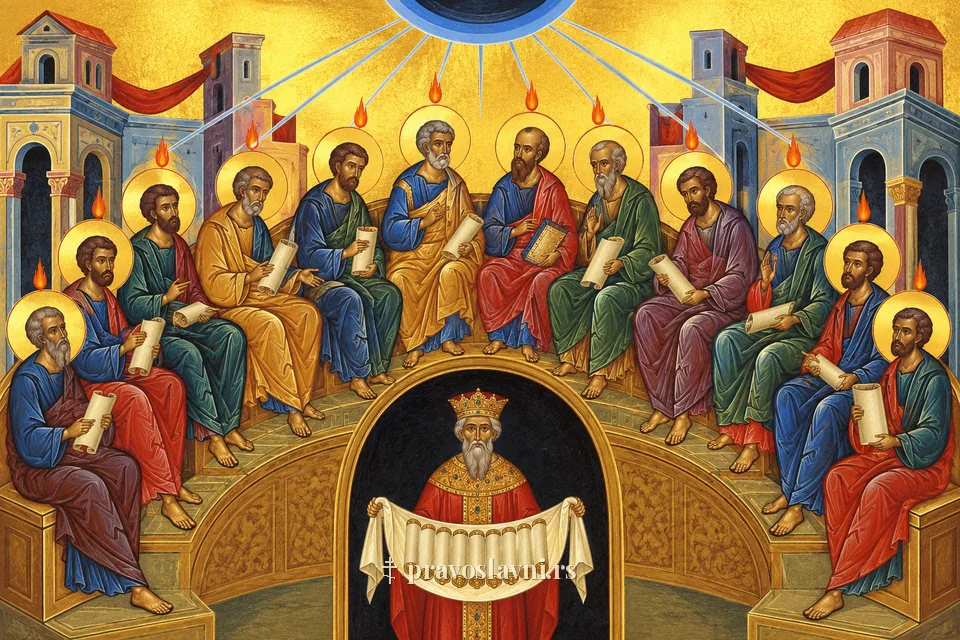
Descent of the Holy Spirit on the Apostles
What happenedOn the fiftieth day after Vaskrs (Pascha) the Church celebrates the descent of the Holy Spirit on the apostles in the form of tongues of fire, and glorifies the Holy Trinity.
“And they were all filled with the Holy Spirit and began to speak with other tongues, as the Spirit gave them utterance.”
— Acts 2:4
About this day
Duhovi — Pentecost (Holy Trinity Day)
Greenery is linked with Duhovi (Pentecost, Holy Trinity Day). By custom, on that feast grass and flowers are brought into the church, and little wreaths are woven from them; according to the “Liturgics” handbook, “Among the Serbs it is the custom to weave little wreaths of green grass during the divine service”. By custom, both churches and homes are decked with greenery and flowers, and at Vespers after the Liturgy the faithful may hold flowers in their hands.
The root of the custom lies in the Old Testament Pentecost: on the fiftieth day Israel offered the Lord a new offering, loaves, the firstfruits to the Lord (Lev 23:16–17).
The greenery is also given a spiritual meaning: as nature is renewed in spring, so the grace of the Holy Spirit renews people. The name Trojice (Trinity) reminds us that this is also the feast of the Holy Trinity. The joy continues all week, right up to the leavetaking on Saturday.
The Descent of the Holy Spirit on the Apostles, Pentecost, which is also called Holy Trinity Day, always falls on a Sunday, on the fiftieth day after Vaskrs (Pascha). On this day the Holy Trinity is glorified as well; the feast is a Red Letter day (great feast) and there is no fasting.
After the Ascension the disciples remained in Jerusalem, gathered on Zion for prayer and waited for the promised Comforter. The place of Judas Iscariot was at that time given by lot to Matthias. “When the Day of Pentecost had fully come, they were all with one accord in one place” (Acts 2:1). The house in which they were was filled with a sound like that of a mighty wind, and upon each of them there came down a tongue as of fire. Filled with the Holy Spirit, they began to speak in other tongues, and each one of the multitude that had gathered heard them in his own language. Peter called those gathered to repentance and baptism, with the promise: “and you shall receive the gift of the Holy Spirit” (Acts 2:38). On that day about three thousand souls were baptised. This is why we call Pentecost the birthday of the Church of Christ.
After the Divine Liturgy, Great Vespers is served, at which the priest, facing the people, reads three prayers on his knees; at the Vigil “O Heavenly King” is sung many times.
By custom, churches and homes are decorated with greenery and flowers. By custom, the faithful may hold flowers in their hands at Vespers, and among the Serbs little wreaths are woven from grass during the service. The renewal of nature in spring, according to the “Liturgics” handbook, is an image of the renewal which the grace of the Holy Spirit brings to man. The festal joy lasts the whole week, with no fasting on Wednesday and Friday, right up to the leave-taking on Saturday. The Saturday before Duhovi (Pentecost) is a Memorial Saturday, and the Sunday after it is dedicated to All Saints.
Full Life
Pentecost
The Descent of the Holy Spirit on the Apostles is also called Pentecost, and the feast is called Trojice (Holy Trinity Day) as well. The Holy Spirit came down on the fiftieth day after Christ's Resurrection, which is why the feast always falls on a Sunday; on that day the Holy Trinity is glorified at the same time. According to the church calendar, Duhovi (Pentecost) comes seven weeks after Vaskrs (Pascha). The day is marked as a Red Letter day (great feast) and no fast is kept.
After the Ascension the disciples did not leave Jerusalem. In prayer they waited for the Comforter whom Christ had promised them, and they often met for prayer on Zion. At that time the vacant place of Judas Iscariot among the Twelve was filled: the lot fell on Matthias.
Tongues of fire
The description of the event in the Acts of the Apostles begins like this: “When the Day of Pentecost had fully come, they were all with one accord in one place” (Acts 2:1). Suddenly a sound was heard from heaven, like a mighty wind, and it filled the whole house where they were. “Then there appeared to them divided tongues, as of fire, and one sat upon each of them” (Acts 2:3). “And they were all filled with the Holy Spirit and began to speak with other tongues, as the Spirit gave them utterance” (Acts 2:4).
The sound gathered a multitude of people, and they were confused, because each one heard the apostles speaking in his own language. Peter preached to them and called them to repent and be baptised, “and you shall receive the gift of the Holy Spirit” (Acts 2:38). Those who received his word were baptised, “and that day about three thousand souls were added to them” (Acts 2:41).
The birthday of the Church
That is why the day of Pentecost is celebrated as the birthday of the Church of Christ. Since Pentecost the Church has lived by the grace of the Holy Spirit.
The service and the greenery
The most recognisable part of the festal service comes immediately after the Divine Liturgy: Great Vespers with an entrance, at which three prayers are read on bended knees. The priest reads them with his face turned towards the people, and Vespers also has its own festal prokeimenon. Before that, at the Vigil, which is served as for the other great feasts, “O Heavenly King” resounds several times, and the Liturgy has festal antiphons.
According to the Liturgics, “There is a custom of decorating churches and houses with greenery and flowers on the day of Pentecost”. At Vespers the faithful are allowed to hold flowers in their hands, and the root of the custom lies in the Old Testament Pentecost. The meaning of the greenery is explained there in this way: “Greenery and flowers, nature that is renewed in spring, symbolise the renewal of people” by the grace of the Holy Spirit.
The festal joy does not die out on Sunday. The whole week is festal, so neither Wednesday nor Friday is a fasting day then, and the leave-taking of the feast is on Saturday. The Saturday before Duhovi is dedicated to the commemoration of the departed, this is the Summer or Pentecost Zadušnice (Memorial Saturday), while on the first Sunday after Duhovi All Saints are celebrated.
Other saints of the day
Holy Martyr Theodotus of Ancyra and the Seven Women Martyrs
St Theodotus was a layman, an innkeeper from Ancyra, in the time of the Emperor Diocletian. He had a wife; according to both sources, he lived by the Apostle's word about those who are married, and his Life also mentions his self-restraint. His inn, according to the Prologue, served him as an opportunity to help Christians. While the persecution lasted, his home was a support for the persecuted, and his Life compares it to Noah's ark. He helped those who had fled to the mountains and took care that those who were killed should receive a grave. According to his Life, he encouraged his friend Victor, who gave way under torture in prison, and in the village of Malos he laid in a grave the relics of the martyr Valens.
His best-known deed is connected with seven virgins — Tecusa, Alexandra, Claudia, Phaine, Euphrasia, Matrona and Julia — who, after trial, torture and mockery, were thrown into a lake. Tecusa, according to his Life, was his aunt. The Prologue and his Life say that she appeared to him in a dream, asking that their bodies should not be left in the water, and that he, with the help of an angel, found them by night and buried them.
He was betrayed to the judge: according to the Prologue it was a travelling companion who betrayed him, and according to his Life a relative, Polychronius, who could not endure torture. His Life says that he did not hide, but after praying went out before the court himself and refused the honours and riches that were offered. According to the Prologue and his Life, even under torture he remained with the Lord in his thoughts. To the Christians who were in tears he said that instead of weeping they should glorify Christ, Who had given him strength to the end. He was beheaded in the year 303. According to his Life, a storm and a light preserved his body from being burned. A certain priest, according to his Life Fronto, buried him outside the city, and later a church dedicated to him was built over the grave of Theodotus.
His martyrdom was written down by Nilus, who was with him in prison and saw his torments.
Theodotus was neither a monk nor a priest, but an innkeeper, and yet he became a martyr: holiness can be lived in every calling, when a person remains with Christ in his heart.