Save your slava — you'll get a reminder a week and a day before.
Monday15February 20272 February (according to the Julian calendar)
Illustration
Great feast
Meeting of the Lord
Meeting of the Lord
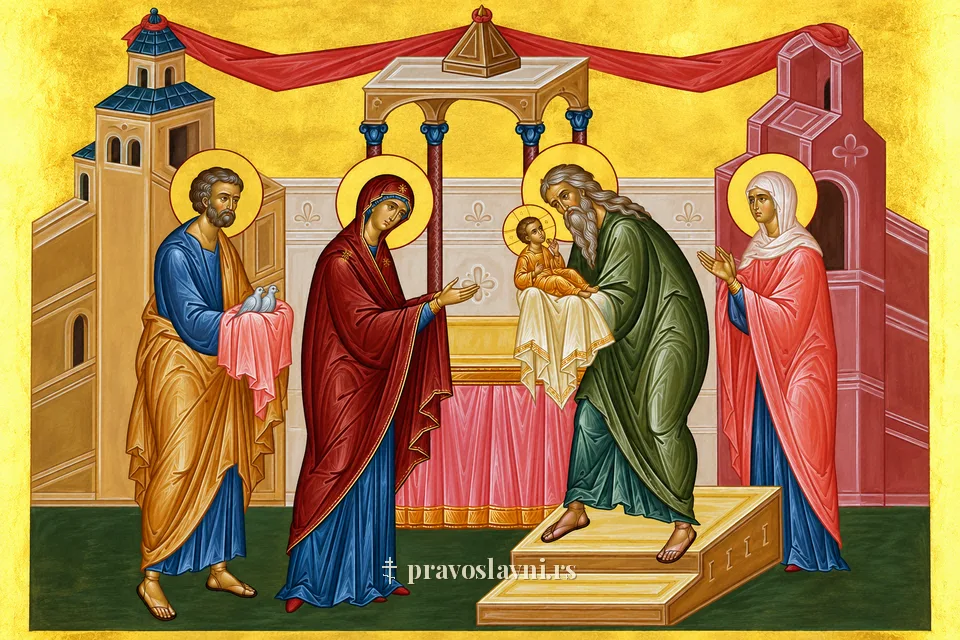
What happenedOn the fortieth day after His birth the Most Holy Virgin brought Christ to the Temple in Jerusalem, where the righteous Simeon and the prophetess Anna met Him.
“Lord, now You are letting Your servant depart in peace, According to Your word; For my eyes have seen Your salvation Which You have prepared before the face of all peoples.”
Sung at the Slava (family patron saint's feast) and on the feast day.
Hail, O Virgin Birth-giver of God: for from thee hath shone forth the Sun of Righteousness, Christ our God, who giveth light to those who are in darkness. And rejoice, thou aged, righteous man, that didst receive in thine arms the Redeemer of our souls, who giveth unto us resurrection.
The Meeting of the Lord is a feast of encounter: on the fortieth day after His birth Christ was brought to the Temple in Jerusalem, and there the elder Simeon and the prophetess Anna recognised Him and welcomed Him (Lk 2:22–40).
Why did Mary and Joseph come to the Temple at all? The Law of Moses required that a firstborn son be dedicated to God and that the mother be purified. Christ, from whom the Law itself comes, wished to fulfil it, although it did not bind Him; nor did His Mother need purification. They offered, according to the Life, the sacrifice that the poor used to give — a pair of turtledoves or two young pigeons (Lk 2:24). Zacharias, the father of the Forerunner and the high priest on that day, gave Mary a place among the virgins.
Simeon, led by the Spirit, arrived in the Temple at just the right hour, took the Child in his arms and blessed God, calling Him a light to the nations and the glory of Israel, while Joseph and His Mother marvelled at his words. Anna too praised the Lord and spoke about the Child to those who were waiting for deliverance. Not everyone shared that joy: Herod, when he heard from the Pharisees what had happened, tried to put the Child to death, but an angel had already sent the Holy Family on their way to Egypt. The Child, according to the Gospel, grew and became strong in spirit, and the grace of God was upon Him.
The feast received its full solemnity in the year 544, under Justinian, although it had been celebrated before that too. The Life tells that at that time the Empire was being ravaged by a plague, from which in the end as many as ten thousand people were dying each day, while Antioch was being shattered by an earthquake. The plague and the tremors, according to the Life, ceased as soon as the Meeting of the Lord, following a revelation given to a certain righteous man, was celebrated for the first time as solemnly as the other feasts of the Lord and of the Theotokos.
The Son of God and His Mother show humility: they did not have to submit to the Law, and yet they did so, and with the gift of the poor at that. Simeon and Anna bear witness that whoever waits for the Lord in faith, prayer and fasting does, in the end, come to meet Him.
Full Life
The Feast of the Meeting
The Serbian name of this feast, Sretenje, means a meeting. On the fortieth day after His birth Christ was brought to the temple in Jerusalem, and there He was met by those who had been waiting for Him: the elder Simeon and the prophetess Anna. The Life notes that this is at one and the same time a feast of the Lord and a feast of the Theotokos.
The Lawgiver under the Law
The Law of Moses required two things: that the firstborn should be dedicated to God, and that the mother should undergo purification after the birth of her child. The Evangelist Luke records that, when the time for this had come, they brought the Child to Jerusalem to present Him to the Lord (Lk 2:22). Yet neither Christ nor His Mother was truly obliged to do this. The One from whom the Law comes, say the Prologue and the Life, wished to fulfil it, and not to go around it.
The Life especially stresses Mary's humility. Her virginity was not impaired either by conceiving or by giving birth, so she had no need of purification, and yet she accepted it out of obedience. Her gift in the temple, according to the Life, was the gift of the poor: two birds, bought for the occasion, instead of a lamb (Lk 2:24). Not even the gold which the wise men had brought, says the Life, did she keep for herself, apart from as much as was needed for the journey into Egypt.
Those Who Were Waiting
The high priest on that day was Zacharias, the father of John the Forerunner. The Prologue and the Life say that he assigned Mary the place in the temple that belonged to the virgins.
Then the meeting took place from which the feast has its name. The elder Simeon, a righteous man upon whom the Holy Spirit rested, came into the temple by the inspiration of the Spirit at the hour when they were bringing in the Child (Lk 2:25–27). He took Him up in his arms, blessed God and said: “Lord, now You are letting Your servant depart in peace, according to Your word” (Lk 2:29). He called the Child the salvation which his eyes had seen, a light to the nations and the glory of Israel, and Joseph and the Mother marvelled at those words. The prophetess Anna, who did not depart from the temple, at that same moment was giving glory to God and speaking of the Child to all who were waiting for redemption (Lk 2:38).
Herod had already heard of the newborn king from the stargazers from the east. News from the temple was brought to him by discontented Pharisees, and the king decided to put the Child to death. He was too late: an angel had already directed the Holy Family to Egypt, and the Life says that he warned Joseph in a dream. The Gospel says further of the Child: “And the Child grew and became strong in spirit, filled with wisdom; and the grace of God was upon Him” (Lk 2:40).
The Feast That Stopped the Plague
Although the Meeting of the Lord had been celebrated earlier too, the year 544, under Justinian, has been remembered as the year when it received its full solemnity. The Life explains why. It was a terrible year: for months the plague carried off thousands of lives a day, at its height as many as ten thousand. In Antioch, moreover, the earth was shaking: Bishop Euphrasius perished under the ruins of a church, and Pompeiopolis half disappeared into the ground.
The Life ties the end of the plague and of the earthquakes to a day — the one on which the Meeting of the Lord was celebrated for the first time with a vigil and a procession, as the equal of the other feasts of the Lord and of the Theotokos. Justinian so commanded, after this had been revealed to a certain righteous man. According to the Life, it was a gift of God's mercy, obtained through the intercession of the Theotokos.
The Son of God, the Lawgiver Himself, humbly submits to the Law, and His Mother, who has no need of purification, comes in obedience, with the gift of the poor. Simeon and Anna, who waited in faith, prayer and fasting, were counted worthy to meet the Saviour and to proclaim Him as a light to the nations. The Meeting of the Lord teaches us that God comes to meet those who wait for Him patiently, and that humility is not weakness, but the path that the Son of God Himself walked.
Other saints of the day
Holy New Martyr Jordan
The New Martyr Jordan was a maker of cauldrons; by origin he was from Trebizond. His Life says that he was married and lived in Galata, in Constantinople. On the feast of the Entry of the Most Holy Theotokos into the Temple he was making merry with some Muslims, his fellow countrymen and members of his guild. During a game one of them mocked the Christian faith, and Jordan answered with a jibe at Muhammad. The Muslim reported him to the vizier for insulting the prophet and demanded his death. The vizier offered him a choice: execution, or conversion to Islam with honours, but Jordan confessed Christ as the true God. The only thing he asked for was time to put his affairs in order: so that no one would suffer loss because of his debts, and so that what he had would go to the Church and to the poor. The vizier agreed and sent a guard with him. He walked to the place of execution without hesitation, glorifying God and asking the passers-by along the way to forgive him. At the place of execution an officer brought him a secret message from the vizier, that he should acknowledge Islam publicly and remain a Christian inwardly, but Jordan replied: “I thank the vizier, but I will never do that.” He was beheaded, and the Prologue gives Galata and 1650 as the place and year of his suffering. That same night his relatives and friends paid the prefect, took his relics and buried them with honour.
The holy martyr Agathodorus did not hide that Christ is the true God, and so, according to his Life, he had to answer before the local ruler in Tyana, a city of Cappadocia. He was subjected to many grievous torments and in them he passed away. His Life says that for his suffering he received an eternal reward — the crown of martyrdom.