Save your slava — you'll get a reminder a week and a day before.
Wednesday10November 202728 October (according to the Julian calendar)
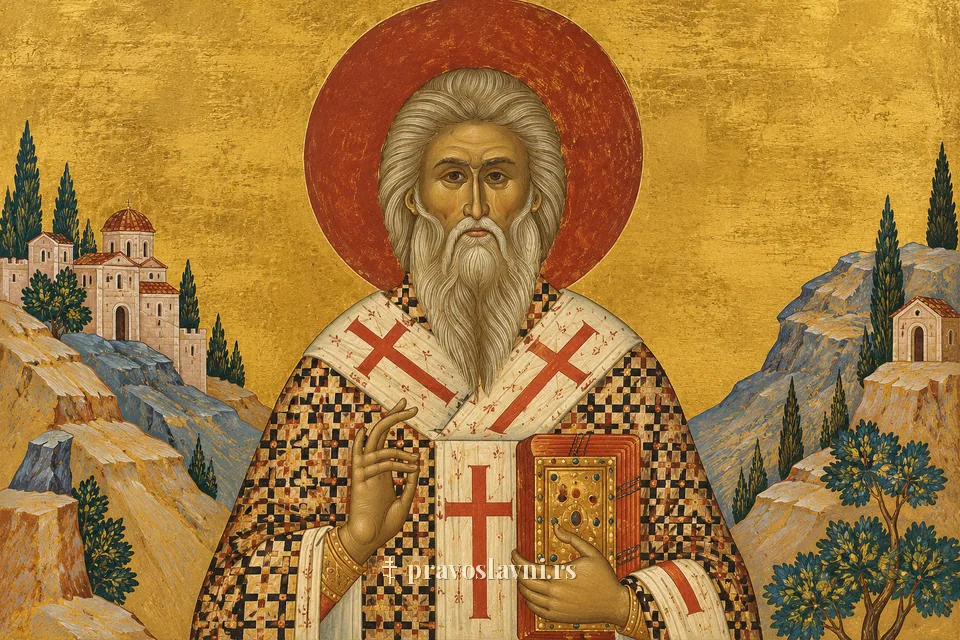
Illustration
Saint of the day
St Arsenije of Srem, Archbishop of Serbia
What happenedArsenije of Srem, the successor of St Sava, chose Peć as a safer seat for the Serbian archbishopric and governed the Church wisely for thirty years.
“Remember those who rule over you, who have spoken the word of God to you, whose faith follow, considering the outcome of their conduct.”
— Heb 13:7
Life
St Arsenije of Srem is remembered for three things: St Sava chose him as his successor, he found the Serbian Church a new home in Peć, and for thirty years he guided it wisely.
Peć is, above all, his work. The Hungarian attacks had shown that Žiča was not a safe seat for the archbishopric, and it was Arsenije who, at Sava's instruction, found a new and more secure see in the south. He built the monastery and church of the Holy Apostles in Peć, and in that church he was buried after his repose on 28 October 1266.
The trust that he won from Sava was not small. A monk from Srem who had sought the salvation of his soul from his youth, he quickly became abbot at Žiča, and later the one for whom Sava, before his second journey to Jerusalem, intended the archbishop's throne. He showed his devotion to his teacher after Sava's death in Tarnovo as well, when he pleaded with King Vladislav for the return of Sava's earthly remains to the Serbs.
He saw himself as a sinner, and that is how he signed himself: the prayer that he left in the altar at Peć contains the words “remember also me, the sinful Arsenije”.
His relics, too, did not rest. His Life follows their journey as well: the monks of Peć hid them away when the Patriarchate of Peć burned down in a Turkish fire in 1737, and after many stops along the way a home was found for them at Ždrebaonik near Danilovgrad. One small portion travelled even further in 1933 — to Peking and Harbin.
His commemoration is on 10 November by the new calendar. May his example teach us that God is to be served faithfully and humbly, and may St Arsenije pray for the Serbian people and for all the Orthodox.
Full Life
The One Whom Sava Trusted
The most important thing about St Arsenije of Srem is told by a single choice: St Sava intended the archbishop's throne for him and no other. That decision was made before Sava's second journey to Jerusalem, and his Life also gives the year — 1233.
Arsenije did not come to such trust by chance. A native of Srem, he chose the monastic path while still a young man, seeking above all the salvation of his soul. The fame of St Sava brought him to Žiča, and there he became a member of Sava's brotherhood. Before long it was he who governed the brotherhood of Žiča, as abbot — a choice that both sources explain by his exceptional virtues. So Sava did not choose his successor from afar.
A New Home for the Serbian Church
The Hungarian invasion of the Serbian lands showed that Žiča, the first seat of the archbishopric, was not safe. Sava gave Arsenije the task of finding a safer seat, and in the south he chose Peć. Thus through his labour Peć received a monastery, and in it a church dedicated to the Holy Apostles — the church would bear the name of the Ascension of the Lord only later.
Arsenije did not leave his signature as praise, but as a prayer. Written on the wall of the altar, it asks God to look upon the church and bless it, and asks people to remember its builder as well: “remember also me, the sinful Arsenije”. The man who gave the Serbian Church a new home called himself a sinner.
Faithfulness to His Teacher
Sava died in Tarnovo in Bulgaria, in a foreign land. It was Arsenije who asked that he should rest among his own people, sending King Vladislav requests to translate the body. The disciple repaid his teacher's trust with faithfulness.
Wisdom is the word that both sources choose for his thirty years at the head of the Serbian Church. He ended his earthly path on 28 October 1266, and was given a grave in his own Church of the Holy Apostles in Peć. Neither the Prologue nor his Life speaks of miracles or of an illness before his death; the picture they leave is the picture of a faithful shepherd.
Relics on the Road
Yet Peć was not his final resting place. Today his relics rest in the Monastery of Ždrebaonik near Danilovgrad. They arrived there after long wandering, which his Life begins with the year 1737: the Turks then burned the Patriarchate of Peć, and the monks of Peć had to hide the holy relics, which passed through many places before they found peace in Ždrebaonik.
His Life also remembers the year 1933, when one small portion made the journey to the Far East. It was received by the Orthodox Church that was then being founded in Beijing and in Harbin in Manchuria: the Russian Archbishop Nestor took it there, after the Serbian Patriarch and the Synod had given their blessing.
Alongside his Life there also stands a newspaper report from the Slava at Ždrebaonik, where Metropolitan Amfilohije called Arsenije a hierarch and enlightener of Serbia and recalled that for centuries the faithful have sought support in those whose life was gathered in God.
His commemoration is on 28 October by the old calendar, that is, 10 November by the new. His life teaches that a great work is built quietly: by the obedience, faithfulness and humility of a man who calls himself a sinner. May his prayers accompany the Serbian people and all the Orthodox.
Other saints of the day
Holy Martyr Terence
The holy martyr Terence and his wife Neonilla, as his Life calls her, came from Syria. They had seven children — the Life knows them by name: Sarbelus, Nita, Hierax, Theodulus, Photius, Bele and Eunice — and they brought all their children onto the path of faith. When they were accused of being Christians, the whole household found itself before the court at once. According to the Life, not one of the nine denied Christ, and they openly mocked the idols. The Prologue speaks briefly of their torture, stressing only one thing: through everything they endured, the power of God was shown. In the Life that power can be seen from miracle to miracle: the wild beasts stayed calm, fire and boiling pitch could do them no harm, and in prison angels freed them from their chains. The torturers were frightened, but they did not give up. The Life records that the members of this family did not rely on their own strength: they prayed without ceasing and gave one another courage to hold out to the end. Only the sword put an end to their suffering — all nine were executed and crowned as martyrs. Their example shows that the faith which a family keeps together in prayer overcomes every suffering.
Venerable Stephen the Sabaite, according to his Life, entered the monastic life in his early youth. The Lavra of St Sabbas the Sanctified became the place of his ascetic struggle. From the holy fathers there, according to his Life, he learned what matters most: to fear God and to live as an ascetic. His Life says that by fasting and labour he overcame the passions, so that neither his body nor his soul was a slave to them any longer. God, according to his Life, glorified him with the gift of healing and with authority over evil spirits, and even the wild beasts grew calm before him. The Prologue adds that the Church inherited many canons from him, and very beautiful ones at that. He who had advanced so far in the spiritual life was, in the end, appointed a bishop. He ended his life in peace; the Prologue gives 807 as the year of his death, while his Life gives no year. His commemoration is on 28 October by the old calendar, that is, 10 November by the new calendar. His life teaches that holiness comes through humble and persevering ascetic struggle and the fear of God.