Friday11December 202628 November (according to the Julian calendar)
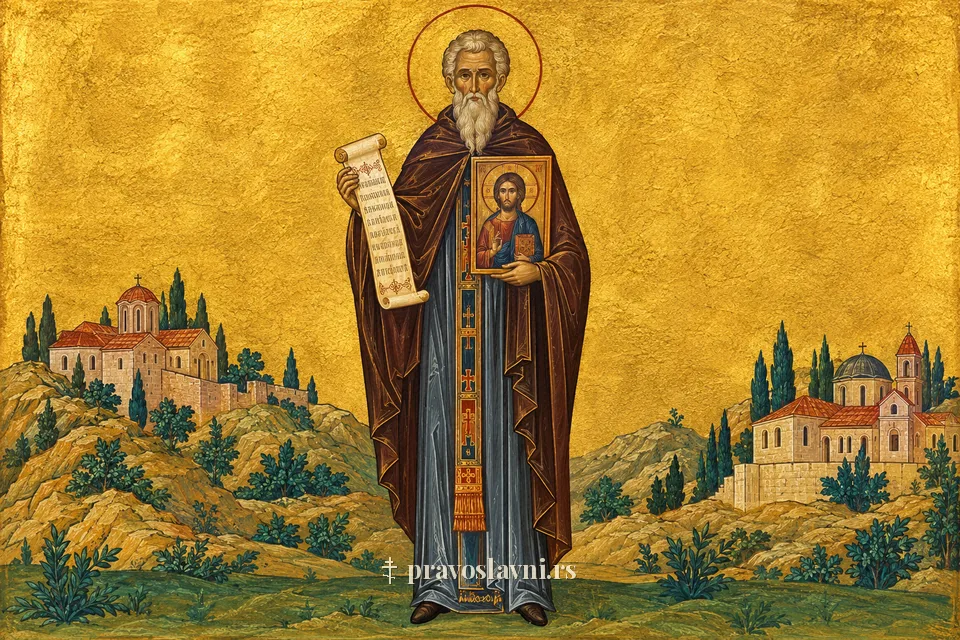
Illustration
Saint of the day
Venerable Martyr Stephen
What happenedAccording to his Life, St Stephen the New trod on a coin bearing the emperor's image in front of the iconoclast emperor, to show how much graver a sin it is to trample on the icons of Christ.
St Stephen the New was born in Constantinople, as a child of prayer. The Prologue and his Life record that his mother Anna prayed before the icon of the Theotokos at Blachernae and that the Theotokos promised her a son in a dream.
At the age of sixteen he was brought to the Mountain of St Auxentius in Bithynia, where the elder John tonsured him a monk. After John's death he stayed on in his cave and became the abbot of a brotherhood which kept growing. His Life says that he supported the monks by copying books.
At that time Emperor Constantine Copronymus was persecuting the monks, forcing people to renounce the icons, and without any election he had made the monk Constantine patriarch. The Life records that he sent Stephen gifts in order to win him over, but he refused them and said that he was ready to shed his blood for the icons. Then came slanders, and after them force as well: the monastery was burned down, and Stephen was held in chains for seventy days. Before the iconoclast bishops he did not give way. He was exiled to Proconnesus, where, as the Life says, he healed the sick and calmed storms.
In the end they brought him to Constantinople. The Life states that before the emperor he asked whose image was on the coin. The emperor said that it was his. Stephen then explained that trampling on the icons of Christ and of the Theotokos deserves a greater punishment than trampling on the emperor's image, and he trod on the coin.
The emperor threw him into prison. There he found 342 monks, mutilated on account of the icons, who even in prison lived by the monastic rule and chose Stephen as their teacher. There he spent eleven months. God revealed to him in advance the day of his death, and so he prepared himself for it by fasting and by taking his leave.
The Prologue records that death was brought to him by a heretic with the blow of a piece of wood, while the emperor's servants were leading him through the city. He suffered in the year 767, in the fifty-third year of his life.
St Stephen the New teaches us that the honour which is given to an icon passes over to the one who is painted on it. Neither gifts nor threats, neither exile nor prison separated him from the truth.
Full Life
A child promised at Blachernae
St Stephen the New lived at the time when the iconoclast emperors were burning icons and persecuting those who venerated them. He opposed them to the end and laid down his life for it.
His Life says that he was born in Constantinople, of devout parents who had two daughters but no son. The son, according to the Prologue and his Life, was obtained by the prayers of his mother Anna: before the Blachernae icon of the Theotokos she promised that she would dedicate the child to God, and the Theotokos promised her in a dream that she would have him. His Life adds that Patriarch Germanus foretold the birth and the name Stephen, and that he baptised him on Great and Holy Saturday.
The boy grew up studying the Holy Scriptures and the works of St John Chrysostom. At that time Emperor Leo the Isaurian turned against the icons. Patriarch Germanus was deposed, and Anastasius was brought in to take his place.
A monk on Mount Auxentius
When he was sixteen his parents brought him to Mount Auxentius in Bithynia, where the elder John tonsured him a monk. His Life records that the elder said of him: “Truly the Spirit of God rests upon this boy.” The elder also foresaw the future: thanks to Stephen the community would prosper, and he himself would never side with heresy.
According to his Life, after his father's death Stephen, having buried him, turned his father's property into alms for the poor. His mother and his sister Theodotia he settled in the women's monastery of Trichinaria, where they were tonsured. After the death of the elder John he remained in his cave and became the abbot of a brotherhood that kept growing. He supported the monks by copying books. At the age of forty-two he handed over the abbacy to Marinus and withdrew to a solitary cell without a roof.
Neither gifts nor threats
The new emperor, Constantine Copronymus, Leo's son, persecuted the monks and forced people to swear an oath against the icons. His Life says that icons were burned and whitewashed, and many monks fled to Stephen. The emperor also tried kindness, sending him delicacies through the patrician Callistus, but Stephen refused the gifts and said that he was ready to shed his blood for the icons.
When that too failed, the slanders began. His Life records that his disciple Sergius, having been bribed, wrote false accusations. The nun Anna, whom Stephen had tonsured, was accused of having sinned with him. Although they offered her rewards, she refused to lie. Before she was tortured she said: “Let the will of the Lord be done!”
As his Life says, the soldiers then burned the monastery on Mount Auxentius and took Stephen to the Monastery of Philippicus in Chrysopolis, where he spent seventy days in chains. Before the iconoclast bishops he said that their council was neither the seventh nor ecumenical, because the patriarchs had not been present at it and because it had rejected the earlier councils, which had been held in churches adorned with icons. After he had healed the sick abbot of that monastery, he was exiled to Proconnesus.
His Life records that on Proconnesus he lived in a cave, feeding on wild plants, and at the age of forty-nine he began to live on a pillar. The miracles which his Life connects with that island are numerous: ships saved from storms, a woman cured of an issue of blood, a young man freed from a demon, a blind man who received his sight. In the second year of his exile his mother died, and seven days after her his sister Theodotia as well.
A coin before the emperor
From exile he was brought back, in chains, to Constantinople and shut up in the Phiale prison. His Life says that before the emperor he defended the icons with the words of Scripture. He asked whose image was on the coin, as in the Gospel according to Matthew. The emperor said that it was his own. Stephen asked whether a man who trampled on that image would be punished. Then he said that trampling on the icons of Christ and of the Theotokos deserves a far heavier punishment, and he trampled on the coin.
The emperor sent him to the public prison. There were 342 monks there, gravely mutilated for the sake of the icons. Even in prison they kept the whole monastic order, and they chose Stephen as their teacher. He spent eleven months there.
God revealed his death to him forty days in advance. He foretold it, fasted and took leave of everyone. The Prologue records that in the end a heretic killed him with a blow from a piece of wood, while the emperor's servants were leading him through the city and stirring up the people against him as against an enemy of the emperor. He suffered, according to the Prologue, in the year 767, in the 53rd year of his life.
St Stephen the New taught that the honour shown to an icon passes to the one who is depicted on it, and for the sake of that truth he endured exile, prison and death.
Other saints of the day
Holy Martyr Irenarchus
St Irenarchus came from Sebaste. According to his Life, in his youth he worked as an executioner and tortured Christians whenever the persecutors ordered him to do so. Under Diocletian the ruler of Sebaste, Maximian, handed seven holy women over to torture, and their courage, before which the torturer was left put to shame, turned the life of Irenarchus around. Seized by grace, according to his Life, he declared in front of everyone that he too was a Christian. He was not killed either by the lake into which they threw him or by the red-hot furnace, where, his Life says, the power of God preserved him. He was beheaded in the year 303. The Church celebrates him together with the seven holy women, on 28 November according to the Julian calendar, that is, 11 December according to the Gregorian calendar. His life shows that the courage of others can awaken faith, for the torturer became a confessor as he watched the steadfastness of the women he was tormenting.
The holy martyr Christos grew and sold vegetables in Constantinople; by birth he was an Albanian, and by faith a Christian. Before the court a certain Turk, with whom he had a dispute, falsely accused him of going back on a promise to convert to Islam. Christos denied this. The interrogation — according to the Prologue accompanied by torture as well — ended in chains and prison. He even refused food in prison, with the words: “it is better that I should appear hungry before my Christ.” He also took care that prayers would be offered for his soul: the money he had he gave to a fellow sufferer, so that Liturgies would be served for him. The Turks beheaded him in the year 1748. His memory is celebrated on 28 November according to the Julian calendar, that is, 11 December according to the Gregorian calendar. He was an ordinary gardener, but he would not agree to deny Christ even in the face of a false accusation, and he prepared himself for death by fasting and by the prayer of the Church for his soul.