Save your slava — you'll get a reminder a week and a day before.
Sunday25April 202712 April (according to the Julian calendar)
Illustration
Great feast
Cveti — Palm Sunday (Entry of the Lord into Jerusalem)
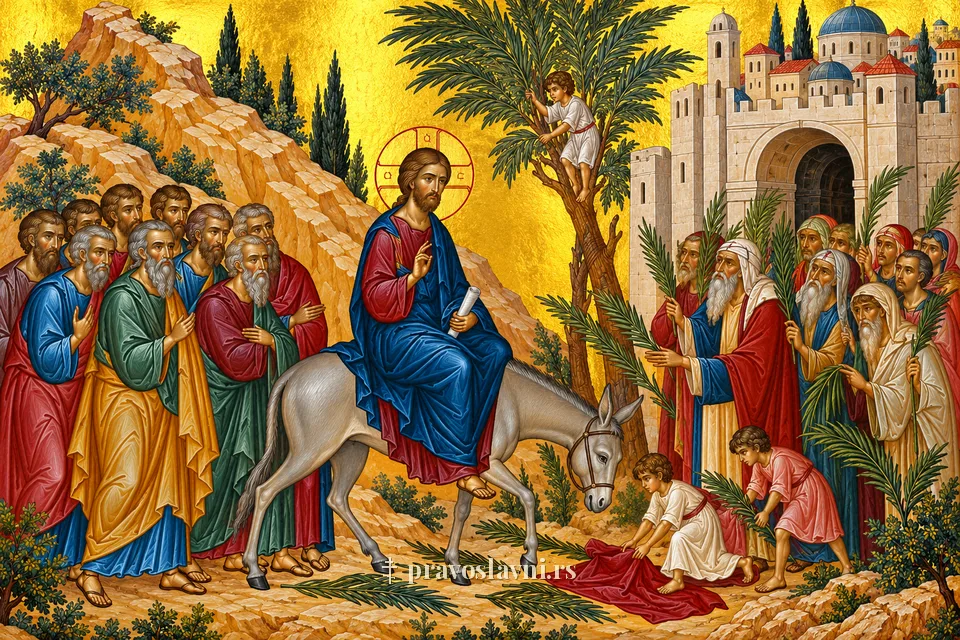
Entry of the Lord into Jerusalem
What happenedOn Cveti (Palm Sunday) the Church celebrates the solemn entry of the Lord Jesus Christ into Jerusalem, when the people welcomed Him with branches as King.
Sung at the Slava (family patron saint's feast), on Lazarus Saturday and on Palm Sunday.
Thou didst raise Lazarus from the dead, O Christ our God, making certain the universal resurrection, before thy Passion. For which cause we also, like unto the children, bearing the emblems of victory, cry aloud unto thee, the Conqueror of Death: Hosanna in the highest! Blessed is he that cometh in the Name of the Lord.
Once, people all over Serbia used to adorn themselves with flowers on that day. The willow blessed in church is, by custom, carried home and stands all year long beside the Slava icon (the icon of the family's patron saint) and the icon lamp. Customs differ from region to region. The people of Herzegovina, by custom, set off for church at dawn; in Popovo polje the day begins with decorating the stables and sheepfolds with spurge. In Šumadija the young meet at a crossroads or a playing field and exchange flowers with jokes and laughter, but there is no kolo (round dance) and no singing, because the fast is still going on. A young man, by custom, gives a girl a little posy in which every flower means something, and from it she reads what he feels. On the eve of the feast children and girls pick flowers, and each kind carries its own wish: cornel for strength, daisy for growth, violet for sweetness, willow for prosperity. In the morning the children wash their faces in water in which the flowers have spent the night outside, in the yard, and in some places a gold or silver ring is also put into that water. Among the people there is also a rule that from Cveti (Palm Sunday) to Duhovi (Pentecost) flowers are not picked.
Life
Cveti (Palm Sunday) is the feast of the solemn entry of the Lord Jesus Christ into Jerusalem, on the last Sunday before Vaskrs (Pascha), the day after Lazarus Saturday. As He was drawing near to the city, Jesus sent two of His disciples to bring a colt on which no one had ever yet sat. The disciples put their garments on it and the Lord sat on it, so that the prophecy about the King who comes in meekness might be fulfilled. Many spread their garments on the road, others cut branches and spread them before Him, and the people who had come for the feast went out to meet Him with palm branches. Those who went before Him and those who followed Him cried out: “Hosanna! Blessed is He who comes in the name of the Lord!” The people welcomed Him also because they had heard that He had raised Lazarus. Luke records that, when some of the Pharisees asked Him to silence the disciples who were praising God, He answered that if these were to keep silent, the stones would cry out. When He caught sight of the city, He wept over Jerusalem, which had not known the time of its visitation. In the Temple He drove out the traders and healed the blind and the lame, and the children cried out to Him.
Established in Jerusalem at the end of the 4th century, the feast is one of the twelve great feasts. It took its name from the branches; where there are no palms, willow is carried. The twigs are carried in procession on the eve of the feast, and at Matins they are blessed and sprinkled with Theophany water; the faithful then hold them together with a lighted candle. The canon of the feast was written by Cosmas the Melodist. Many households keep Cveti as their Krsna slava (family patron saint's day). In the joy of the feast the sorrow of the days that follow can already be glimpsed. The King enters His city meek, on a colt; the Church calls us to welcome Him with the joy of children and with the sobriety of those who know that the way of the King leads through the Cross.
Full Life
The King comes in meekness
As He drew near to Jerusalem, at Bethphage and Bethany, on the Mount of Olives, Jesus sent two of His disciples into the village opposite them to bring a colt on which no one had ever yet sat; if anyone asked them, they were to say that the Lord had need of it. The Evangelist Matthew records that by this the prophecy was fulfilled: tell the daughter of Zion, behold, your King is coming to you, lowly, and sitting on a donkey. The disciples laid their clothes on the animal and Jesus sat on it. “And many spread their clothes on the road, and others cut down leafy branches from the trees and spread them on the road.” (Mk 11:8)
Hosanna
Many who had come to the feast took palm branches and went out to meet Him. Those who went before Him and those who followed cried out: “Hosanna! Blessed is He who comes in the name of the Lord!” (Mk 11:9) John records that the people met Him also because they had heard that He had raised Lazarus, and those who had seen it bore witness. Luke records that at the descent of the Mount of Olives the whole multitude of the disciples praised God for the mighty works they had seen. When some of the Pharisees demanded that He silence them, the Lord answered: “I tell you that if these should keep silent, the stones would immediately cry out.” (Lk 19:40) The disciples did not understand at the time what was taking place; only when Jesus was glorified did they remember that this had been written about Him. The Pharisees said among themselves that they were accomplishing nothing, for the world was going after Him.
The weeping over the city and the cleansing of the Temple
When He drew near and saw the city, Jesus wept over it, because it had not known the things that made for its peace, and He foretold its destruction, because it had not known the time of its visitation. When He entered Jerusalem, the whole city was stirred, asking who this was, and the people answered that this was Jesus, the prophet from Nazareth of Galilee. In the Temple He drove out those who were selling and buying, saying that His house would be called a house of prayer, and He healed the blind and the lame. The children were crying out to the Son of David, and to the indignant chief priests He replied: “Out of the mouth of babes and nursing infants You have perfected praise?” (Mt 21:16) In the evening He went out of the city to Bethany.
A feast of joy before the Passion
The joy of this feast is not a carefree one: the faithful celebrate it gladly, and yet they know that days of sorrow come after it. Cveti (Palm Sunday) is one of the twelve great feasts and falls on the last Sunday before Pascha, the day after Lazarus Saturday. In Jerusalem the feast was established at the end of the fourth century, and its canon was written by Cosmas the Melodist of Jerusalem. The name of the feast comes from the branches which the people carried before Christ; in regions without palms those branches are replaced by willow. At Vespers on the eve of the feast the twigs are carried in procession, and at Matins, after the Fiftieth Psalm, the priest reads a special prayer over them and sprinkles them with Theophany water. The faithful then stand with willow and a lighted candle in their hands. At the Divine Liturgy the Gospel of John about the coming to Bethany and the entry into Jerusalem is read, and the Apostle Paul in his epistle exhorts: “Rejoice in the Lord always. Again I will say, rejoice!” (Phil 4:4) In many homes Cveti is the Krsna slava (family patron saint's day). On this feast Miloš Obrenović raised the Second Serbian Uprising beside the church in Takovo, and so in Serbia the day was also observed as a national holiday.
Other saints of the day
Venerable Basil the Confessor, Bishop of Parium
Basil, Bishop of Parium, is remembered for a signature which he would not give. He was required to put his name to an imperial document against the veneration of icons. His Life says that this was in the time of the iconoclast heresy, under the Emperor Leo the Isaurian, and that they tried to force him to sign. He did not yield.
The Prologue and his Life remember him as a man of virtue, and the Life adds that he was chosen as bishop of Parium, a city in Asia Minor under the Metropolitan of Cyzicus, because of his God-pleasing life. For his faithfulness to the icons he endured persecution and torture, and according to the Life his whole life was marked by afflictions. The Prologue says of him: “But he remained as firm in Orthodoxy as a diamond.” He reposed in the first half of the eighth century, having pleased God, according to the Life, in all things.