Sunday05April 202623 March (according to the Julian calendar)‹›
Illustration
Great feast
Cveti — Palm Sunday (Entry of the Lord into Jerusalem)
Entry of the Lord into Jerusalem
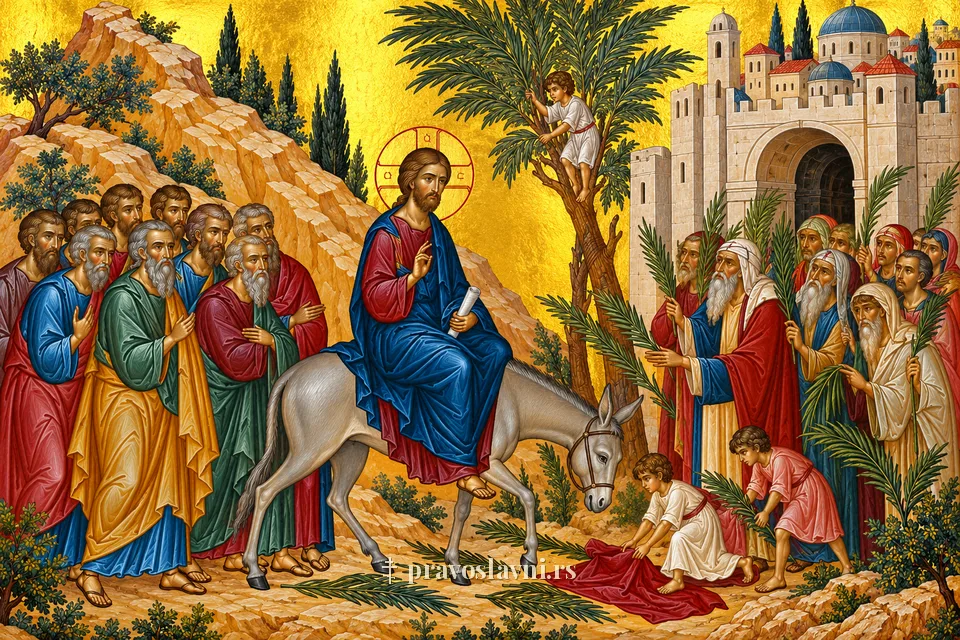
What happenedOn Cveti (Palm Sunday) the Church celebrates the solemn entry of the Lord Jesus Christ into Jerusalem, when the people welcomed Him with branches as King.
Sung at the Slava (family patron saint's feast), on Lazarus Saturday and on Palm Sunday.
Thou didst raise Lazarus from the dead, O Christ our God, making certain the universal resurrection, before thy Passion. For which cause we also, like unto the children, bearing the emblems of victory, cry aloud unto thee, the Conqueror of Death: Hosanna in the highest! Blessed is he that cometh in the Name of the Lord.
Cveti — Palm Sunday (Entry of the Lord into Jerusalem)
Once, people all over Serbia used to adorn themselves with flowers on that day. The willow blessed in church is, by custom, carried home and stands all year long beside the Slava icon (the icon of the family's patron saint) and the icon lamp. Customs differ from region to region. The people of Herzegovina, by custom, set off for church at dawn; in Popovo polje the day begins with decorating the stables and sheepfolds with spurge. In Šumadija the young meet at a crossroads or a playing field and exchange flowers with jokes and laughter, but there is no kolo (round dance) and no singing, because the fast is still going on. A young man, by custom, gives a girl a little posy in which every flower means something, and from it she reads what he feels. On the eve of the feast children and girls pick flowers, and each kind carries its own wish: cornel for strength, daisy for growth, violet for sweetness, willow for prosperity. In the morning the children wash their faces in water in which the flowers have spent the night outside, in the yard, and in some places a gold or silver ring is also put into that water. Among the people there is also a rule that from Cveti (Palm Sunday) to Duhovi (Pentecost) flowers are not picked.
Cveti (Palm Sunday) is the feast of the solemn entry of the Lord Jesus Christ into Jerusalem, on the last Sunday before Vaskrs (Pascha), the day after Lazarus Saturday. As He was drawing near to the city, Jesus sent two of His disciples to bring a colt on which no one had ever yet sat. The disciples put their garments on it and the Lord sat on it, so that the prophecy about the King who comes in meekness might be fulfilled. Many spread their garments on the road, others cut branches and spread them before Him, and the people who had come for the feast went out to meet Him with palm branches. Those who went before Him and those who followed Him cried out: “Hosanna! Blessed is He who comes in the name of the Lord!” The people welcomed Him also because they had heard that He had raised Lazarus. Luke records that, when some of the Pharisees asked Him to silence the disciples who were praising God, He answered that if these were to keep silent, the stones would cry out. When He caught sight of the city, He wept over Jerusalem, which had not known the time of its visitation. In the Temple He drove out the traders and healed the blind and the lame, and the children cried out to Him.
Established in Jerusalem at the end of the 4th century, the feast is one of the twelve great feasts. It took its name from the branches; where there are no palms, willow is carried. The twigs are carried in procession on the eve of the feast, and at Matins they are blessed and sprinkled with Theophany water; the faithful then hold them together with a lighted candle. The canon of the feast was written by Cosmas the Melodist. Many households keep Cveti as their Krsna slava (family patron saint's day). In the joy of the feast the sorrow of the days that follow can already be glimpsed. The King enters His city meek, on a colt; the Church calls us to welcome Him with the joy of children and with the sobriety of those who know that the way of the King leads through the Cross.
Full Life
The King comes in meekness
As He drew near to Jerusalem, at Bethphage and Bethany, on the Mount of Olives, Jesus sent two of His disciples into the village opposite them to bring a colt on which no one had ever yet sat; if anyone asked them, they were to say that the Lord had need of it. The Evangelist Matthew records that by this the prophecy was fulfilled: tell the daughter of Zion, behold, your King is coming to you, lowly, and sitting on a donkey. The disciples laid their clothes on the animal and Jesus sat on it. “And many spread their clothes on the road, and others cut down leafy branches from the trees and spread them on the road.” (Mk 11:8)
Hosanna
Many who had come to the feast took palm branches and went out to meet Him. Those who went before Him and those who followed cried out: “Hosanna! Blessed is He who comes in the name of the Lord!” (Mk 11:9) John records that the people met Him also because they had heard that He had raised Lazarus, and those who had seen it bore witness. Luke records that at the descent of the Mount of Olives the whole multitude of the disciples praised God for the mighty works they had seen. When some of the Pharisees demanded that He silence them, the Lord answered: “I tell you that if these should keep silent, the stones would immediately cry out.” (Lk 19:40) The disciples did not understand at the time what was taking place; only when Jesus was glorified did they remember that this had been written about Him. The Pharisees said among themselves that they were accomplishing nothing, for the world was going after Him.
The weeping over the city and the cleansing of the Temple
When He drew near and saw the city, Jesus wept over it, because it had not known the things that made for its peace, and He foretold its destruction, because it had not known the time of its visitation. When He entered Jerusalem, the whole city was stirred, asking who this was, and the people answered that this was Jesus, the prophet from Nazareth of Galilee. In the Temple He drove out those who were selling and buying, saying that His house would be called a house of prayer, and He healed the blind and the lame. The children were crying out to the Son of David, and to the indignant chief priests He replied: “Out of the mouth of babes and nursing infants You have perfected praise?” (Mt 21:16) In the evening He went out of the city to Bethany.
A feast of joy before the Passion
The joy of this feast is not a carefree one: the faithful celebrate it gladly, and yet they know that days of sorrow come after it. Cveti (Palm Sunday) is one of the twelve great feasts and falls on the last Sunday before Pascha, the day after Lazarus Saturday. In Jerusalem the feast was established at the end of the fourth century, and its canon was written by Cosmas the Melodist of Jerusalem. The name of the feast comes from the branches which the people carried before Christ; in regions without palms those branches are replaced by willow. At Vespers on the eve of the feast the twigs are carried in procession, and at Matins, after the Fiftieth Psalm, the priest reads a special prayer over them and sprinkles them with Theophany water. The faithful then stand with willow and a lighted candle in their hands. At the Divine Liturgy the Gospel of John about the coming to Bethany and the entry into Jerusalem is read, and the Apostle Paul in his epistle exhorts: “Rejoice in the Lord always. Again I will say, rejoice!” (Phil 4:4) In many homes Cveti is the Krsna slava (family patron saint's day). On this feast Miloš Obrenović raised the Second Serbian Uprising beside the church in Takovo, and so in Serbia the day was also observed as a national holiday.
Other saints of the day
Hieromartyr Nikon and those with him
Nikon was a soldier twice over: first a Roman officer, a native of Naples, and then an ascetic of Christ and a bishop, whom his former comrades from the army also followed.
The turning point came in a battle. His unit found itself surrounded, and he, on the advice of his Christian mother, protected himself with the sign of the cross and called upon Christ. The enemy, as the Prologue and his Life record, was routed, and Nikon came back with the cry: “Great is the God of the Christians!”
From then on he lived for Christ. He sailed away in secret and received baptism from Theodosius, Bishop of Cyzicus, with whom he stayed in the monastery, devoted to books and to the ascetic life. Since it had been revealed to him in a vision that Nikon was to succeed him, Theodosius led him through all the ranks of the priesthood up to that of bishop. When he returned to Naples, he found his mother still alive, and nine of his former comrades from the army joined him. With them he crossed over to Sicily and, according to the Prologue, preached the Gospel; his Life says that the monks whom Theodosius had entrusted to him were with him as well.
Quintian, the governor of Sicily, in the reign of Decius, arrested them all. The monks, according to the Life, confessed: “We are Christians, and we shall never abandon our faith,” and all of them were put to death by the sword — one hundred and ninety-nine in all. Nikon was tortured in many ways, and his Life says that an angel visited him in prison with the words: “Be valiant in God, Nikon, soldier of Christ, and rejoice.” In the end he was beheaded, and his body was left in a field. The Life adds that Quintian perished soon afterwards, drowning in a river, as Nikon had foretold to him.
The last testimony came through a boy. An unclean spirit left a certain shepherd boy when he fell upon the martyr's body, and the boy's story brought the Christians to bury Nikon with honour. According to the Life, his disciples were buried then as well.
The life of St Nikon shows that the quiet faith of a mother can bear great fruit: a soldier saved by the sign of the cross became a soldier of Christ and, together with his disciples, chose to give up his life rather than renounce the faith.