Holy Week
Great and Holy Wednesday
What happenedThe Church devotes Great and Holy Wednesday to the sinful woman who anointed the Lord with myrrh in Bethany, and to Judas's betrayal of the Teacher for thirty pieces of silver.
Read the LifeOrthodox Calendar · 26 March according to the Julian calendar
Wednesday, 8 April 202626 March (according to the Julian calendar)What happenedThe Church devotes Great and Holy Wednesday to the sinful woman who anointed the Lord with myrrh in Bethany, and to Judas's betrayal of the Teacher for thirty pieces of silver.
Read the Life
No meat, dairy products, eggs or fish — oil and wine are allowed.
This is a recommendation — for your own fast, consult your priest or spiritual father.Prayer of St Ephraim the Syrian →More about the fast →
Great and Holy Wednesday – Holy Week; Leavetaking of the Annunciation
More about the feast →
“Assuredly, I say to you, wherever this gospel is preached in the whole world, what this woman has done will also be told as a memorial to her.”
— Mk 14:9Great and Holy Wednesday, the third day of Holy Week, is spent in fasting like the whole of this week; Wednesday is in any case a fasting day dedicated to Christ's passion. On this day prostrations are made in church for the last time. When the Liturgy of the Presanctified Gifts is finished, the priest reads the prayer of St Ephraim the Syrian for the last time, and the faithful make three prostrations; from then on prostrations are no longer made in church. The Hours do not have the usual dismissal either: instead of it the priest reads the prayer “O Master, great in mercy”, while the people bow down to the ground. At the Hours the Four Gospels continue to be read, as on the first two days of the week, and until Great and Holy Thursday “Thy bridal chamber” is sung. In the evening there is Great Compline, at which the priests serve in black vestments.
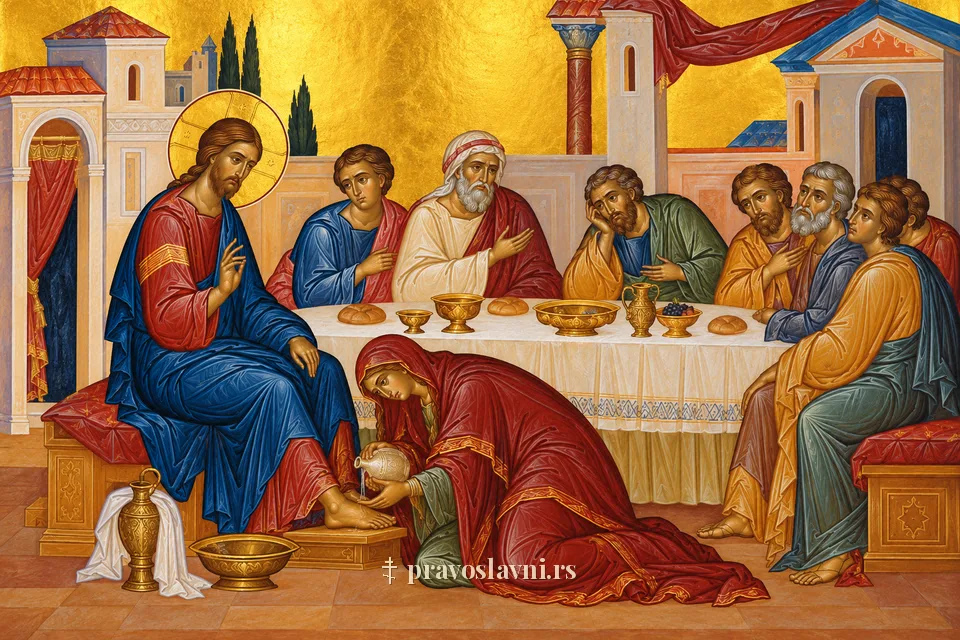
Great and Holy Wednesday is the third day of Holy Week. At the centre of this day are two people: the sinful woman, who poured myrrh on the Lord in the house of Simon the leper in Bethany, and Judas, whose betrayal followed after that. The hymns of this day set the repentant woman and the traitor disciple over against each other. Two days before the Passover the chief priests and the elders were consulting together in the court of Caiaphas how they might take Jesus by trickery and kill Him. While the Lord was sitting at table, a woman came up to Him with an alabaster flask of costly myrrh of pure nard, broke the flask and poured the myrrh on His head. Some were indignant that the myrrh had not been sold and the money given to the poor, and according to the Synaxarion it was Judas who reproached her most of all. Jesus defended her: “She has done what she could. She has come beforehand to anoint My body for burial.” He promised that what she had done would be spoken of everywhere that the Gospel is preached.
Then Judas Iscariot, one of the Twelve, went to the chief priests and asked what they would give him to betray Him to them, and they weighed out for him thirty pieces of silver. From then on he sought an opportunity to betray the Teacher. According to the Synaxarion, Christ, by speaking of His own burial, was trying to turn him away from it.
Great and Holy Wednesday is the day of the last prostrations in church: the prayer of St Ephraim the Syrian, with three prostrations, is read at the end of the Liturgy of the Presanctified Gifts for the last time. The Hours do not end with the usual dismissal, but with the prayer “O Master, plenteous in mercy”, while the faithful bow down to the ground. In Bethany two people meet: a woman who out of love and repentance gives everything, and a disciple who sells his Teacher. The day asks which of those two our own heart resembles, and reminds us that it is not yet too late to choose the way of the woman.
Two figures stand at the centre of Great and Holy Wednesday: the sinful woman, who in Bethany, in the house of Simon the leper, poured myrrh upon the Lord, and Judas, who after that went off to betray Him. The hymns of this day set the repentant woman and the traitor disciple over against each other. The Synaxarion of Holy Week records that the commemoration of the woman who anointed Christ before His Passion is the work of the holy fathers.
Two days before the Passover, Jesus said that the Son of Man would be delivered up to be crucified. The chief priests, the scribes and the elders assembled in the court of the high priest Caiaphas and plotted to take Jesus by trickery and kill Him, but not during the feast, lest the people rise in an uproar. In Bethany, in the house of Simon the leper, as He sat at table, a woman came to Him with an alabaster flask of costly oil of pure spikenard, broke the flask and poured the oil on His head. The Synaxarion also explains why she came: if Christ does not shun the house of a leper, she thought, He will heal the sickness of her soul as well. Some were indignant at the waste, saying that the oil might have been sold for more than three hundred denarii and given to the poor. The disciples rebuked her, and according to the Synaxarion Judas most of all. Jesus said: “Let her alone. Why do you trouble her? She has done a good work for Me.” (Mk 14:6) And further: “She has done what she could. She has come beforehand to anoint My body for burial.” (Mk 14:8) He promised that her deed would be spoken of wherever the Gospel is preached.
According to the Synaxarion, which follows St John Chrysostom, the sinful woman of the Gospels of Matthew and Mark anointed Christ's head two days before the Passover, while Mary, the sister of Lazarus, who was not a sinner, anointed His feet six days before the Passover. These are two different women and two suppers in Bethany.
In speaking of His burial, Christ, according to the Synaxarion, was trying to turn Judas away from the betrayal. “Then Judas Iscariot, one of the twelve, went to the chief priests to betray Him to them.” (Mk 14:10) He asked them: “What are you willing to give me if I deliver Him to you? And they counted out to him thirty pieces of silver.” (Mt 26:15) They were glad and promised him money, and from then on he sought a convenient opportunity to betray Him.
Great and Holy Wednesday is the day when prostrations are made in church for the last time: at the end of the Liturgy of the Presanctified Gifts, with three prostrations, the Prayer of St Ephraim the Syrian is read for the last time, and from then on prostrations are no longer made. Nor do the Hours on that day end with the usual dismissal: instead of it the priest reads the prayer “O Master, plenteous in mercy”, and the faithful bow down to the ground. At the Hours, as on the first two days of the week, the reading of the four Gospels continues. In the evening Great Compline is served, in black vestments.
Why was it Gabriel who was sent to the Virgin Mary in Nazareth? His Life answers that his ministry is to reveal the mysteries of God, and the Incarnation of the Son of God was a mystery so great that it was fitting for one of the highest angels to announce it. Michael, according to the Life, was not sent because that was not his ministry.
The Prologue and the Life number him among the seven highest archangels, who stand by the throne of God. The Life puts him in second place, after Michael. All of them have their own ministry and, according to the Prologue, equal honour: Michael defeats the enemies of God's faith, and Gabriel proclaims the good news of salvation. The holy fathers number him in the highest rank, among the seraphim. According to St Dionysius the Areopagite, as the Life states, the seven archangels always stand before God, and to them the highest mysteries are entrusted.
He is the messenger of God's mysteries even before the Annunciation. The Life records that he revealed to the Prophet Daniel the deliverance of the people from Babylon and the time of the Messiah's coming. To Zacharias he announced the birth of the Forerunner and told him that he stands in the presence of God (Lk 1:19). And in the sixth month he was sent to Nazareth, where he told the Virgin that She would give birth to the Son of God (Lk 1:26–38). Some, according to both sources, also hold that he announced the birth of the Virgin to Joachim and Anna. The Life also recalls the words of Scripture about the spirits who are sent forth to minister (Heb 1:14).
His name, according to the Life, means the power of God, or God and man, and foreshadows in advance that the mighty God would become perfect man in the womb of the Virgin. According to the Prologue, the name Gabriel means man – God. St Proclus of Constantinople, as the Life states, says that the name itself portrayed the One who was to come.
The Church, as the Life says, dedicates the first day after the Annunciation to the synaxis of the Archangel Gabriel. The Life compares this feast with the honour that people show to the envoy of their ruler: Gabriel brought the news of salvation, and so the Church honours him with a special feast.
The feast teaches us to honour the messenger together with the message. The angels stand before God, and they are sent to serve those who are to be saved.
St Irenaeus, Bishop of Sirmium (Srem), suffered in the year 304, while Maximian was emperor. According to the Prologue, it is thought that he was a Slav by origin, and before he became a bishop he had a wife and children. For that reason his temptation did not come only from the persecutors: those closest to him begged him in tears to abandon the faith and so to spare both himself and them. Irenaeus did not give way. The Prologue stresses that suffering for Christ was dearer to him than anything this world can offer. Because of this steadfastness the governor of the city condemned him to death: he was thrown from a bridge into the Sava, and there he met his end. Thus the Bishop of Srem bore witness that faithfulness to Christ stands above one's kin and above life itself.