Wednesday28April 202715 April (according to the Julian calendar)
Illustration
Holy Week
Great and Holy Wednesday
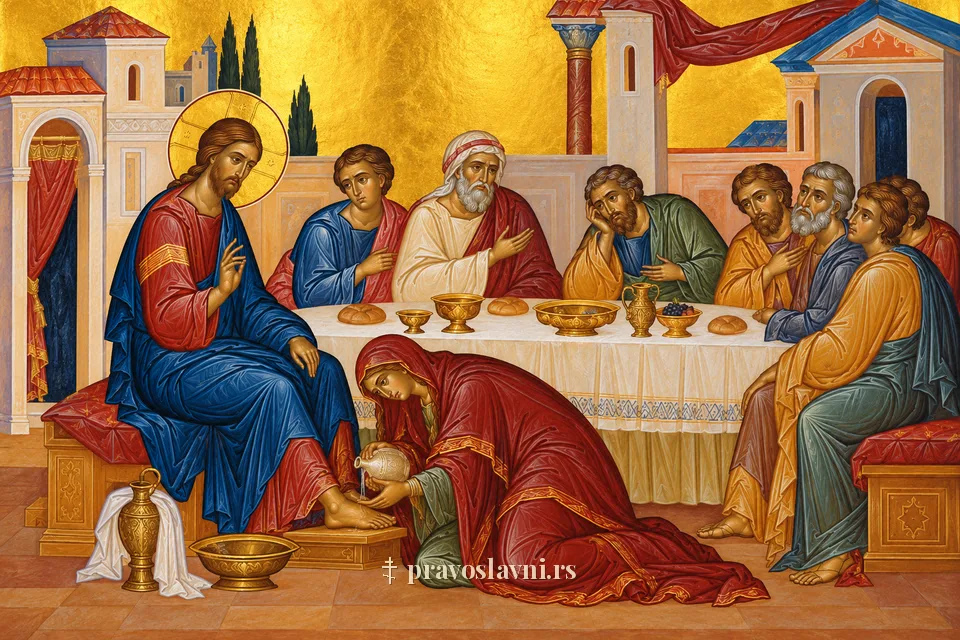
What happenedThe Church devotes Great and Holy Wednesday to the sinful woman who anointed the Lord with myrrh in Bethany, and to Judas's betrayal of the Teacher for thirty pieces of silver.
“Assuredly, I say to you, wherever this gospel is preached in the whole world, what this woman has done will also be told as a memorial to her.”
— Mk 14:9
About this day
Great and Holy Wednesday, the third day of Holy Week, is spent in fasting like the whole of this week; Wednesday is in any case a fasting day dedicated to Christ's passion. On this day prostrations are made in church for the last time. When the Liturgy of the Presanctified Gifts is finished, the priest reads the prayer of St Ephraim the Syrian for the last time, and the faithful make three prostrations; from then on prostrations are no longer made in church. The Hours do not have the usual dismissal either: instead of it the priest reads the prayer “O Master, great in mercy”, while the people bow down to the ground. At the Hours the Four Gospels continue to be read, as on the first two days of the week, and until Great and Holy Thursday “Thy bridal chamber” is sung. In the evening there is Great Compline, at which the priests serve in black vestments.
Life
Great and Holy Wednesday is the third day of Holy Week. At the centre of this day are two people: the sinful woman, who poured myrrh on the Lord in the house of Simon the leper in Bethany, and Judas, whose betrayal followed after that. The hymns of this day set the repentant woman and the traitor disciple over against each other. Two days before the Passover the chief priests and the elders were consulting together in the court of Caiaphas how they might take Jesus by trickery and kill Him. While the Lord was sitting at table, a woman came up to Him with an alabaster flask of costly myrrh of pure nard, broke the flask and poured the myrrh on His head. Some were indignant that the myrrh had not been sold and the money given to the poor, and according to the Synaxarion it was Judas who reproached her most of all. Jesus defended her: “She has done what she could. She has come beforehand to anoint My body for burial.” He promised that what she had done would be spoken of everywhere that the Gospel is preached.
Then Judas Iscariot, one of the Twelve, went to the chief priests and asked what they would give him to betray Him to them, and they weighed out for him thirty pieces of silver. From then on he sought an opportunity to betray the Teacher. According to the Synaxarion, Christ, by speaking of His own burial, was trying to turn him away from it.
Great and Holy Wednesday is the day of the last prostrations in church: the prayer of St Ephraim the Syrian, with three prostrations, is read at the end of the Liturgy of the Presanctified Gifts for the last time. The Hours do not end with the usual dismissal, but with the prayer “O Master, plenteous in mercy”, while the faithful bow down to the ground. In Bethany two people meet: a woman who out of love and repentance gives everything, and a disciple who sells his Teacher. The day asks which of those two our own heart resembles, and reminds us that it is not yet too late to choose the way of the woman.
Full Life
The woman and the disciple
Two figures stand at the centre of Great and Holy Wednesday: the sinful woman, who in Bethany, in the house of Simon the leper, poured myrrh upon the Lord, and Judas, who after that went off to betray Him. The hymns of this day set the repentant woman and the traitor disciple over against each other. The Synaxarion of Holy Week records that the commemoration of the woman who anointed Christ before His Passion is the work of the holy fathers.
The anointing in Bethany
Two days before the Passover, Jesus said that the Son of Man would be delivered up to be crucified. The chief priests, the scribes and the elders assembled in the court of the high priest Caiaphas and plotted to take Jesus by trickery and kill Him, but not during the feast, lest the people rise in an uproar. In Bethany, in the house of Simon the leper, as He sat at table, a woman came to Him with an alabaster flask of costly oil of pure spikenard, broke the flask and poured the oil on His head. The Synaxarion also explains why she came: if Christ does not shun the house of a leper, she thought, He will heal the sickness of her soul as well. Some were indignant at the waste, saying that the oil might have been sold for more than three hundred denarii and given to the poor. The disciples rebuked her, and according to the Synaxarion Judas most of all. Jesus said: “Let her alone. Why do you trouble her? She has done a good work for Me.” (Mk 14:6) And further: “She has done what she could. She has come beforehand to anoint My body for burial.” (Mk 14:8) He promised that her deed would be spoken of wherever the Gospel is preached.
According to the Synaxarion, which follows St John Chrysostom, the sinful woman of the Gospels of Matthew and Mark anointed Christ's head two days before the Passover, while Mary, the sister of Lazarus, who was not a sinner, anointed His feet six days before the Passover. These are two different women and two suppers in Bethany.
The betrayal
In speaking of His burial, Christ, according to the Synaxarion, was trying to turn Judas away from the betrayal. “Then Judas Iscariot, one of the twelve, went to the chief priests to betray Him to them.” (Mk 14:10) He asked them: “What are you willing to give me if I deliver Him to you? And they counted out to him thirty pieces of silver.” (Mt 26:15) They were glad and promised him money, and from then on he sought a convenient opportunity to betray Him.
The services
Great and Holy Wednesday is the day when prostrations are made in church for the last time: at the end of the Liturgy of the Presanctified Gifts, with three prostrations, the Prayer of St Ephraim the Syrian is read for the last time, and from then on prostrations are no longer made. Nor do the Hours on that day end with the usual dismissal: instead of it the priest reads the prayer “O Master, plenteous in mercy”, and the faithful bow down to the ground. At the Hours, as on the first two days of the week, the reading of the four Gospels continues. In the evening Great Compline is served, in black vestments.
Other saints of the day
Holy Apostles Aristarchus, Pudens and Trophimus
Aristarchus, Pudens and Trophimus were fellow workers of the Apostle Paul, and the Prologue numbers them among the Seventy Apostles. Each of them has left a trace in Holy Scripture, in the Epistles and in the Acts of the Apostles.
Trophimus was from Asia (Acts 20:4) and accompanied Paul on his journeys. The Apostle records that he left him sick in Miletus; the verse, as the Prologue quotes it, reads: “Trophimus I have left in Miletus sick” (2 Tim 4:20).
Aristarchus shared both danger and chains with Paul. The Prologue says that in Ephesus he was seized, together with Gaius, by the people who had risen up against the Apostle (Acts 19:29), and in the Epistle to the Colossians Paul sends a greeting from him; the verse, as the Prologue quotes it, reads: “Aristarchus my fellow prisoner greets you” (Col 4:10). Aristarchus became bishop of Apamea in Syria.
Pudens, a distinguished Roman citizen whom Paul mentions in the Second Epistle to Timothy (2 Tim 4:21), opened his home to the chief apostles. That house in Rome later became a church, called “the Shepherd's Church”, and the Life says that it is told how the Apostle Peter himself served in it.
All three were beheaded in Nero's persecution, when Paul too was put to death. They stayed with the Apostle in his labours, in prison and in sickness, and with him they also shared martyrdom.
Holy Martyr Sabbas the Goth
Sabbas was a Goth and lived in the land of the Goths at a time of fierce persecution of Christians. His Life, which begins as a letter from the Church of Gothia to the Church in Cappadocia, describes him as a meek, humble and truth-loving man, modest in speech and yet wise, who fasted, prayed, sang in church and took care of it. When the Gothic princes were forcing Christians to eat what had been sacrificed to idols, Sabbas refused and taught that anyone who eats it cannot be a Christian, and so, according to the Life, he was driven out of the village and later allowed to come back. When a certain prince came to the village and asked whether there were any Christians, the villagers swore that there were none, but Sabbas stood before the prince and, according to the Life, said: “Let no one swear on my behalf; I am a Christian.” Since Sabbas, as the Life says, owned nothing except the clothes he was wearing, the prince dismissed him with the words: “That one can neither be of any use nor do any harm.” The following year the priest Sansalas came to him, and Sabbas celebrated the feast with him. The pagans burst into the house, seized them both and beat them, and then tied them to a tree and offered them meat sacrificed to idols. Both of them refused, and Sabbas, according to the Life, said: “There is one Master — God, who is in heaven.” He received the sentence with joy and praised God all the way to the place of execution, and the Prologue records that the soldiers, seeing how good he was, were ready to let him go, but Sabbas reminded them that the order had to be carried out. They drowned him in a river — the Life calls it the Musaeus — with a stone around his neck, and his body was cast up on the bank. He suffered in the year 372 — according to the Prologue in his thirty-first year, and according to the Life he was thirty-eight years old. The Prologue adds that his body was later translated to Cappadocia.