Holy Week
Great and Holy Monday
What happenedThe Church devotes Great and Holy Monday to the memory of the chaste Joseph, whom his envious brothers sold to the Ishmaelites, and of the barren fig tree which the Lord cursed.
Read the LifeOrthodox Calendar · 24 March according to the Julian calendar
Monday, 6 April 202624 March (according to the Julian calendar)What happenedThe Church devotes Great and Holy Monday to the memory of the chaste Joseph, whom his envious brothers sold to the Ishmaelites, and of the barren fig tree which the Lord cursed.
Read the Life
No meat, dairy products, eggs, fish or oil — food cooked in water.
This is a recommendation — for your own fast, consult your priest or spiritual father.Prayer of St Ephraim the Syrian →More about the fast →
Great and Holy Monday – Holy Week; Forefeast of the Annunciation
More about the feast →
“In response Jesus said to it, ”Let no one eat fruit from you ever again.” And His disciples heard it.“
— Mk 11:14Great and Holy Monday, Tuesday and Wednesday are the first days of Holy Week, which, like Great Lent before it, is spent in fasting. The service of Great and Holy Monday remembers the chaste Joseph and the barren fig tree. During the first three days of the week the whole of the Four Gospels is gone through at the Hours, reading by reading, nine sections in all, up to the words that now the Son of Man is glorified. After the Hours the Liturgy of the Presanctified Gifts is served. At it, on Monday, the Gospel is read in which the Lord warns of false prophets and of love that grows cold, and promises salvation to the one who endures to the end. The day in church begins already on the eve, with Matins served in the evening, with the troparion “Behold, the Bridegroom”, and ends with Small Compline, at which a three-ode canon from the Lenten Triodion is sung. Until Great and Holy Thursday “Thy bridal chamber” is sung as well.
Great and Holy Monday is the first day of Holy Week. On that day the Church commemorates the chaste Joseph, in whom the divine services see a prefiguration of Christ, and the barren fig tree which the Lord cursed. Jacob, who was called Israel, loved Joseph more than his other sons, because he had been born to him in his old age, and he made him a coat of many colours. His brothers came to hate him, and the dreams in which their sheaves bowed down to his sheaf only made their envy stronger. When their father sent Joseph to them, they wanted to kill him; Reuben dissuaded them, and so they threw him into an empty pit. At Judah's suggestion they sold him to the Ishmaelites for twenty pieces of silver, and to their father they sent the coat dipped in the blood of a kid. Jacob mourned his son for a long time, and in Egypt Joseph was sold to Potiphar, the captain of Pharaoh's guard.
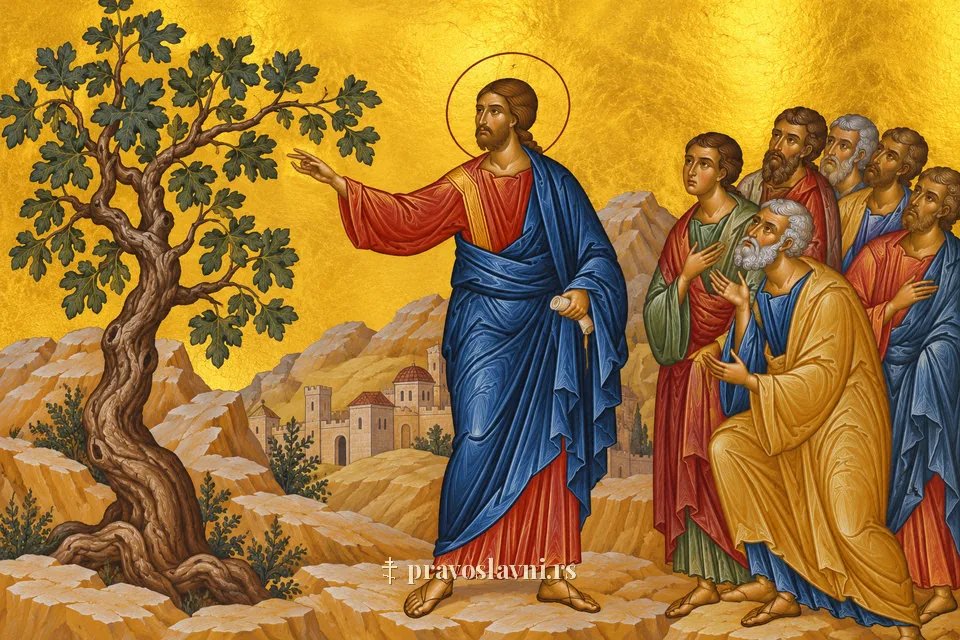
On that day the Church also remembers the fig tree which the Lord cursed. In the morning, after the entry into Jerusalem, Jesus was hungry and went up to a fig tree full of leaves, but He found nothing on it except leaves. He said to it: “Let no one eat fruit from you ever again!” The fig tree withered away from the roots, and the Lord told His disciples that one who believes and does not doubt can even move a mountain. The fig tree with leaves but without fruit is a warning that God looks for fruit, and not only for outward appearance.
Over the first three days of the week the whole of the four Gospels is read through at the Hours, and after them the Liturgy of the Presanctified Gifts is served; until Great and Holy Thursday “Thy Bridal Chamber” is sung. Monday begins in church already on the evening before, with Matins and the troparion “Behold, the Bridegroom”. Holy Week calls us to fruit, and not to leaves.
Great and Holy Monday, Tuesday and Wednesday are the first days of Holy Week. On this day the Church has two images before her eyes: the chaste Joseph, betrayed by his own brothers, in whom the services see a prefiguration of Christ, and the barren fig tree, which the Lord cursed.
Jacob, who was also called Israel, loved Joseph more than all his sons. “Now Israel loved Joseph more than all his children, because he was the son of his old age. Also he made him a tunic of many colors.” (Gen 37:3) Because of this his brothers came to hate him and could not speak peaceably to him. Joseph dreamed that their sheaves were bowing down to his sheaf, and that the sun, the moon and eleven stars were bowing down to him. “And his brothers envied him, but his father kept the matter in mind.” (Gen 37:11)
His father sent Joseph to his brothers, who were pasturing the flock, and he found them near Dothan. When they saw him from afar, they agreed to kill him and to say that a wild beast had torn him to pieces. Reuben persuaded them not to kill him, but to throw him into a pit, intending to rescue him. They stripped him of his tunic and threw him into an empty pit. Then Judah proposed that they should sell him instead of killing him, and they pulled Joseph out and sold him to the Ishmaelites for twenty pieces of silver, and they took him away to Egypt. The brothers dipped his tunic in the blood of a young goat and sent it to their father. Jacob thought that a wild beast had torn him to pieces, tore his clothes and mourned for him a long time, refusing to be comforted. In Egypt Joseph was sold to Potiphar, an officer of Pharaoh and captain of the guard.
In the morning, after the entry into Jerusalem, as He was returning to the city, Jesus was hungry. “And seeing from afar a fig tree having leaves, He went to see if perhaps He would find something on it. When He came to it, He found nothing but leaves, for it was not the season for figs.” (Mk 11:13) Then He said: “Let no one eat fruit from you ever again.” (Mk 11:14) The disciples heard it. “Now in the morning, as they passed by, they saw the fig tree dried up from the roots.” (Mk 11:20) Peter said to the Teacher that the fig tree which He had cursed had withered away, and Jesus answered that whoever has faith and does not doubt can move even a mountain, and that he will receive everything he asks for in prayer with faith. The fig tree full of leaves, yet without fruit, is a warning that God seeks fruit from a person, and not merely an outward appearance.
All of the first three days of Holy Week are linked by a common thread: at the Third, Sixth and Ninth Hours the whole of the four Gospels is read through, in nine readings. After the Hours comes the Liturgy of the Presanctified Gifts, and until Great and Holy Thursday “Thy Bridal Chamber” is sung. Matins of Monday begins as early as the previous evening, with the troparion “Behold, the Bridegroom”, and Compline is the Small Compline, with a three-ode canon from the Lenten Triodion.
What does it mean to be a monk? This is what the young Zacharias was asked by both Abba Macarius and Abba Moses, elders of the desert of Scetis. To Macarius, according to the Prologue, he answered that a monk is one who constantly strives to fulfil the commandments of God. Before Moses he took off his monastic cowl, trampled it underfoot and said: “If a man does not crush himself like this, he cannot be a monk!”
The older monks wanted to learn from the younger one. Both sources record that Zacharias, although younger than many, received more grace than many among them. His Life explains that the elders sought his instruction because they knew that the Holy Spirit was with him.
He was brought to the desert while still a boy by his father, Carion the Egyptian. The Prologue explains why the boy ended up in the desert: Carion had left his home for the sake of the monastic life, and took his son in only when the mother was left without the means to feed him. His Life records that Zacharias too became a monk in Scetis. Carion himself, according to the Life, admitted that he had laboured more than his son and yet had not reached his son's measure; he ascribed that height to humility and silence.
Silence marked his end as well. To Abba Moses' question as to what he saw, the dying man, according to the Life, replied by asking whether it was not better to keep silent. The Life also says that Abba Isidore, who was beside him at the hour of his death, declared that the gates of the Kingdom of Heaven had opened to him. The Prologue numbers him among the most radiant monks of the desert and records that he departed early to the Lord.
St Zacharias teaches that humility raises even a younger man above his elders, and that a monk does not exalt himself but, in his own words, always strives to fulfil what God commands.
St Artemon, according to the Prologue, was born and brought up in Seleucia. When the holy Apostle Paul came to that city, he found Artemon there, strengthened him in the faith and appointed him bishop. Thus Artemon received his pastoral ministry from the hands of the Apostle himself. He was a caring shepherd who, according to the Prologue, healed his faithful both spiritually and bodily. The Prologue says that he “passed over into eternity in deep old age”.


