Great and Holy MondayCommemoration: 6 April 2026 · 26 April 2027
Commemoration in our calendar
Monday, 6 April 2026strict fast (no oil) · 24 March (according to the Julian calendar)
Monday, 26 April 2027strict fast (no oil) · 13 April (according to the Julian calendar)
Monday26April 202713 April (according to the Julian calendar)
Illustration
Holy Week
Great and Holy Monday
What happenedThe Church devotes Great and Holy Monday to the memory of the chaste Joseph, whom his envious brothers sold to the Ishmaelites, and of the barren fig tree which the Lord cursed.
“In response Jesus said to it, ”Let no one eat fruit from you ever again.” And His disciples heard it.“
— Mk 11:14
About this day
Great and Holy Monday, Tuesday and Wednesday are the first days of Holy Week, which, like Great Lent before it, is spent in fasting. The service of Great and Holy Monday remembers the chaste Joseph and the barren fig tree. During the first three days of the week the whole of the Four Gospels is gone through at the Hours, reading by reading, nine sections in all, up to the words that now the Son of Man is glorified. After the Hours the Liturgy of the Presanctified Gifts is served. At it, on Monday, the Gospel is read in which the Lord warns of false prophets and of love that grows cold, and promises salvation to the one who endures to the end. The day in church begins already on the eve, with Matins served in the evening, with the troparion “Behold, the Bridegroom”, and ends with Small Compline, at which a three-ode canon from the Lenten Triodion is sung. Until Great and Holy Thursday “Thy bridal chamber” is sung as well.
Life
Great and Holy Monday is the first day of Holy Week. On that day the Church commemorates the chaste Joseph, in whom the divine services see a prefiguration of Christ, and the barren fig tree which the Lord cursed. Jacob, who was called Israel, loved Joseph more than his other sons, because he had been born to him in his old age, and he made him a coat of many colours. His brothers came to hate him, and the dreams in which their sheaves bowed down to his sheaf only made their envy stronger. When their father sent Joseph to them, they wanted to kill him; Reuben dissuaded them, and so they threw him into an empty pit. At Judah's suggestion they sold him to the Ishmaelites for twenty pieces of silver, and to their father they sent the coat dipped in the blood of a kid. Jacob mourned his son for a long time, and in Egypt Joseph was sold to Potiphar, the captain of Pharaoh's guard.
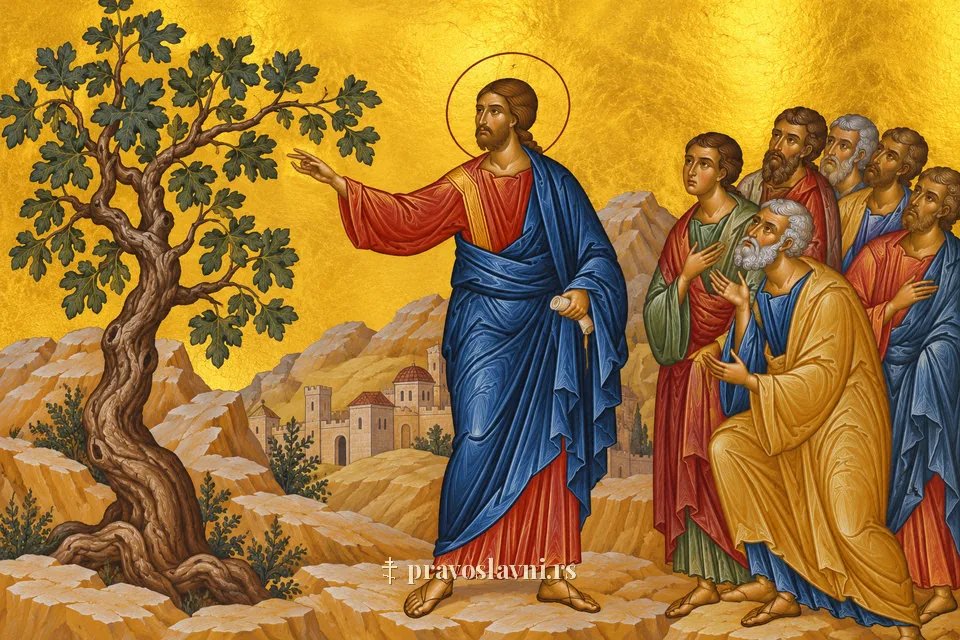
On that day the Church also remembers the fig tree which the Lord cursed. In the morning, after the entry into Jerusalem, Jesus was hungry and went up to a fig tree full of leaves, but He found nothing on it except leaves. He said to it: “Let no one eat fruit from you ever again!” The fig tree withered away from the roots, and the Lord told His disciples that one who believes and does not doubt can even move a mountain. The fig tree with leaves but without fruit is a warning that God looks for fruit, and not only for outward appearance.
Over the first three days of the week the whole of the four Gospels is read through at the Hours, and after them the Liturgy of the Presanctified Gifts is served; until Great and Holy Thursday “Thy Bridal Chamber” is sung. Monday begins in church already on the evening before, with Matins and the troparion “Behold, the Bridegroom”. Holy Week calls us to fruit, and not to leaves.
Full Life
The first day of Holy Week
Great and Holy Monday, Tuesday and Wednesday are the first days of Holy Week. On this day the Church has two images before her eyes: the chaste Joseph, betrayed by his own brothers, in whom the services see a prefiguration of Christ, and the barren fig tree, which the Lord cursed.
Joseph, the beloved son
Jacob, who was also called Israel, loved Joseph more than all his sons. “Now Israel loved Joseph more than all his children, because he was the son of his old age. Also he made him a tunic of many colors.” (Gen 37:3) Because of this his brothers came to hate him and could not speak peaceably to him. Joseph dreamed that their sheaves were bowing down to his sheaf, and that the sun, the moon and eleven stars were bowing down to him. “And his brothers envied him, but his father kept the matter in mind.” (Gen 37:11)
Sold for silver
His father sent Joseph to his brothers, who were pasturing the flock, and he found them near Dothan. When they saw him from afar, they agreed to kill him and to say that a wild beast had torn him to pieces. Reuben persuaded them not to kill him, but to throw him into a pit, intending to rescue him. They stripped him of his tunic and threw him into an empty pit. Then Judah proposed that they should sell him instead of killing him, and they pulled Joseph out and sold him to the Ishmaelites for twenty pieces of silver, and they took him away to Egypt. The brothers dipped his tunic in the blood of a young goat and sent it to their father. Jacob thought that a wild beast had torn him to pieces, tore his clothes and mourned for him a long time, refusing to be comforted. In Egypt Joseph was sold to Potiphar, an officer of Pharaoh and captain of the guard.
The barren fig tree
In the morning, after the entry into Jerusalem, as He was returning to the city, Jesus was hungry. “And seeing from afar a fig tree having leaves, He went to see if perhaps He would find something on it. When He came to it, He found nothing but leaves, for it was not the season for figs.” (Mk 11:13) Then He said: “Let no one eat fruit from you ever again.” (Mk 11:14) The disciples heard it. “Now in the morning, as they passed by, they saw the fig tree dried up from the roots.” (Mk 11:20) Peter said to the Teacher that the fig tree which He had cursed had withered away, and Jesus answered that whoever has faith and does not doubt can move even a mountain, and that he will receive everything he asks for in prayer with faith. The fig tree full of leaves, yet without fruit, is a warning that God seeks fruit from a person, and not merely an outward appearance.
The services
All of the first three days of Holy Week are linked by a common thread: at the Third, Sixth and Ninth Hours the whole of the four Gospels is read through, in nine readings. After the Hours comes the Liturgy of the Presanctified Gifts, and until Great and Holy Thursday “Thy Bridal Chamber” is sung. Matins of Monday begins as early as the previous evening, with the troparion “Behold, the Bridegroom”, and Compline is the Small Compline, with a three-ode canon from the Lenten Triodion.
Other saints of the day
Hieromartyr Artemon of Laodicea
In the temple of Aesculapius the pagan priests kept great serpents, and it was there that they brought the old priest Artemon of Laodicea, after he had, according to his Life, refused to offer sacrifice to Aesculapius. As the Prologue and the Life record, the sign of the Cross made them rigid, and the elder's breath, when he had brought them out into the courtyard, was death to them. The chief pagan priest, Vitalius, fell down before him and, as the Prologue records, cried out: “Great is the God of the Christians!” Artemon baptised him. The Life adds that he ascribed the miracle not to sorcery, as the governor Patricius claimed, but to the power of Christ and the help of the holy Archangel Raphael.
Artemon served the Church in Laodicea in the time of the Emperor Diocletian: sixteen years as a reader, twenty-eight as a deacon and thirty-three as a presbyter. When the persecution began, the Life says that Bishop Sisinius, Artemon and other Christians broke and burnt the idols in the temple of Artemis by night. According to the Life, he was seized as he was returning from the country round the city, said openly that he had been a Christian from his youth, and was taken in chains to Caesarea. Before the judge, according to the Prologue, he called himself a servant of Christ his God and said that he had taught people the way of salvation.
After the miracle with the serpents the tortures went on. The judge intended boiling pitch for him, but the Life records that it was the judge himself who perished in it, for angels in the form of eagles carried him from his saddle straight into it. The Life records that at the place of his suffering, at Artemon's prayer, a spring gushed forth, and that there he instructed and baptised Vitalius and many others; Vitalius later became a bishop in Palestine.
According to the Prologue, he was free for a time and preached, and two deer went with him; the Life says that an angel carried him to the seaside town of Vili, where he worked miracles and converted many. In the end they seized him again and beheaded him — in 303 according to the Prologue, and in 304 according to the Life.
Artemon's life shows that faithful service through a whole lifetime is crowned with courage in old age, and that the tormentor's snare falls in the end upon the tormentor himself.