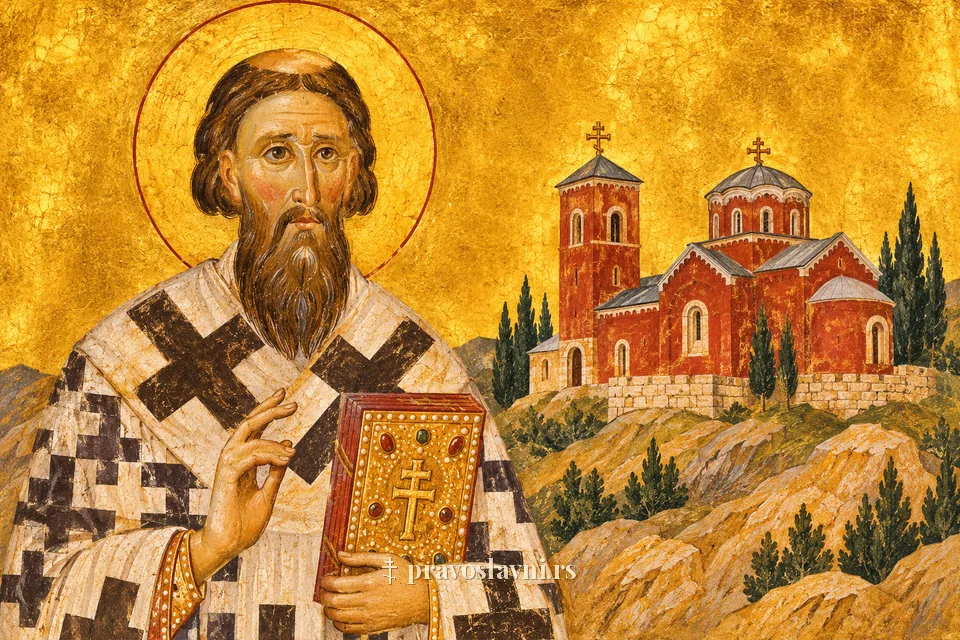
St Sava, by birth Rastko, was the son of Stefan Nemanja, the Grand Župan of Serbia. The Prologue records that he was born in the year 1169. His Life says that his parents obtained him by prayer, and that after many children, when his mother was no longer bearing.
While still a young man, as his Life records, he loved the holy books more than hunting and amusements among the young nobles. He listened to monks who told of the Holy Mountain (Mount Athos). When his parents began to arrange a marriage for him, he went away in secret with a certain Russian monk to the Holy Mountain. His father sent a commander after him to bring him back. But Rastko, according to his Life, was tonsured a monk by night at the top of the monastery tower and received the name Sava. All that was left for Nemanja's men was to carry home his princely clothes, his shorn hair and a letter.
On the Holy Mountain he lived as the most ordinary monk. He made no use of his princely birth; he lived in poverty, obedience and prayer. The gold that his parents sent him he gave away to churches and to the poor. His Life says that by his letter he also called his father to leave the throne. Nemanja in the end became a monk himself, Simeon. The meeting of father and son took place on the Holy Mountain, where, according to the Prologue, Simeon also died.
For the rest of Sava's life we rely on the Prologue. It praises him as a peacemaker: he reconciled brothers who had quarrelled over power, and the Serbs with the neighbouring peoples, and the peoples of the Balkans honoured and loved him. He was the first archbishop of the independent Serbian Church. Together with his father he built Hilandar, and throughout Serbia he raised churches and monasteries and founded schools. Twice he went on pilgrimage to the Holy Land.
The Prologue records that he reposed in Tarnovo in the year 1236. His body rested in Mileševa right up until 1594, when Sinan Pasha burnt it on Vračar in Belgrade. The faith that Sava impressed upon his people, according to the Prologue, outlived the Serbian state. His life shows what Christ can make of a man who leaves everything for His sake.
Full Life
A Son Obtained by Prayer
St Sava was the son of Stefan Nemanja, the Grand Župan of Serbia. The Prologue records that he was born in the year 1169. The Life says that his mother was Ana, the daughter of the Greek Emperor Romanus.
Nemanja and Ana had many children, and then the mother bore no more. The Life records that they prayed to God for one more son, with a vow that from his conception they would live in continence. The son was born as an answer to prayer, was baptised soon after his birth and was given the name Rastko. People said at that time: “This child will be some new sign.”
According to the Life, he surpassed his brothers both in beauty and in intelligence. Neither the rule over a region, which he received when he was only fifteen years old, nor hunting and the company of young noblemen separated him from the holy books. Monks who called in for alms used to tell him about the Holy Mountain (Mount Athos) beyond Thessalonica.
The Flight to the Holy Mountain
When he reached the age of sixteen, his parents began to prepare a marriage for him. At the age of seventeen, as the Life records, he spoke in secret with a certain Russian monk. This monk told him that love for one's parents is natural, but that Christ calls a man to leave everything and take up his cross. Under the pretext of a hunt, Rastko slipped away by night with the monk and a few companions and went to the Holy Mountain.
Nemanja sent a commander after him. The Life says that they found him in the Russian monastery, in the church of St Panteleimon, still in his princely attire. The commander threatened that he would take him back home bound, and Rastko, as though consenting, said: “May the Lord's will be done!” That night, during the vigil, the guards fell asleep. Rastko stole out, and in a small chapel at the top of the monastery tower an old hieromonk tonsured him a monk and gave him the name Sava. When day broke, Nemanja's men received from the tower only his princely clothing, his cut hair and a letter for his parents. He begged them not to mourn him as one dead, but to pray for his ascetic struggle, and he wrote that he hoped to meet his father on the Holy Mountain.
A Monk among Monks
The Life records that Sava then settled at Vatopedi, where he placed himself under the hieromonk Macarius and served as an ordinary monk, seeking no privileges as a prince's son. Barefoot he went round the monasteries of the Holy Mountain, and he prayed the whole night on the summit of Athos. When he asked to live as a hermit, the abbot did not allow him this on account of his youth, and Sava obeyed with the words: “The Lord's will be upon us through you, honourable father!”
The gold that his parents sent him he mostly gave away to churches and to the poor. During Great Lent he himself carried bread to the hermits, walking barefoot with his load. The Life says that once robbers seized him, but after his prayer they let him go, and when they learned who he was, they repented. At Vatopedi he raised new buildings, began three churches and covered the great church with lead, and so they named him its second ktetor (founder).
The Father Follows the Son
Sava wrote to his father and called on him to leave the throne and come to the Holy Mountain. Nemanja, according to the Life, wept over the letter, and then divided his property among the poor. The Life states that in 1196 he handed over power to his son Stefan and received the monastic name Simeon, while Ana became the nun Anastasija. Father and son met at Vatopedi. The Life places Nemanja's tonsure at Studenica, where Bishop Kalinik tonsured him, and the Prologue on the Holy Mountain; both sources nevertheless agree that the father set out on the path that his son had shown him. According to the Prologue, Simeon also died on the Holy Mountain.
Teacher of the Serbian People
The rest of Sava's life we know from the Prologue. First, together with his father, he built Hilandar. Later, in Serbia, he raised monasteries and churches and opened schools. Through his efforts the Serbian Church became independent of the Byzantine emperor and patriarch, and he was the first to bear the title of Serbian archbishop. He visited the Holy Land twice.
The peoples of the Balkans, according to the Prologue, loved him and honoured him as a peacemaker. He built concord both abroad, between the Serbs and their neighbours, and within his own family, when a dispute over power divided his brothers. From his labour for the Church, according to the Prologue, both the state and culture drew benefit.
The Prologue records that he passed away in Tarnovo on 12 January 1236, in the reign of Tsar Asen; the illness that carried him off began after the Liturgy on Theophany. King Vladislav brought his relics to Mileševa. On Vračar in Belgrade, on 27 April 1594, they were burned by Sinan Pasha, who had carried them off from Mileševa.
According to the Prologue, Sava impressed upon his people a faith that outlived the Serbian state. And the Life sees his whole life as the work of Christ in him: a prince left power for the sake of poverty and obedience, and drew even his own father after him.