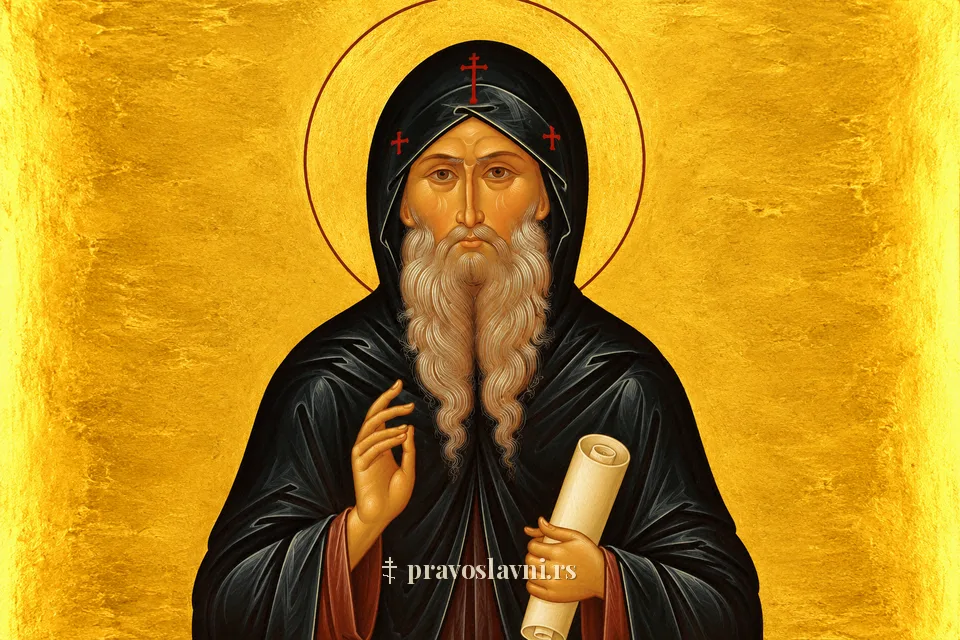
Saint of the day
Venerable Anthony the Great
What happenedHis Life records that St Anthony, after a fierce assault by demons in the tomb, heard the voice of the Lord: “Anthony, I was here, but I waited to see your courage.”
Read the LifeOrthodox Calendar · 17 January according to the Julian calendar
Friday, 30 January 202617 January (according to the Julian calendar)What happenedHis Life records that St Anthony, after a fierce assault by demons in the tomb, heard the voice of the Lord: “Anthony, I was here, but I waited to see your courage.”
Read the Life
No meat, dairy products, eggs or fish — oil and wine are allowed.
This is a recommendation — for your own fast, consult your priest or spiritual father.More about the fast →
Today the Church keeps the commemoration of a saint · not a Red Letter day.
More about the feast →
“Therefore submit to God. Resist the devil and he will flee from you.”
— Jas 4:7St Anthony the Great was an Egyptian, from the village of Coma near Heraclea. His parents were well-to-do, and they died when he was twenty years old. His Life says that it was then that he heard in church the words of the Gospel that one should sell everything and give to the poor. Anthony did just that. Everything he had he gave to the poor, he found guardians for his sister and, with nothing of his own, began the life he had wished for ever since he was a boy.
He began his ascetic struggle in the region where he was born. His Life says that he worked with his hands, shared out his earnings among the poor and learned Holy Scripture by heart. From other ascetics he learned one virtue from each. Against the thoughts sent by the devil his weapons were prayer, fasting and vigil. His Life records that the demons, while he was living in an old tomb, attacked him so fiercely that a friend took him for dead. When after this a light shone forth and his wounds were healed, Anthony asked the Lord why He had not come sooner. He heard: “Anthony, I was here, but I was waiting to see your valour.”
In order to be alone, he went away into the desert. For twenty years he lived in solitude, in prayer, withstanding the demons. Disciples nevertheless gathered around him and many monasteries sprang up. According to his Life, he used to tell them that the demons, whose power Christ has taken away, are not to be feared, and that they should think of death every day.
When the Christians in Alexandria were being led out to torture, he came to encourage them, and later also to expose the Arians. The Prologue points out that a man without schooling was the one whom the educated asked for advice; one of them was St Athanasius the Great. The learned Greeks, who wanted to outwit him, he silenced, as the Prologue records, with the question: “Which is older: the mind or the book?” Athanasius later wrote his Life.
Many disciples continued along his path, and he himself reposed when he was one hundred and five years old. His Life says that his disciples, according to his wish, buried him in secret, and so his grave is not known. Even so, it was precisely his holy life that made him renowned far and wide. Anthony teaches us that God does not reject anyone who sincerely repents.
St Anthony the Great was an Egyptian, born in the village of Coma, near Heracleopolis. The Prologue says that he was born around 250, and the Life says in the year 251. His parents were well-to-do, and the Life adds that they were devout Christians. The Life says that as a child he did not care for games, but preferred to go to church and listen to edifying reading.
When he was twenty years old, his parents died. The Life tells us that he then heard in church the words of the Gospel: sell all that you have and give to the poor. He turned his property into money, and the money into alms. His neighbours received his orchard as well — three hundred palm trees. He entrusted his sister to others — the Prologue says to relatives, and the Life says to well-known and faithful virgins.
At about the age of twenty nothing any longer held him back from the ascetic life that he had desired even as a boy. He spent the first years in the neighbourhood of his birthplace. His first teacher, according to the Life, was a certain elder, a hermit from the days of his youth. He worked with his hands, gave what he earned to the poor and learned the Holy Scriptures by heart. He also visited other ascetics and learned one virtue from each of them.
The Life tells us that the devil first tried by means of thoughts: he brought back to his mind what he had left behind and frightened him with the hardship of the ascetic life. Against this Anthony had vigil, fasting and prayer. His words addressed to the demons have also been preserved: “No one can separate me from the love of Christ.” He ate once a day, after sunset, and sometimes only every other day: bread, salt and water.
After that he shut himself up in an old tomb not far from the village, and a friend brought him food. The Life records that the demons attacked him there so grievously that his friend thought him dead and carried him to the village. As soon as he came to himself, he went back. When they afterwards attacked him in the form of wild beasts, a light shone from above, the demons fled, and his wounds were healed. Anthony asked the Lord why He had not come sooner. He heard the answer: “Anthony, I was here, but I was waiting to see your courage.” He was thirty-five years old at that time.
Longing for solitude, he went away into the desert. Where he found it, the two sources do not say the same: according to the Prologue, on the shores of the Red Sea, while according to the Life he shut himself up in an abandoned shelter on a mountain, which he did not leave; food was brought to him, by agreement, by a friend, and that only twice a year. There he lived alone for twenty years, praying and withstanding the temptations of the demons.
Nevertheless, disciples gathered around him, many monasteries sprang up, and Anthony became their father and teacher. To the monks, according to the Life, he would repeat that there is no reason to fear the demons, for Christ has taken away their power; against them prayer, fasting and the sign of the Cross are enough. He advised them to remember death every day and to know that the Kingdom of God is within us.
When the Emperor Maximinus was persecuting the Christians, Anthony went to Alexandria to encourage the martyrs, ready, as the Prologue says, to suffer himself as well. He himself did not suffer; in that persecution Peter, Archbishop of Alexandria, met a martyr's end. Later he came to Alexandria again to denounce the Arians. The Prologue stresses that he saw the city only those two times, in all his eighty-five years of ascetic life.
The Prologue stresses that even the most learned sought advice from the unschooled hermit, and even St Athanasius the Great did so. The Prologue remembers one question of his: “Which is older: the mind or the book?” He put it to Greek philosophers who wanted to outwit him, and they went away put to shame. The Life says that the Emperor Constantine and his sons invited him to come to them; he did not go, but in a letter he told them to judge justly, to be merciful and to take care of the poor.
According to the Life, before his death Anthony asked his disciples not to carry his body to Egypt, but to bury him in secret. He divided his clothing among Athanasius, the future writer of his Life, Bishop Serapion and the two disciples who had spent half a century with him. He reposed when he was one hundred and five years old. The Life says that angels received his soul, and his grave has remained unknown.
His fame, according to the Life, reached far to the west, all the way to Old Rome; he achieved this neither by learning nor by wealth, but by a life lived according to God. Anthony teaches us that true wisdom lies in understanding, and not in books. By prayer, fasting and the sign of the Cross the demons are overcome, and God does not reject anyone who sincerely repents.


