Feast of the day
Precious Chains of the Holy Apostle Peter
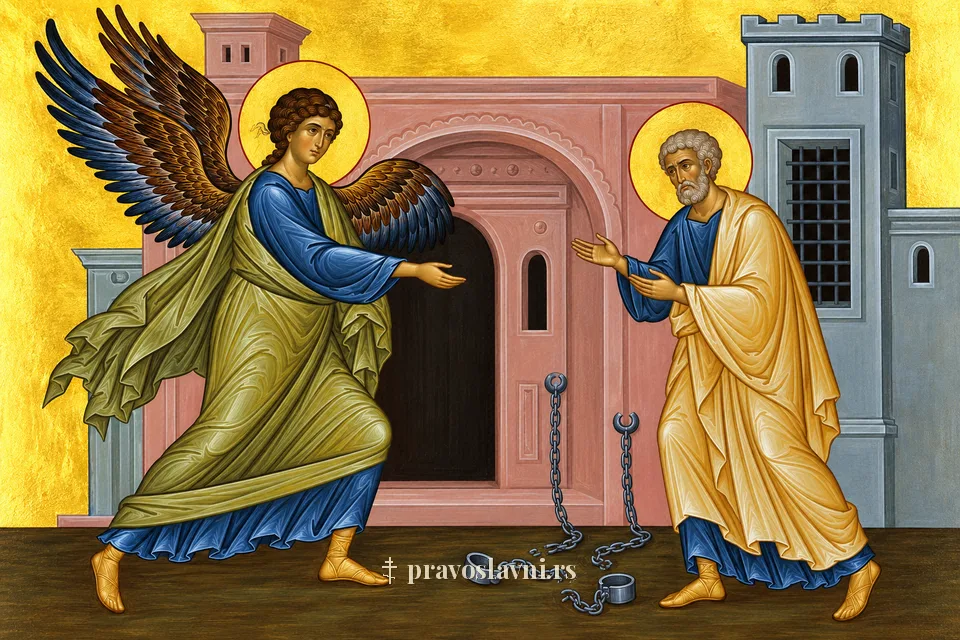
What happenedAt night an angel of the Lord appeared in the prison and woke the Apostle Peter, and the chains with which King Herod had bound him fell from him.
Read the LifeOrthodox Calendar · 16 January according to the Julian calendar
Thursday, 29 January 202616 January (according to the Julian calendar)Save your slava — you'll get a reminder a week and a day before.
Send a greeting card →What happenedAt night an angel of the Lord appeared in the prison and woke the Apostle Peter, and the chains with which King Herod had bound him fell from him.
Read the Life
You may eat meat, eggs, milk and dairy products, as well as any other food — but try to be moderate.
More about the fast →
Many families celebrate their Krsna slava (family patron saint's day) today
More about the feast →
“Peter was therefore kept in prison, but constant prayer was offered to God for him by the church.”
— Acts 12:5Sung at the Slava (family patron saint's feast) and on the saint's feast day.
Without leaving Rome thou hast come unto us through the precious chains which thou didst wear, O first-enthroned of the Apostles. Venerating them with faith, we pray: by thy prayers unto God grant us great mercy.
Translation: pravoslavni.rs
King Herod began to persecute the Church. After he had killed James the brother of John with the sword, he seized the Apostle Peter as well, during the days of Unleavened Bread, and shut him up in prison. He was guarded by four squads of four soldiers each, and Herod intended to bring him out after the Passover. The Acts of the Apostles relate that at night Peter was sleeping between two soldiers, bound with two chains, while guards stood before the door. Then an angel of the Lord appeared and a light shone in the prison. The angel struck Peter on the side and woke him, and the chains fell off. The angel led Peter out past the guards, and the iron gate opened of its own accord. Then Peter understood that the Lord had delivered him from the hands of Herod.
The news of the deliverance, according to the Life, spread through Jerusalem, and the Christians there secretly preserved those fetters. The Prologue and the Life say that the sick recovered when they touched them, as once from Paul's handkerchiefs, of which the Acts of the Apostles speak. The Life adds that the veneration shown to them continued through the generations.
The Empress Eudocia, the wife of Theodosius the Younger, was building churches in Jerusalem; there she received them as a gift from Patriarch Juvenal and took them to Constantinople. One part remained there, but as to where it was placed the sources do not say the same: the Prologue mentions the church of the Holy Apostles, and the Life Hagia Sophia.
The other part came to Rome, to the empress's daughter Eudoxia, who was married to the Emperor Valentinian. In the church of St Peter, which she built in Rome, the chains from Jerusalem were joined to those with which Nero had fettered the apostle before his death.
The Life gives the feast a twofold meaning: honour to the apostle and glory to Christ. It is celebrated on 16 January by the Church calendar, and on 29 January by the civil calendar. When we venerate what the apostle wore for the Lord's sake, we do not venerate the iron, but him, and through him we glorify the Lord Himself. His grace works also through what His saints have touched, so that even the fetters of a prisoner become a source of healings.
Among the holy things of the Christians there is one that is unusual: chains. With them King Herod bound the holy Apostle Peter, and the Christians kept them as a remembrance of the Apostle.
The Acts of the Apostles tell us that Herod began to persecute the members of the Church. He put James, the brother of John, to death with the sword. When he saw that this pleased the Jews, he seized Peter as well. This was during the Days of Unleavened Bread. The Apostle was guarded by four squads of four soldiers each, and Herod intended to bring him out after the Passover.
That night Peter was sleeping between two soldiers, bound with two chains, and guards stood before the door. Then there happened what the Acts of the Apostles describe in this way: “Now behold, an angel of the Lord stood by him, and a light shone in the prison.” The angel struck Peter on the side and woke him, and the chains fell off. He led him past the first and the second guard posts, and the iron gate opened of its own accord. Then Peter understood that the Lord had sent His angel to deliver him from the hands of Herod.
What happened afterwards to the fetters themselves, the Acts of the Apostles do not say; that is remembered by the Prologue and the Life. The Life first records that the news of Peter's deliverance spread through Jerusalem. According to the Life, the Christians in Jerusalem kept them in secret. The Life says that for them to have those fetters meant to have Peter beside them. The healings that followed the Life explains by the fact that the chains had touched the body of the Apostle. The Prologue bears the same witness briefly: the Christians kept them in remembrance of the Apostle, “for many of the sick were healed by touching them”.
Both books here call to mind Paul, from whose handkerchiefs, according to the witness of the Acts of the Apostles, the sick recovered; the Life also mentions deliverance from evil spirits. “These precious chains the faithful devoutly venerated,” the Life records, and it adds that they remained in faithful families, handed down through the generations.
The next trace leads to the Empress Eudocia, the wife of Theodosius the Younger. The Life remembers her as the ktetor (founder) of churches and holy places in Jerusalem, who built and adorned them from the imperial treasury. The chains were at that time with Juvenal, Patriarch of Jerusalem, and he gave them to her as a gift; the Life adds that she took them with her to Constantinople. According to the Life, the chains were only a part of the many holy gifts which the Patriarch gave her before her return, while the Prologue says of the Empress herself that she was the exiled wife of Theodosius the Younger.
Here the sources part ways. The Prologue speaks of a division into two parts, of which the Constantinople part went to the Church of the Holy Apostles. According to the Life, one of the two chains was placed in the reliquary of St Peter in Hagia Sophia. For that reason it cannot be said with certainty in which church of Constantinople that part remained; the only point of agreement is that one part remained in the capital.
The other part, according to both sources, was received by Eudoxia, the Empress's daughter and the wife of the Emperor Valentinian in Rome. There she built the Church of St Peter (the Life places it on the Esquiline Hill), and in it the chains from Jerusalem found their place beside the Roman ones, with which Nero had bound Peter before his death. The Life says that those Roman chains too were found in the city itself. So the fetters from Jerusalem and the fetters from Rome came to be under the same roof.
The Life gives the feast a twofold meaning: honour and remembrance to the Apostle Peter, and glory to Christ. It is celebrated on 16 January according to the Church calendar, which is 29 January according to the civil calendar.
That meaning holds true today as well. When we venerate the Apostle's chains, we do not venerate the object itself, but the Apostle who wore them for the sake of Christ, and through him we glorify Christ Himself. His grace works also through the things that His saints have touched. The fetters of one prisoner became for many a source of healing.
Venerable Romilo came from Vidin. His teacher was St Gregory of Sinai. As an ascetic he passed through several monasteries, and he found his last refuge at Ravanica, in Serbia. Among those who were with him at Ravanica, Konstantin Camblak is also mentioned. Ravanica was also the place of his repose, around the year 1375. The Prologue and his Life preserve only a short note about him. His commemoration is on 16 January according to the Church calendar, that is, on 29 January according to the civil calendar.


