Saint of the day
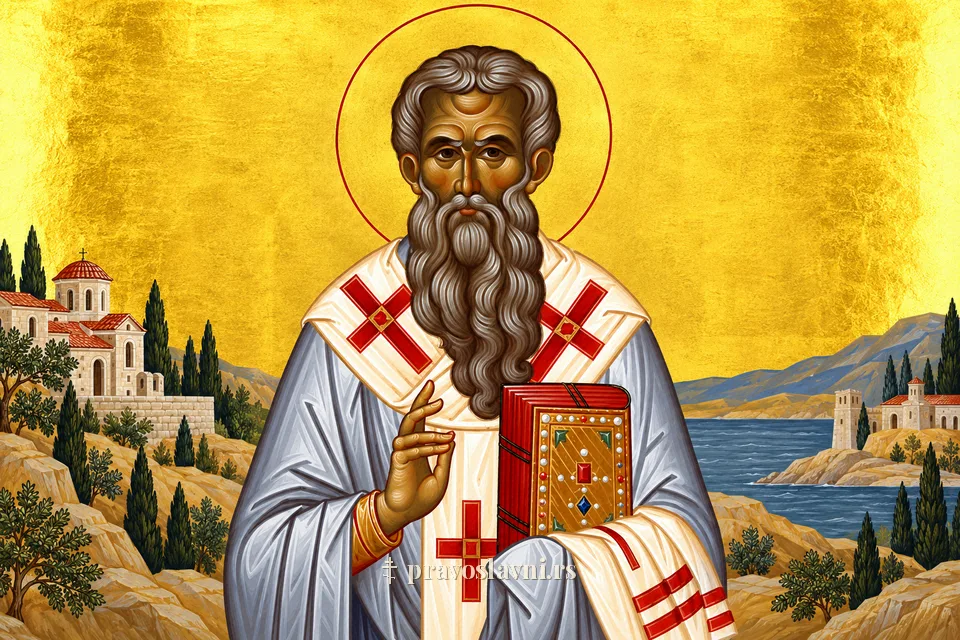
St Parthenius, Bishop of Lampsacus
What happenedSt Parthenius, who as a fisherman shared his earnings with the poor, became a wonderworking bishop and brought the whole of Lampsacus to Christ.
Read the LifeOrthodox Calendar · 7 February according to the Julian calendar
Friday, 20 February 20267 February (according to the Julian calendar)What happenedSt Parthenius, who as a fisherman shared his earnings with the poor, became a wonderworking bishop and brought the whole of Lampsacus to Christ.
Read the Life
No meat — eggs, milk, dairy products and fish may be eaten (Cheesefare Week).
This is a recommendation — for your own fast, consult your priest or spiritual father.More about the fast →
Today the Church keeps the commemoration of a saint · Cheesefare Week – dairy allowed (no meat).
More about the feast →
“And the prayer of faith will save the sick, and the Lord will raise him up. And if he has committed sins, he will be forgiven.”
— Jas 5:15Before he became a bishop, Parthenius was a fisherman from Melitopolis, the son of a deacon, and he used to give the money from his catch to the poor. He had no book learning, but the Gospel stayed in his memory and he lived by it. According to his Life, the gift that he had carried within him since childhood became visible only when, at the age of eighteen, he began to cast out demons in the name of Christ. He did not seek the priestly rank — it was given to him by Bishop Philip.
As Bishop of Lampsacus he found few Christians there. Sermons, rebukes, entreaties and healings turned the city to God. The Prologue says that he closed the doors of the pagan temples and raised many churches, and the Life that Emperor Constantine the Great gave him permission and gold, and that he himself worked alongside the masons on the great church. The Life also records that, when a demon frightened the oxen as the altar stone was being brought, he restored to life by his prayer the driver Eutychian, who had been killed.
The Prologue and the Life also remember his conversation with an evil spirit that did not want to leave a certain man: the hierarch invited it to pass into himself. The demon, for whom it was impossible to enter the house of God, fled, and the sick man recovered.
The Prologue testifies that there was no illness which his prayer did not heal, and the Life cites many healings, including the fact that by prayer with tears he restored the young man Maximus to life.
According to the Life, when Hypatian, the Archbishop of Heraclea, fell ill because of his love of money, Parthenius told him to give back to the poor what he had taken; the archbishop obeyed and recovered. For his archdeacon, whose fields were suffering from drought, he obtained rain by prayer. Nor did he keep the rich load of food with which the new archbishop later thanked him, but, according to the Life, he said to him: “Give thanks to God for everything, and share this out among the brethren.”
He went to the Lord in peace, in his later years, and the Life says that healings continued at his tomb. St Parthenius teaches us that strength does not come from ourselves, but from the name of Christ, and that mercy towards the poor is a sure sign of true repentance.
His Life reveals that he carried the grace of God from his earliest childhood and that he hid it from people. When he was eighteen years old, miracles began to appear through him: in the name of Christ he freed people from demons. He did not seek the priestly rank: it was given to him by Philip, the Bishop of Melitopolis, who had first examined him and sent him to learn to read, and then also entrusted him with a church. His Life also remembers miracles from those years: a man whose eye had been knocked out he helped with plain water, with which he washed him, and a woman with a wound that no one could heal — with the sign of the cross on her forehead.
His Life adds that he found support with Emperor Constantine the Great himself: the Emperor received him kindly and gave him written permission to remove the idol-temples, and along with it gold for new churches. Parthenius did not merely raise the great church in the centre of the city, but also worked on it himself alongside the masons. The demon tried to hinder that building. According to his Life, the oxen that were pulling the altar stone became agitated, and the driver Eutychian perished under the cart; at the saint's tearful prayer he rose up alive and himself brought the stone to the church.
The Prologue bears witness that there was no illness which his prayer did not heal. His Life relates that people stopped going to physicians and brought the sick and the possessed to him. Among those healed it mentions the daughter of Dionysius, the paralysed soldier Axanus, the poisoned Eucheria, the lame Callistus and Lesbius, who was covered with sores. The dead youth Maximus of Bizye, according to his Life, he brought back to life by prayer with tears. The fishermen, whose nets a demon had been emptying, he helped by fasting, prayer and the blessing of the water, and the nets were full once again.
The archdeacon, who was also called Hypatian, had fields that were stricken by drought; after the tearful prayer of Parthenius rain fell, and the blessed fields bore fruit. Parthenius also said that the archdeacon would succeed the archbishop, which indeed came true. When the new archbishop, out of gratitude, brought him a boat laden with grain, wine and fruit, the saint took nothing for himself, but instructed him: “Give thanks to God for everything, and distribute this to the brethren.”
St Parthenius teaches us that healing comes through the name of Christ and through prayer, and that true repentance is mercy towards the poor and the returning of what was taken from them.
According to the Prologue, Luke was from Kastoria, while his Life says that he was born in the year 896 in Hellas, of parents who had fled from Aegina before the Saracen raids. From childhood he ate no meat and lived in purity and prayer. Once, when it was time to sow, he gave most of the seed to the poor and cast into the ground what was left over; yet God gave a harvest such as even a sowing with all the seed had never brought. He left his widowed mother in order to become a monk; his Life says that, at about the age of seventeen, two monks who were coming from Rome took him to a monastery in Athens. His mother asked in prayer to learn where he was, and the abbot, for three nights in a row, heard in a dream the reproaches of a woman because he had taken away her only child; and so he sent the young man back home. Luke spent some time with his mother, four months according to the Life, and then he left her for ever. After that he settled on Mount John, as that place was called: he devoted his nights to prayer, and by day he tilled a garden and a field so as to have something with which to feed the poor and guests, while he himself ate only barley bread. God gave him the gift of working miracles; his Life speaks of healings, of the bite of a poisonous snake which did him no harm, and of how he foretold the Bulgarian incursion into Greece. According to the Life, at the last place where he lived a brotherhood gathered around him and a church of St Barbara was built. He ended his earthly life peacefully in the year 946. Myrrh flowed from his relics from time to time. Almsgiving does not make a person poor: the seed that was given away came back multiplied, and a life of prayer and of labour for others made Luke a wonderworker.


