Saint of the day
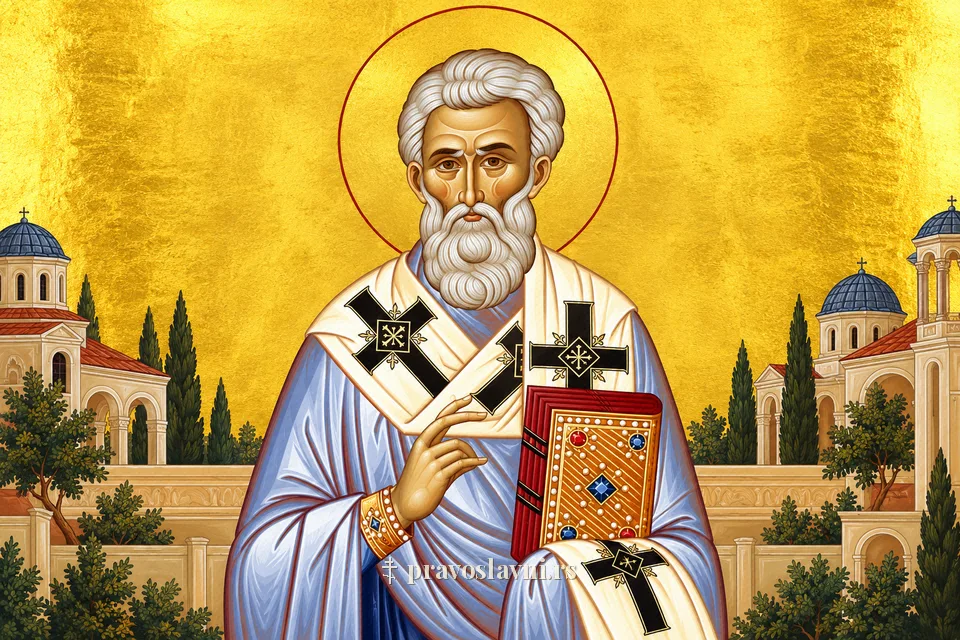
St Photius, Patriarch of Constantinople
What happenedSt Photius, a great teacher and luminary of the Church, defended the unaltered Symbol of Faith (the Creed), and bore his exile giving thanks to God for everything.
Read the LifeOrthodox Calendar · 6 February according to the Julian calendar
Thursday, 19 February 20266 February (according to the Julian calendar)What happenedSt Photius, a great teacher and luminary of the Church, defended the unaltered Symbol of Faith (the Creed), and bore his exile giving thanks to God for everything.
Read the Life
No meat — eggs, milk, dairy products and fish may be eaten (Cheesefare Week).
This is a recommendation — for your own fast, consult your priest or spiritual father.More about the fast →
Today the Church keeps the commemoration of a saint · Cheesefare Week – dairy allowed (no meat); Leavetaking of the Meeting of the Lord.
More about the feast →
“Beloved, while I was very diligent to write to you concerning our common salvation, I found it necessary to write to you exhorting you to contend earnestly for the faith which was once for all delivered to the saints.”
— Jude 1:3When they brought him before the judges at the council of 869–870, St Photius did not defend himself. He kept silent, and his Life remembers his answer: “God hears even the voice of one who is silent.” He was anathematised, his books were burned, and he was sent into exile under guard. Yet even then he did not lose heart. He comforted the other exiles and gave thanks to God for everything. From the Emperor he asked for books at least. Not even the earthquake of the year 870 would he interpret as a punishment for his banishment.
The Prologue calls him a great luminary of the Church. The Life records that he was born in Constantinople around the year 820. He was a kinsman of Patriarch Tarasius and of the imperial house. Because they venerated the icons, his parents lost their estate, were tortured and died in exile as confessors. Photius acquired immense knowledge, taught at the school of the Magnaura and was the Emperor's first counsellor. As an imperial envoy he went to the caliph to intercede for persecuted Christians. He wrote many works on Holy Scripture, the faith and the canons of the Church.
He became Patriarch against his will, after resisting for a long time, and passed through all the ranks in a few days. When the supporters of Ignatius accused him in Rome, and the caesar Bardas began to persecute them, Photius begged Bardas to spare them. As Patriarch he defended the Church against the papal love of power. He rejected the Latin addition to the Creed concerning the procession of the Holy Spirit from the Son as well. In his time Cyril and Methodius set out for Moravia, and the Bulgarian Prince Boris was baptised.
When Emperor Basil killed Emperor Michael and took the throne, Photius was deposed and banished. Later the same Emperor brought him back to teach his sons. After the death of Patriarch Ignatius, Photius became Patriarch once more and entered Ignatius in the diptychs as a saint. The great council of 879–880 vindicated him completely and confirmed the Creed without any addition whatsoever. The Prologue records that he reposed in the year 891.
St Photius shows that wisdom has its greatest worth when it is accompanied by humility and by gratitude to God even in the midst of injustice.
Photius longed for the monastic life, but, as his Life says, he first devoted himself to learning. He studied grammar, poetry, rhetoric, philosophy, medicine, mathematics and Aristotle, and with one old teacher Holy Scripture and the Holy Fathers. While still at home he himself also taught pupils. Under Emperor Michael he became the first imperial counsellor and secretary. As the Emperor's envoy he went to the caliph to intercede for persecuted Christians, and he was accompanied by Constantine, the future St Cyril. He taught at the school of Magnaura, which had been restored by Caesar Bardas, together with Leo the Mathematician and Constantine the Philosopher.
His Life lists many of his works: answers to 326 questions on Holy Scripture, a treatise against the Manichaeans, a treatise on the Holy Spirit, a commentary on the epistles of the Apostle Paul and the Nomocanon, along with letters, homilies and hymns.
To Pope Nicholas he sent a letter in which he confessed his faith in the Holy Trinity and the seven Ecumenical Councils. When the supporters of Ignatius went to Rome to accuse him, and Bardas began to persecute them, Photius begged Bardas to stop the persecution.
When Latin missionaries began to teach the Bulgarians that the Holy Spirit proceeds also from the Son, Photius sent an encyclical letter to the Eastern patriarchs and rejected that addition, as well as other Latin customs. A council in Constantinople, at which there were about a thousand participants, condemned and deposed Pope Nicholas.
In his time Cyril and Methodius were sent to the Khazars, and afterwards to Moravia, at the invitation of Prince Rastislav. The Bulgarian Prince Boris was baptised in the year 864, and Photius wrote him a letter of instruction. His Life also says that Photius sent the first bishop to the Rus.
In exile he remained at peace, comforted the other exiles and gave thanks to God for everything. From the Emperor he asked at least for books. When an earthquake occurred in the year 870, he rejected the thought that it was a punishment for his exile. His Life also passes on his words: “My rights are not in this world.”
St Photius teaches us that the faith is defended by knowledge, but also by patience, and that God does not forget the one who, amid injustice, keeps silent and gives thanks to Him.
The Church of Smyrna remembers St Bucolus also for the successor he left to her: towards the end of his life he ordained St Polycarp as bishop. He himself was a disciple of an apostle, for St John the Theologian appointed him Bishop of Smyrna. In the city at that time, according to the Prologue, hardly anyone had been baptised. His Life says that from his youth he lived in purity and was filled with the Holy Spirit. Through his preaching and through baptism the pagans came out from under the power of the demons. The Prologue remembers his meek and gentle nature. He departed to the Lord in peace. His Life also mentions healings which continue to this day: the sick who come with faith to his grave receive help from a tree which God caused to spring up there.


