Saint of the day
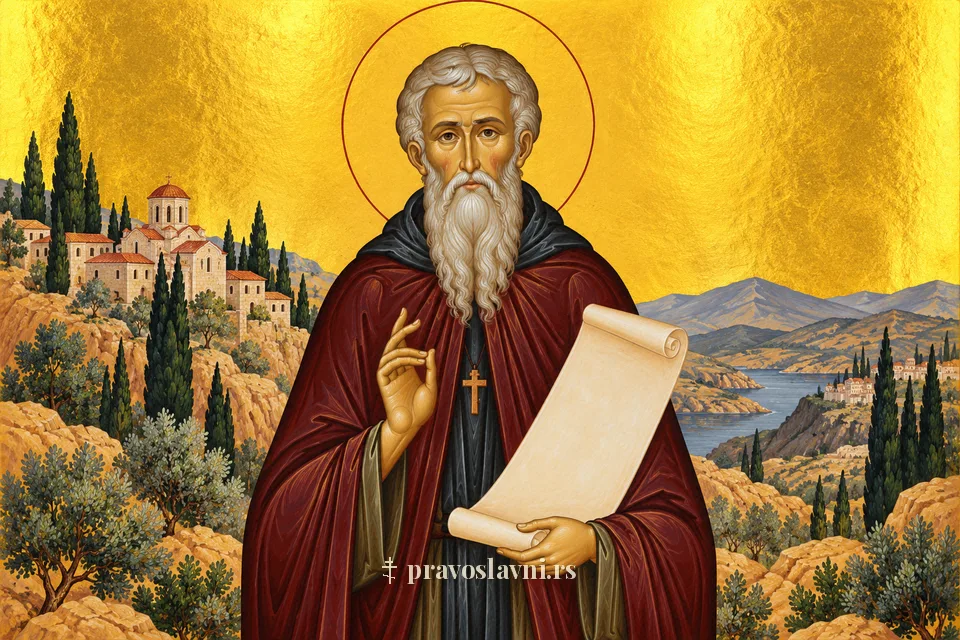
Venerable Theodore the Sykeote
What happenedTheodore the Sykeote, guided from childhood by St George, became a wonderworking healer and gave up the honour of a bishop for the sake of the ascetic life.
Read the LifeOrthodox Calendar · 22 April according to the Julian calendar
Tuesday, 5 May 202622 April (according to the Julian calendar)What happenedTheodore the Sykeote, guided from childhood by St George, became a wonderworking healer and gave up the honour of a bishop for the sake of the ascetic life.
Read the Life
You may eat meat, eggs, milk and dairy products, as well as any other food — but try to be moderate.
More about the fast →
Today the Church keeps the commemoration of a saint · not a Red Letter day.
More about the feast →
“It is good for a man to bear The yoke in his youth.”
— Lam 3:27After eleven years on the episcopal throne of Anastasiopolis Theodore the Sykeote returned to his monastery; the Prologue says that he had begged God for this. He had become a bishop unwillingly, because others saw in him a pure and spiritual man.
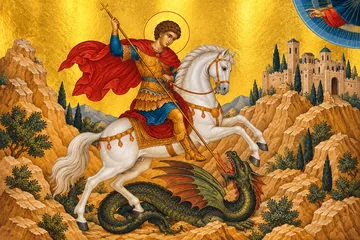
He was born in the village of Sykeon in Galatia. His Life says that before his birth his mother dreamed of a star falling into her womb, which spiritual men interpreted as a sign of holiness. His mother Mary, according to the Prologue a rich widow, intended to prepare him for the army, until St George revealed to her in a dream that the boy would serve the heavenly King. George, as the Prologue and his Life record, was his guardian and teacher later on as well: many times he appeared to him and delivered him from the snares of the demons. Theodore also had visions of the Most Holy Theotokos.
Following the example of the elder Stephen, who lived in their house, he began while still a boy to fast and to pray at night. His Life says that as a young man he lived in a cave beneath the altar of the church of St George, that at the age of eighteen he became a priest, and that he became a monk in the Lavra of Chozeba, when he went on pilgrimage to Jerusalem to venerate the Cross and the Tomb of the Lord. He kept his body under strict restraint, so that the soul might rule over it; his Life says that he even lived in an iron cell.
God gave him authority over evil spirits and diseases. His Life records that by prayer he stopped the locusts, obtained rain, converted a certain sorcerer and healed many in Constantinople. He foretold that Maurice would become emperor, and Maurice later helped the monastery which had sprung up around him, with its church of the Archangel Michael.
He reposed in old age, at the beginning of the reign of Emperor Heraclius, around the year 613. His Life was written by his disciple Eleusius, whom Theodore had named George.
Theodore teaches that humility flees from honours, and that God gives to those who serve Him with a pure heart the grace to heal and to overcome evil.
Venerable Theodore was born in the village of Sykeon in Galatia, and so he was named the Sykeote after it. His Life says that his father Cosmas was an official of Justinian the Great, and that his mother was Mary. Before his birth his mother, according to his Life, dreamed of a great star falling into her womb, and a hermit near the village and Theodosius, Bishop of Anastasiopolis, interpreted this as a sign of the child's future holiness.
Mary, whom the Prologue calls a rich widow, intended to prepare her son for military service, in Constantinople according to his Life, when he should be six years old. St George, however, warned her in a dream that the boy was destined for the service of the heavenly King. Following the example of the elder Stephen, who lived in their house, the boy began to fast and to pray at night — from the age of ten according to the Prologue, and already from about the age of eight according to his Life.
St George appeared to him many times, taught him and delivered him from the dangers that the demons prepared for him. His Life relates that he led him by night to his church on the hill and guarded him from demons in the form of wolves, and that when the devil, disguised as a certain Gerontius, brought him to a cliff and urged him to jump, George saved him. Theodore also had visions of the Most Holy Theotokos; his Life remembers that in the church of St Aemilian in Ancyra he saw the King upon a throne and a woman in purple, who promised him a heavenly crown.
While still a youth, according to his Life, he dug a cave beneath the altar of St George's church and lived in it, and later he spent two years shut up in a cave in the mountains, where a certain deacon fed him. Bishop Theodosius ordained him a priest at the age of eighteen and foretold that he would be a bishop. He went to Jerusalem, venerated the Cross and the Tomb of the Lord, became a monk in the Lavra of Choziba near the Jordan, and then returned to the church of St George.
By strict ascetic labour he kept his body in obedience to his soul. For this reason, as both sources say, he kept his body in strict abstinence and in irons, and spent his nights in prayer. His Life says that he lived in an iron cell and wore an iron breastplate and chains. According to his Life, a monastery grew up around him; he built a church of the Archangel Michael and dwellings for the monks.
God granted him to command evil spirits and human illnesses, and so he became known far and wide as a man who heals and works miracles. His Life records that by prayer he drove away a plague of locusts and obtained rain in a time of drought, and that a certain sorcerer, who had been sending demons and poison against him, repented, burned his books and was baptised. When he was summoned to Constantinople, he healed many: the blind, the paralysed and the possessed. He foretold, according to his Life, that Maurice would become emperor, and Maurice later sent grain and gifts to the monastery.
His purity and spirituality led others, against his own wish, to make him Bishop of Anastasiopolis. After eleven years he asked to be released — the Prologue says that he prayed to God for this — and returned to his monastery and his ascetic life; his Life adds that the Emperor Maurice and Patriarch Cyriacus gave their consent. He reposed in old age, at the beginning of the reign of the Emperor Heraclius, about the year 613. His Life was written by his disciple Eleusius, whom Theodore named George; he, according to his Life, was born to childless parents through Theodore's blessing.
Theodore's life shows what happens when a person is led from childhood by God and His saints: strict mastery of the body for the sake of the soul, a humility that flees even from the honour of a bishop, and the great grace to heal and to drive out evil.
St Platon, Bishop of Banja Luka, was born, as his Life records, in Belgrade on 29 September 1874; in the world he was called Milivoje, and his parents were Ilija and Jelka, née Sokolović. He was educated at the grammar schools of Vranje and Niš, and then at the Belgrade Seminary, where he received monastic tonsure in his third year. After his ordination as deacon and priest he was sent in 1896 to the Serbian Podvorye (representation church) in Moscow, where in 1901 he completed the Theological Academy as a candidate of theology. On his return he was superior of the monastery of Rajinovac, an assistant teacher in Belgrade, a teacher in Aleksinac and Jagodina, and then an archimandrite. He was a brigade chaplain in 1912 and a military chaplain in the First World War, and during the occupation he remained in Serbia and helped those who were suffering, especially orphans and widows. He ran the monastery printing house in Sremski Karlovci and edited the Herald of the Serbian Patriarchate, and for a time he was also abbot of Krušedol. He was consecrated Bishop of Moravica by Patriarch Varnava in 1936, then he was Bishop of Ohrid and Bitola, and in 1939 he was transferred to Banja Luka. On the tenth of April 1941 he was informed that, since he was from Serbia, he had to move out; his answer was: “I have been canonically and lawfully appointed Bishop of Banja Luka by the competent authorities” — and he did not abandon his flock. His Life records that the Ustaše arrested him on the night of 5 May 1941 and, together with Dušan Subotić, the archpriest of Gradiška, took him out of the city; they killed them both and threw the bodies into the Vrbanja. His body was found on 23 May in the village of Kumsale; he was buried first in the military cemetery in Banja Luka, and in 1973 he was transferred to the Cathedral church. The Holy Assembly of Bishops of the Serbian Orthodox Church proclaimed him a hieromartyr in 1998 As a good shepherd, he did not abandon his flock, but laid down his life for it.
Separate page: Hieromartyr Platon, Bishop of Banja Luka →
St Sava Trlajić, named Svetozar at baptism, was born in the year 1884 in Mol. According to his Life, he completed the seminary in Sremski Karlovci and studied law in Belgrade. He was ordained in 1909, and until 1927 he was the parish priest in Bašaid. As a widower he was tonsured a monk in 1929 at Krušedol and became the superior of that monastery. He was consecrated in 1934 as vicar Bishop of Srem, and in 1938 he was enthroned as Bishop of Gornji Karlovac with his seat in Plaški. In the year 1941 the Ustaše took him hostage and drove him out of the bishop's residence. When he was ordered to leave for Serbia, he refused, because he was the lawful bishop and did not want to abandon his flock. He was arrested together with the priests and the more prominent Serbs of Plaški, tortured and taken to the prison in Gospić. In the middle of August he was led away with other Serbs towards Velebit, where, it is supposed, he was killed; the place and manner of his death are not known for certain.