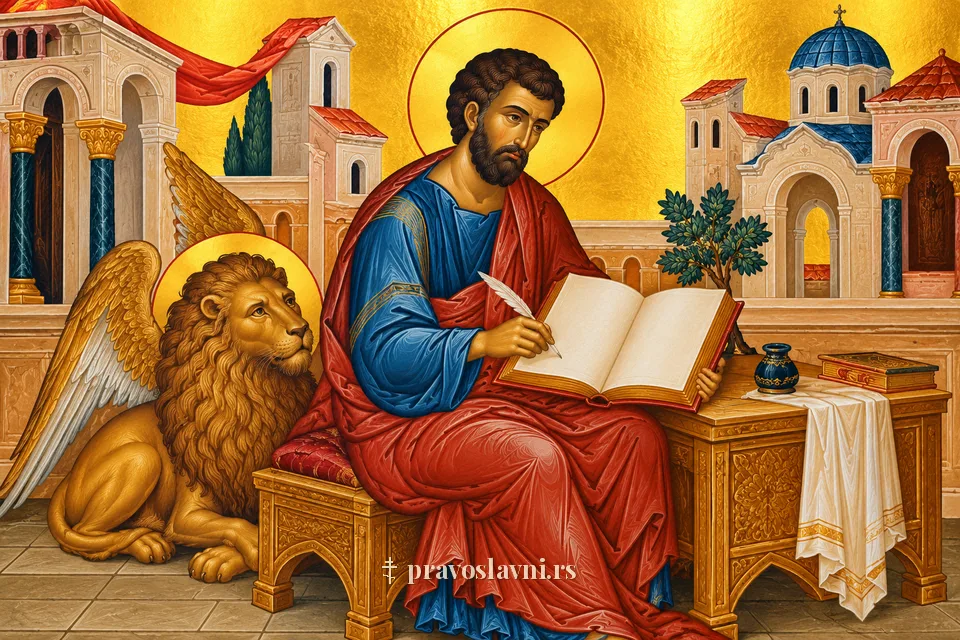
St Mark left the Church the Gospel that bears his name. It came into being in Rome, where he was staying with the Apostle Peter: the Christians there wished to have in writing what they had heard about the Lord, and Mark did this for them. Peter, who in his epistle calls Mark his son in the spirit, looked through that writing and confirmed that it was true. His Life adds that Mark was a Jew of the tribe of Levi and one of the Seventy.
Ordained by Peter, Mark went out to preach — according to his Life, by way of Aquileia to Egypt. Egypt heard the Gospel for the first time from him and received its first bishop from him. He travelled through Libya, Ammoniaca and the Pentapolis, and everywhere he left ordained bishops, priests and deacons. According to his Life, in Cyrene many were baptised after the sick had been healed and demons cast out.
He came to Alexandria led by the Holy Spirit. There the cobbler Anianus came to believe: Mark healed him when he had hurt himself with an awl, and then taught him and baptised him with his whole household; later Anianus became the second Bishop of Alexandria. His Life adds that the two of them appointed three presbyters, seven deacons and eleven clerics. The Prologue records that the Church in that city was founded by Mark's preaching, which was confirmed by many miracles. When the pagans hatched a plot, Mark took refuge for two years in the Pentapolis, and on his return he found an even larger community, which, according to his Life, built a church on the shore.
In the end the pagans bound him and dragged him through the city until he died, giving up his spirit to the Lord. Before that, in prison, Christ had called him His evangelist, and an angel also gave him strength. His Life says that the pagans wanted to burn his body too, but a storm with hail and an earthquake prevented them. The faithful buried him with honour, and the Prologue says that his relics heal every illness.
Mark's life teaches tirelessness: he served the Gospel by labour and by prayer until his last breath.
Full Life
Peter's spiritual son
St Mark, apostle and evangelist, was, according to his Life, a Jew of the tribe of Levi, and he is numbered among the Seventy Apostles. His life is closely bound up with the Apostle Peter. In his first epistle Peter calls him his son (1 Pet 5:13), meaning a spiritual kinship, for Mark was his disciple and fellow worker.
He stayed with Peter in Rome. The Christians of that city asked him to preserve in writing what they had heard about the Lord's life, miracles and teaching. This is how the Gospel that bears Mark's name came to be; his Life says that he wrote it according to Peter's spoken preaching. That it was written down faithfully was confirmed by Peter himself, who looked through the work and, according to his Life, recommended it to the faithful.
The first preacher of the Gospel in Egypt
Peter ordained Mark a bishop and sent him to preach — first to Aquileia, his Life states, and then to Egypt. Mark was the first preacher of the Gospel in Egypt and the first bishop there. He preached in Libya, Ammoniaca and the Pentapolis, and everywhere he appointed bishops, priests and deacons. His Life records that in Cyrene he healed the sick and drove out demons, and so many were baptised. It also cites the testimony of Philo, handed down by Eusebius of Caesarea and Nicephorus Xanthopoulos, about the ascetic Christian communities in Egypt that sprang from Mark's teaching.
The cobbler of Alexandria
Led by the Holy Spirit, Mark came to Alexandria; his Life says that he sailed there by ship and arrived on the second day. His Life relates that at the city gate his sandal broke and that he gave it to the cobbler Anianus to mend. As he worked, Anianus wounded his left hand with the awl. Mark anointed the wound with dust moistened with spittle, and the hand was healed; according to his Life, he said: “In the name of the ever-living Jesus Christ, be well!”
That meeting changed Anianus's life. He listened to Mark's preaching and was baptised with his whole household. Later Mark ordained him a bishop, and he became the second Bishop of Alexandria. His Life adds that together they appointed three presbyters — Milaius, Sabinus and Cerdon — seven deacons and eleven other clergy. Thus the Church was founded in Alexandria, and the Prologue says that Mark's preaching was confirmed by many miracles.
To his last breath
The pagans began to plot against him, and so Mark withdrew to the Pentapolis and stayed there for two years. When he returned, he found the Christian community grown larger; his Life records that the faithful had built a church on the shore, at a place called Boucolou. According to his Life, the pagan leaders envied him his miracles and, on a day that coincided with the feast of the god Serapis, they seized him while he was serving the Liturgy. They bound him and then dragged him through the city.
Christ did not abandon him in prison either: He appeared to him, and an angel strengthened him as well. The Prologue records the Lord's words: “Peace to you, Mark, My evangelist!” The next day they dragged him again, until he breathed his last with the words: “Into Your hands, O Lord, I commit my spirit!” His Life states that he suffered in Alexandria, in the time of the Emperor Nero, about the year 68.
A tomb that heals
Even after his death the pagans did not manage to burn his body: according to his Life, a storm and hail put out the fire, and an earthquake brought down buildings. After this the place was called “the Angels' place”. The Christians buried Mark with honour, in a stone tomb on the eastern side of their place of prayer, according to his Life. The Prologue says that his relics give healing from every illness.
Mark was a tireless and faithful labourer of the Gospel to the very end. The Prologue, in its homily, reminds us that idleness invites the devil, while diligent work and prayer guard us from sin, just as the apostles too laboured day and night.