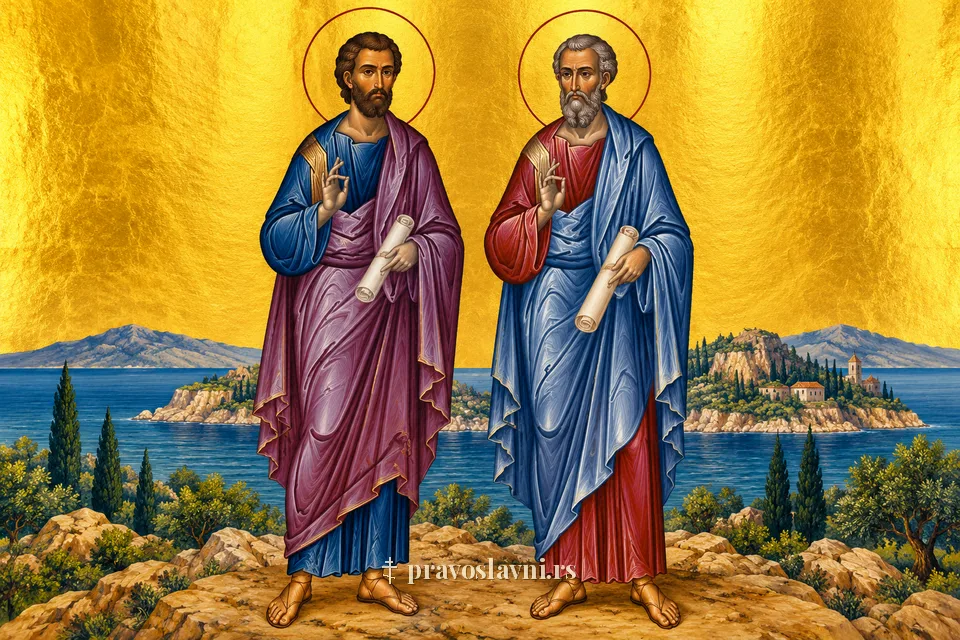
The Apostles Jason and Sosipater, according to their Life disciples of Paul, brought to Christ on Corfu robbers, and the ruler's daughter, and the ruler himself. The first were seven robbers with whom they shared a prison: they became Christians and suffered in boiling pitch. According to the Life, the gaoler Anthony also came to believe and likewise suffered as a martyr. Then there was the ruler's daughter Cercyra: the tortures of the Christians led her to ask about their faith, to confess Christ and to give away her jewellery to the poor. The Life tells that in prison she drove off a bear in the name of Christ and healed a man whom her father had sent to dishonour her, and then baptised him as Christodoulos. Neither her father's threats, nor prison, nor fire could make her waver; she died from arrows, tied to a tree. Finally the ruler of the island also accepted Christ, receiving the name Sebastian at his baptism. The Life says that this was Datianus, who at first tortured the apostles himself, and repented when a red-hot vessel filled with pitch, sulphur and wax did them no harm, while the fire killed the onlookers. He hung a stone around his neck and begged the God of Jason and Sosipater for mercy. According to the Life, the apostles then raised his dead son to life and built churches together with him.
Jason and Sosipater were of the number of the Seventy, and Paul calls them his kinsmen (Rom 16:21). Jason, like Paul, came from Tarsus and was bishop there, while Sosipater came from Achaia and was bishop in Iconium. On Corfu they built the church of St Stephen the Protomartyr.
The first ruler, who persecuted them, perished: when he set out by ship after the Christians who had taken refuge on a neighbouring island, he sank like Pharaoh. From then on Jason and Sosipater were able to teach without hindrance; the Church on Corfu grew strong through their work, and they lived to a great old age and reposed there, and so, according to the Life, their relics rest in their church.
This account bears witness that faith in Christ overcomes persecution and that God guards His witnesses.
Full Life
The apostles of Corfu
On Corfu the Church was established by the labours of two apostles, Jason and Sosipater. Before they were able to preach without hindrance, many on the island suffered for Christ. When that faith finally prevailed, the two of them went on teaching the people and strengthening the Church. They remained on Corfu to a great old age and reposed there, and their Life says that their relics rest in their church on the island.
Paul's kinsmen
The Apostle Paul in the Epistle to the Romans mentions Jason and Sosipater as his kinsmen (Rom 16:21). Both are among the Seventy, and their Life calls them Paul's disciples. Jason, like Paul, was from Tarsus and became bishop there; Sosipater came from Achaia, and he carried out his ministry as bishop in Iconium. On Corfu they built a church dedicated to the Protomartyr Stephen and brought some of the local people into the Church.
Those who suffered
The ruler of the island — their Life calls him Cercyllinus and says that slanders moved him to it — imprisoned the apostles. In the prison there happened to be seven robbers: Saturninus, Jakischolus, Faustianus, Januarius, Marsalius, Euphrasius and Mammius. There these men became Christians, and then martyrs as well: they ended their lives in boiling pitch, mixed with sulphur and wax according to the Life. The Life also counts among the martyrs the gaoler Antony, who believed and, after severe tortures, suffered. It records, too, that the prefect Carpianus sent the apostles back to prison in chains.
Among those who suffered was also Cercyra, the daughter of the ruler himself. She was able to see the torture of the Christians from the palace; when she learned what they were suffering for, she confessed Christ and gave her jewellery away to the poor. Her father first tried to bring her back to paganism, and then shut her away in a separate prison. The Life relates that her father sent a man into the prison to dishonour her, but a bear attacked him at the door. Cercyra drove the beast away in the name of Christ, healed the man, taught him the faith and baptised him with the name Christodulus, and he cried out: “Great is the God of the Christians!” He too, according to the Life, later died as a martyr. Not even the flames with which her father set fire to the prison did Cercyra any harm, and many, seeing this, were baptised. She ended her life tied to a tree and pierced by arrows.
The fall of the persecutor, the repentance of his successor
The faithful fled to a neighbouring island. Pursuing them, the ruler met his death in the sea: his ship sank, just as Pharaoh once perished in his pursuit. The Life continues the story: the apostles were released and taught the people, but the new ruler, Datianus, threw them into an iron vessel with heated pitch, sulphur and wax. They remained unharmed, while the fire killed those who were standing around, and many believed.
Datianus then repented. With a stone around his neck, in tears, he prayed to the God of the apostles: “O God of Jason and Sosipater, have mercy on me!” The Prologue says only that the new ruler was baptised as Sebastian, while the Life says that this was Datianus himself and that he was baptised by the apostles, who then raised his dead son and built churches together with him.
What they tell us
On Corfu robbers, a gaoler, the daughter of a persecutor and, in the end, the ruler of the island came to Christ. Their story shows that faith in Christ overcomes persecution, that God guards His witnesses and that He judges those who persecute them.