Feast of the day
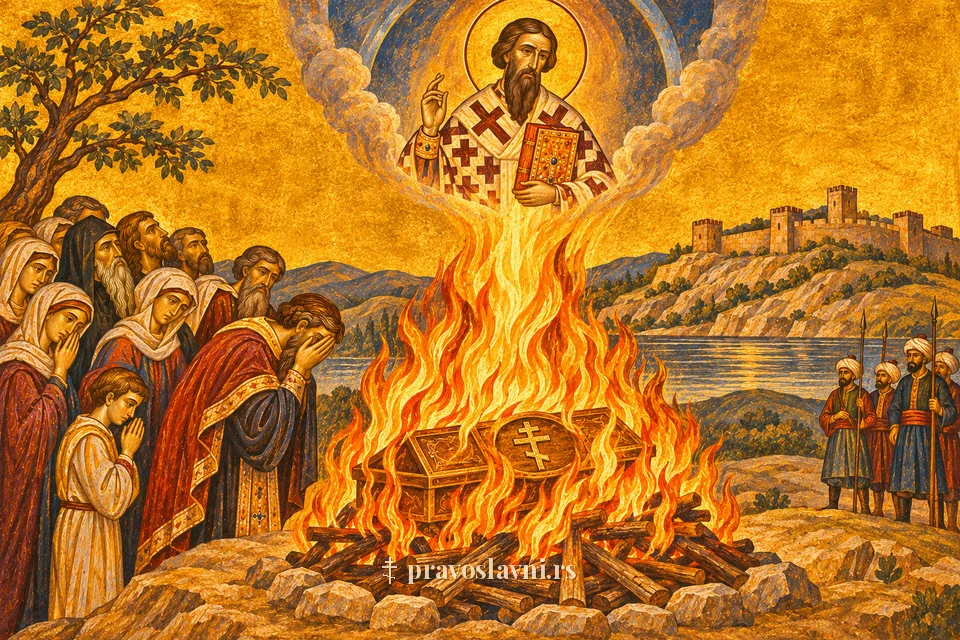
Burning of the Relics of St Sava on Vračar
What happenedSinan Pasha ordered the relics of St Sava to be brought from Mileševa to Belgrade and burned on Vračar, fearing an uprising.
Read the LifeOrthodox Calendar · 27 April according to the Julian calendar
Sunday, 10 May 202627 April (according to the Julian calendar)What happenedSinan Pasha ordered the relics of St Sava to be brought from Mileševa to Belgrade and burned on Vračar, fearing an uprising.
Read the Life
You may eat meat, eggs, milk and dairy products, as well as any other food — but try to be moderate.
More about the fast →
Sunday — a festive day · Fifth Sunday of Pascha – Sunday of the Samaritan Woman. Tone 4.
More about the feast →
“Persecuted, but not forsaken; struck down, but not destroyed.”
— 2 Cor 4:9On Vračar in Belgrade, on 27 April 1594 (according to the Julian calendar), by order of Sinan Pasha, the relics of St Sava, the first Archbishop of Serbia, were burnt. The Pasha was afraid that the gathering of the people around the saint's relics might stir up a revolt against Turkish rule.
Sava's body, which according to his Life had been brought from Tarnovo in Bulgaria, rested at Mileševa, the monastery built by King Vladislav. Under the Turks the Serbs came to the relics for comfort and healing, and the Life records many healings, which Muslims received as well. In that same year, as the Life states, the Serbs in Banat, led by Bishop Teodor of Vršac, rose in revolt and carried banners bearing the image of St Sava. Sinan Pasha, according to the Life a superstitious man and cruel towards Christians, then sent an army to Mileševa; it took the relics out of their coffin and brought them to him in Belgrade.
A certain monk, as the Life says, wrote down in a chronicle: “Let it be known when the Turks burnt St Sava.” The Life adds that the saint was mourned in all the Serbian lands.
The Life adds that through this suffering Sava also became a martyr for Christ.
Today the Church remembers the burning of the relics of St Sava, the first Archbishop of Serbia. His Life says that his body was translated from Tarnovo in Bulgaria to Serbia. It was laid in the Mileševa Monastery, the endowment (zadužbina) of his nephew King Vladislav, who, according to his Life, reigned from 1234 to 1243.
Under Turkish rule — after the defeat at Kosovo in 1389, his Life states — the Serbs gathered around Sava's relics and sought comfort and healing, and, according to his Life, hope of liberation as well. His Life records many healings of soul and body, which Muslims too received there.
In the year 1594, as his Life records, the Serbs in Banat rose up against Turkish rule. The uprising was led by Teodor, Bishop of Vršac, and Jovan Kantul, Patriarch of Peć, and Visarion, Metropolitan of Herzegovina, were also involved in it. The rebels carried banners bearing the image of St Sava.
The Turkish commander at that time was Sinan Pasha. His Life hides neither his abilities nor his faults: he knew how to wage war, but he was unlearned and superstitious, and cruel towards Christians — by his orders many churches were torn down, and priests and believers were killed.
The Pasha, fearing that the people gathered around the relics might rebel against the Turks, gave the order that they be brought to Belgrade and burned. His Life says that a detachment of soldiers was sent to Mileševa, which took the relics out of the reliquary and brought them to the Pasha in Belgrade. They were burned on Vračar on 27 April 1594 (according to the Julian calendar).
A certain monk, according to his Life, noted that day in a chronicle with the words: “Let it be known when the Turks burned St Sava.” His Life adds that the saint was mourned in all the Serbian lands.
Yet both sources see in this event also that which the flames could not reach. For the Prologue, Sava did not cease to live even after the burning — he is alive with God and in the hearts of his fellow countrymen. For his Life, the body was burned, but his glory and his memory remained. By this suffering, his Life adds, Sava also became a martyr for Christ.


