Great feast
Đurđevdan — Great Martyr George
Great Martyr George
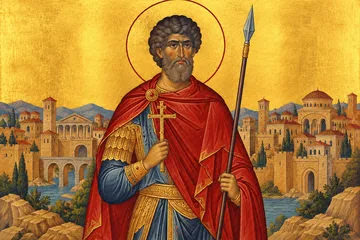
What happenedThe tribune George stood before Emperor Diocletian and openly confessed that Christ is the only God, giving up his rank, his wealth and imperial honours.
Read the LifeOrthodox Calendar · 23 April according to the Julian calendar
Wednesday, 6 May 202623 April (according to the Julian calendar)Save your slava — you'll get a reminder a week and a day before.
Send a greeting card →What happenedThe tribune George stood before Emperor Diocletian and openly confessed that Christ is the only God, giving up his rank, his wealth and imperial honours.
Read the Life
Fish, oil and wine are allowed — no meat, dairy products or eggs.
This is a recommendation — for your own fast, consult your priest or spiritual father.More about the fast →
Red Letter day — great feast; by custom, no work is done
More about the feast →
“But thanks be to God, who gives us the victory through our Lord Jesus Christ.”
— 1 Cor 15:57Sung at the Slava (family patron saint's feast) and on the saint's feast day.
As liberator of captives and defender of the poor, physician of the sick, champion of kings, O victorious Great Martyr George, entreat Christ God that our souls be saved.
Translation: pravoslavni.rs
Đurđevdan (St George's Day) is the day of the Holy Great Martyr George, whom the Church calls the Victory-bearer. Few Slavas (family patron saint's day) are more widespread among Orthodox Serbs: by the number of families that keep it, Đurđevdan is among the first, and folk song ascribes it as a Slava to Prince Marko (Kraljević Marko) as well. A separate, autumn commemoration is linked to the translation of his relics – Đurđic.
In the people's understanding, Đurđevdan is a spring feast, when nature is renewed, and in the old reckoning of time it divided the year in two. On that day the people pray to God for a fruitful year – for the fields, orchards and vineyards. In many regions herbs are gathered on the eve of the feast – cranesbill (zdravac), nettle, lily of the valley, cornel and others – which are left overnight in water under the open sky, and in the morning people wash with it, so that it may carry away evil and weariness. Homes and gates are decked with greenery, and crosses for the fields and gardens are made from hazel twigs. By custom, the first cheese from the Đurđevdan milking is taken to be blessed, and a clear day, it is believed, is taken as a sign of a good year.
The Prologue records numerous miracles at the tomb of St George, and even today he appears and helps those who call upon him. The glory of that swift helper begins with one bold confession.
George was born in Cappadocia, into a rich and devout family. He lost his father as a martyr for Christ, and his mother moved to Palestine, from where she originally came. While still young he became a tribune in the army. When Diocletian set in motion a fierce persecution of Christians, George, as his Life says, gave away his property to the poor, set his slaves free and went before the Emperor, who did not know that his commander was a Christian. He publicly confessed that he was a Christian and that Christ is the only God. Not even the honours offered to him shook him: out of love for Christ he left everything he had.
They tortured him in many ways: they kept him in prison with a stone on his chest, bound him to a wheel, kept him in a pit for three days and three nights, gave him poison. His Life says that the spears of the soldiers bent on him like lead. He came out of it all alive; his Life says that after the wheel an angel healed him. By prayer he raised a dead man, and many believed. His Life also tells of the ploughman Glycerius, to whom George said that his dead ox was alive; when he found it alive, Glycerius glorified Christ and suffered. Among the converts the Prologue names Empress Alexandra, the pagan priest Athanasius and the ploughman Glycerius. According to his Life, before his sign of the cross the idols in the temple of Apollo fell and were shattered. He was beheaded in the year 303, and Empress Alexandra, condemned with him, died at the place of execution before the sword. His Life says that he was buried at Lydda.
His Life also records miracles after his death — healings and the return of captive youths to their homes — and it tells too of the victory over the dragon near Beirut. Đurđevdan (St George's Day), his feast, is marked as a Red Letter day (great feast), and his Life mentions churches and Slavas (family patron saint's days) dedicated to him.
George teaches that Christ is to be confessed without fear even before the most powerful, and that one who leaves everything for His sake becomes a helper to many.
The holy Great Martyr George was born in Cappadocia, of noble and devout parents; the Prologue says that they were rich. His father suffered for Christ, and his mother, who was from Palestine, moved back there; his Life adds that she had great estates there, that she brought up her son and died when he was about twenty years old. George entered the army and at about the age of twenty became a tribune. His Life says that after this he commanded a special regiment and that Diocletian, not knowing that he was a Christian, made him a count and a commander.
When the Emperor, according to his Life, renewed the persecution of the Christians at the councils in Nicomedia — because a demon from the oracle of Apollo had told him that the righteous were hindering his prophecies — George distributed his gold, silver and clothing to the poor, freed his slaves and put his Palestinian estates in order. According to the Prologue, out of love for Christ he left everything without hesitation.
Then he stood before Diocletian and publicly confessed that he was a Christian. His Life preserves his words: “Christ is the only God!” When Magnentius questioned him, he answered: “The truth is Christ Himself, whom you persecute.” The Emperor offered him rank and honours if he would offer sacrifice, but George refused.
The tortures began, and with them the miracles. His Life says that the soldiers' spears bent against him as if they were made of lead. The Prologue and his Life record that he lay in prison with his feet in the stocks and a heavy stone on his chest, and that he was bound to a wheel set with nails; according to his Life, an angel appeared to him after this and healed him. For three days and three nights he was buried in a pit — up to his head according to the Prologue, and in a pit of lime according to his Life — and he was found alive, praying. His Life speaks of other tortures as well, after which he would be well again by morning. A magician, whom his Life calls Athanasius, gave him a deadly poison, and he remained unharmed. By prayer he also raised a dead man, and many believed.
George's steadfastness led people to Christ. Among the converts the Prologue names the Empress Alexandra, the chief pagan priest Athanasius, the farmer Glycerius, Valerius, Donatus and Therinus. His Life relates that the soldiers Anatolius and Protoleon believed on seeing the miracle of his healing and that they were beheaded. To the farmer Glycerius, whose ox had fallen into a ravine and died, George said that the ox was alive; Glycerius found it alive, publicly glorified Christ and was beheaded. In the prison too, according to his Life, people bribed the guards in order to reach him, and he healed the sick by calling upon Christ and by the sign of the cross. In the temple of Apollo, as his Life records, he made the sign of the cross before the idol; the demon admitted that it was not a god, and the idols fell and were shattered.
George and Alexandra were condemned to be beheaded, but the Empress died at the place of execution before the sword fell. George was beheaded in the year 303 — outside the city, after praying, according to his Life — and was buried, as his Life says, near Lydda.
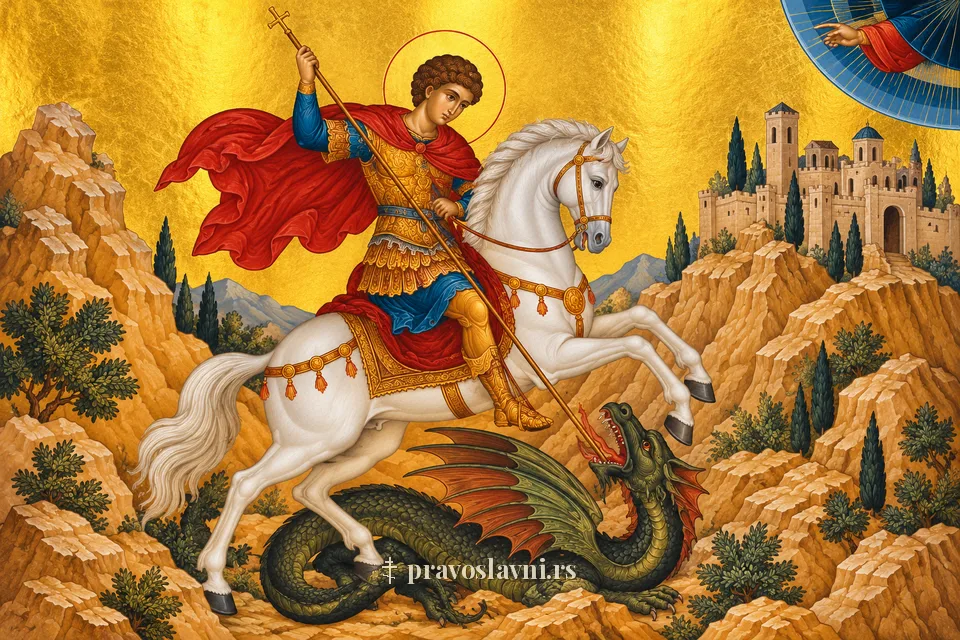
The Prologue says: “The miracles that have taken place at the tomb of St George are without number.” He appears to many in dreams and visions and helps those who call upon him. His Life remembers miracles after his death: a pillar lost at sea was restored to a widow; a Saracen who shot an arrow at his icon was wounded in the hand, was healed with oil from the lamp and was baptised; and young men held captive were returned to their homes. A special place in his Life also belongs to the story of the dragon near Berytus, to which children were being given: George killed it and saved the king's daughter, after which about twenty-five thousand people were baptised.
Đurđevdan (St George's Day), a Red Letter day (great feast), is dedicated to him; his Life mentions the Krsna slava (family patron saint's day) celebrations in his honour and the many churches dedicated to him. The Prologue says that he received from God a glory that does not pass away, and so even today he comes to the help of those who call on him in trouble. George teaches the fearless confession of Christ before the most powerful and the renunciation of every earthly honour for His sake.
The holy martyr Alexandra was the wife of Emperor Diocletian, who persecuted St George. What brought her to faith in Christ was what she saw in George: how he endured, how he did not give way, and what miracles were taking place around him. The sources do not agree as to when this came about: the Life of St George says that after the miracle on the wheel she secretly confessed the faith and that she was sent home, the Prologue links her conversion with the raising of a dead man, and the joint Life of the martyrs says that she had been a Christian even before. According to the Life of St George, later on, when the idols fell in the temple of Apollo, she publicly declared that she was a Christian. The emperor condemned her to be beheaded together with George. She died at the place of execution before the sword fell; the Life says that on the way she sat down, leaned against a wall and breathed her last. Thus the empress followed Christ together with the martyr whose courage she had watched.
Separate page: Holy Martyr Empress Alexandra →
Sts Anatolius and Protoleon were soldiers, as the Life of St George says. They were witnesses of George's torments and saw how, after he had been tortured on the wheel, an angel healed him. That miracle brought them to faith in Christ. The Life of St George says that because of that faith they were beheaded. The joint Life of these martyrs records only that they suffered for Christ, without giving either the place or the year. Their example shows how the steadfastness of one martyr opened the eyes of those who were watching it.