Feast of the day
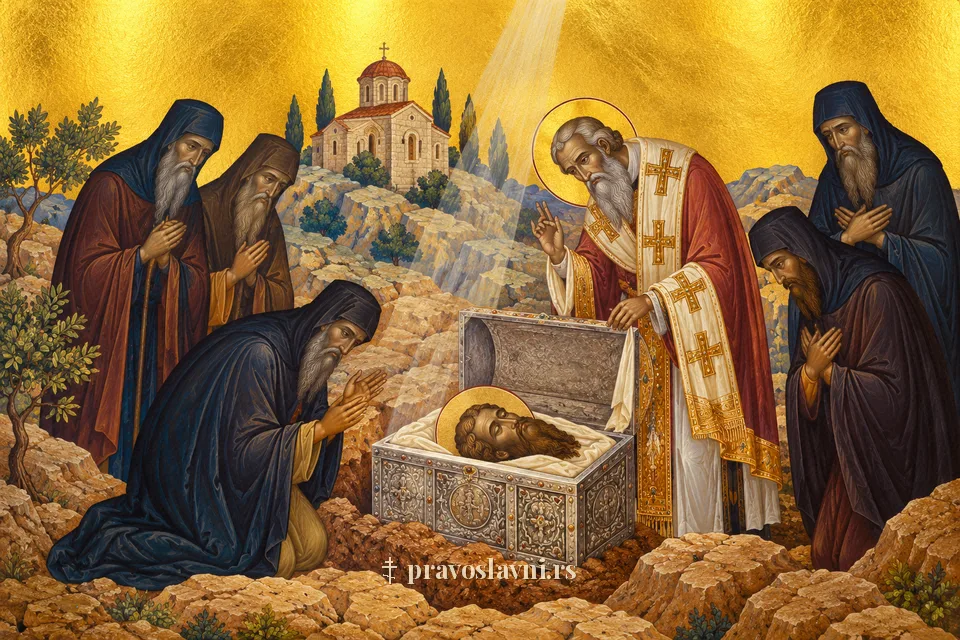
Third Finding of the Head of St John the Baptist
What happenedAfter the time of iconoclasm the head of St John the Baptist was taken from Comana to Constantinople and placed in the imperial court church.
Read the LifeOrthodox Calendar · 25 May according to the Julian calendar
Sunday, 7 June 202625 May (according to the Julian calendar)What happenedAfter the time of iconoclasm the head of St John the Baptist was taken from Comana to Constantinople and placed in the imperial court church.
Read the Life
You may eat meat, eggs, milk and dairy products, as well as any other food — but try to be moderate.
More about the fast →
Sunday — a festive day · 1st Sunday after Pentecost – Sunday of All Saints. Tone 8. Petrovske poklade (the last day before the Apostles' Fast).
More about the feast →
“There was a man sent from God, whose name was John.”
— Jn 1:6Petrovske poklade (the last day before the Apostles' Fast) is the final day before the beginning of the Apostles' Fast. It falls on the Sunday of All Saints, the first after Pentecost, so it has no fixed date but moves together with Pascha.
According to the “Liturgics” handbook, the Sunday of All Saints is called the harvest of the Spirit of God, because in the saints there ripen the fruits of the grace bestowed at Pentecost. With it ends the period in which the services follow the Pentecostarion. From then on the divine services are again celebrated according to the Octoechos and the Menaion, the numbering of the Sunday Gospels begins from this Sunday, and the cycle of the tones of the Octoechos begins the following Sunday with the first tone.
The next day the Apostles' Fast begins, by which the faithful prepare for the feast of the Holy Apostles Peter and Paul.
By folk custom, on Petrovske poklade households prepare a rich, non-fasting table before the fast. In some villages, by folk custom, the pokladni svatovi (a mock wedding procession of masqueraders) pass through the village.
The head of St John the Baptist travelled through the centuries along the path of a holy treasure that was hidden and guarded. The Prologue counts this commemoration among the several feasts dedicated to the Forerunner, and it is called the third “obretenje”, which means finding.
The hardest period came with iconoclasm in the eighth century. So that it might be kept safe, the head was taken to Comana, the place of exile of St John Chrysostom, which the Life places in Cappadocia. Only when the iconoclasts had lost their power, in the reign of Emperor Michael and Patriarch Ignatius, was the holy treasure returned to Constantinople. That was in the year 850, and the imperial court church was appointed as its place.
The Life also mentions an earlier time, when the head was hidden, until God revealed to a certain priest where it was to be found; it lay in a silver casket.
This feast reminds us that God guards His holy things even in a time of persecution and gives them back to the Church when peace comes.
The word “finding” means the discovery of something that was lost. Under this name the Church remembers several events connected with the precious head of St John the Baptist, and the Prologue places this commemoration among the other feasts dedicated to the Forerunner. The Third Finding is connected with the return of this holy treasure to Constantinople, after a time during which it had to be hidden away.
The reason for hiding it was iconoclasm, which struck the Church fiercely in the eighth century. The head was then carried away to Comana — according to the Life, a place in Cappadocia — to which St John Chrysostom had once been exiled. There it remained until iconoclasm had passed.
The Life also remembers an older part of this story. Before that, the head had long been hidden, until God revealed where it lay. It was found by a certain priest, whose name the Life does not preserve, and he found it in a silver casket.
Peace returned to the Church during the reign of Emperor Michael and Patriarch Ignatius. Then, in the year 850, the head was brought from Comana to Constantinople and placed in the imperial court church.
The journey of this holy treasure bears witness to the providence of God. God preserved the head of the Forerunner throughout the persecution and returned it to the faithful people when the persecution came to an end.
The Holy Martyrs of Piva are the innocent inhabitants of Piva who suffered in the Second World War. Their Life explains their suffering by their Serbian name: they crossed themselves with three fingers, spoke their own language and signed their names in Cyrillic, and for the killers that was enough. One of the places of execution was at Doli in Piva, where on 7 June 1943, on the feast of the Finding of the Head of St John the Baptist, 522 inhabitants were shot, among them 109 children. Their Life names as the perpetrators members of the SS Division “Prinz Eugen”, and the attack was part of the offensive against the partisan forces around Mount Durmitor, after the battle on the Neretva. The suffering spread to other places in Piva as well, so the exact number of victims is not known. According to what is told, and what their Life records, more than 1,260 people lost their lives in huts that were set on fire or in ravines. The loss struck every clan: the Blagojević clan alone was left without more than 220 of its members, some households lost half of their people, and one family was wiped out entirely. Their Life remembers the seventeen-year-old Jaglika Adžić, who escaped from the hut in which her parents Stoja and Krsto and her brothers Milorad, Momčilo and Dušan were locked up with some fifty villagers. When she heard them, she went back to them into the fire. The youngest martyr of Piva, their Life says, is the newborn child of Mališa and Mitra Đukanović, who came into the world at the very hour of the shooting and did not live long enough to be given a name. All the innocent sufferers of Piva from the Second World War have been numbered among the saints, and on the anniversary a memorial service is held at Doli in Piva every year.


