Saint of the day
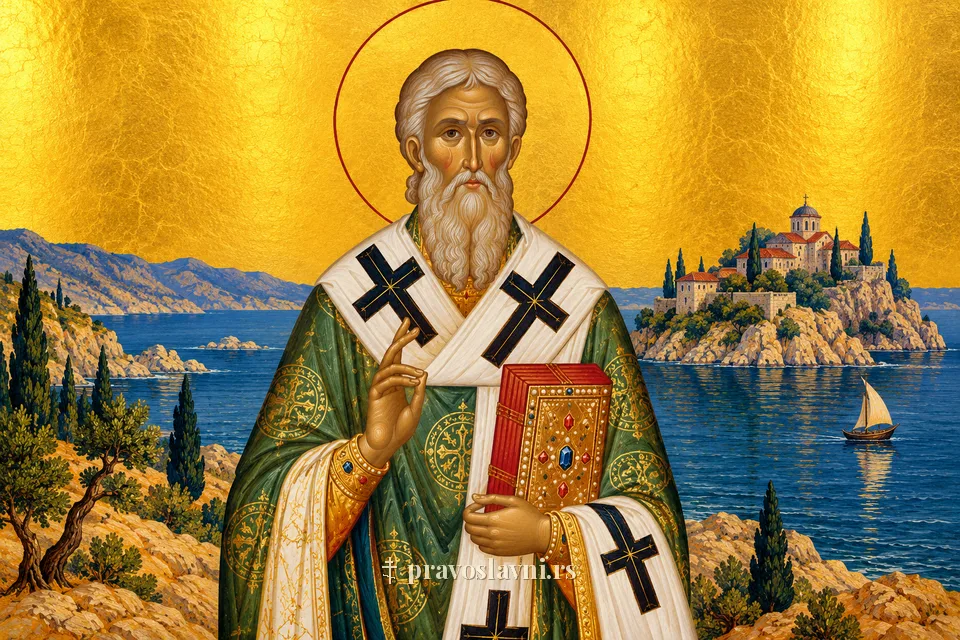
Hieromartyr Therapon
What happenedThe four dry stakes to which Bishop Therapon was tied during his torture put out leaves and grew into tall, healing trees.
Read the LifeOrthodox Calendar · 27 May according to the Julian calendar
Tuesday, 9 June 202627 May (according to the Julian calendar)What happenedThe four dry stakes to which Bishop Therapon was tied during his torture put out leaves and grew into tall, healing trees.
Read the Life
No meat, dairy products, eggs or fish — oil and wine are allowed.
This is a recommendation — for your own fast, consult your priest or spiritual father.More about the fast →
Today the Church keeps the commemoration of a saint · not a Red Letter day.
More about the feast →
“And all the trees of the field shall know that I, the LORD, have brought down the high tree and exalted the low tree, dried up the green tree and made the dry tree flourish; I, the LORD, have spoken and have done it.”
— Ezek 17:24At the place where Bishop Therapon was tortured, tall green trees grew up from the four dry stakes to which he had been tied. The sick received healing from them, and according to his Life the leaves of those trees cured them of every illness. This miracle is remembered by the Prologue and by his Life.
Therapon was Bishop of Sardis. He turned many Hellenes away from the idols and, as his Life adds, baptised them. For this the pagans repaid him with hunger, prison and beatings. According to his Life, Prince Julian kept him in chains for a long time, without food or water, and then the torture was continued in Synaus and in Ancyra. On the bank of the Astala, says the Life, they stripped him, tied him to stakes and beat him without mercy, but he survived.
The path of his sufferings, according to his Life, came to an end in Lydia, by the River Hermus, where after fresh tortures he was beheaded for Christ. The Prologue places his death in the time of Emperor Valerian. He suffered in the year 259.
God turns dry wood into wood that is living and healing. In the same way the steadfastness of His witness through long torments becomes a blessing for others.
St Therapon was bishop in Sardis, a city that was the seat of a metropolis. He turned many Greeks away from the idols and brought them to Christ, and the Life adds that he also baptised them. The Prologue places his suffering in the time of Emperor Valerian, and both sources record that he suffered in the year 259.
Because of his faith the pagans punished him with hunger, prison and beatings. The Life says that the governor Julian put him in chains and kept him for a long time in prison, hungry and thirsty. According to the Life, the torture continued on the road as well: the bishop was taken in chains to Synaus in Phrygia, and then to Ancyra in Galatia, and in neither place was he spared.
The Life also mentions the bank of the river Astala. There he was beaten, naked and tied to four dry stakes. Yet Therapon survived.
Then, according to both sources, a miracle took place: the dry wood to which he had been tied turned green, and the stakes grew into tall trees. Many of the sick received healing from them, and the Life says that the leaves of those trees cured every illness.
The Life says that in the end he was brought to the Thracesian region in Lydia, beside the river Hermus, where the diocese of Satala was, under the metropolis of Sardis. There, after new torments, he was beheaded for Christ.
God turned dry wood into wood that was living and healing. By this He showed that the suffering of His witnesses is not in vain. Therapon's steadfastness in his long torments bears witness to a strength that does not come from man, but from God.
St John the Russian was a slave in body, but free in faith. He was born, according to his Life, in Little Russia, in a devout Orthodox family, and as a soldier of Peter the Great he fell into slavery in the war with the Turks: the Tatars took him captive and sold him to a Turkish dignitary in Prokopion, near Caesarea in Asia Minor. Neither gifts nor threats nor tortures brought him to accept Islam; to his master, according to his Life, he offered faithful service in everything except the faith, ready even to die for Christ. When his master gave up, John became a groom and lived in the stable with the horses, and he spent his nights in secret prayer in the Church of St George. Even later he did not want a better life: when his master offered him a clean room, he humbly stayed in the stable. The reason for that offer was a miracle which his Life describes at length. His master was then on a journey to Mecca, and John, having prayed, sent him a plate of pilaf, his favourite dish; on his return, the master bore witness that he had found it on his table that same day, on a plate marked with the sign of his own house. He fell ill while still young and, according to his Life, received Holy Communion, which the priest, out of caution, brought to him hidden in an apple, and then he reposed in peace in the year 1730. Three and a half years later a heavenly light shone upon the grave, the body was found incorrupt and fragrant, and the relics were translated to the Church of St George in Prokopion, where many were healed. His Life records that in 1832 the janissaries wanted to burn them, but fled in terror at the miracle that took place before them over the saint's body. After the Asia Minor catastrophe the Christians took his relics with them to Euboea, to Neo Prokopion, where they rest in a large church.


