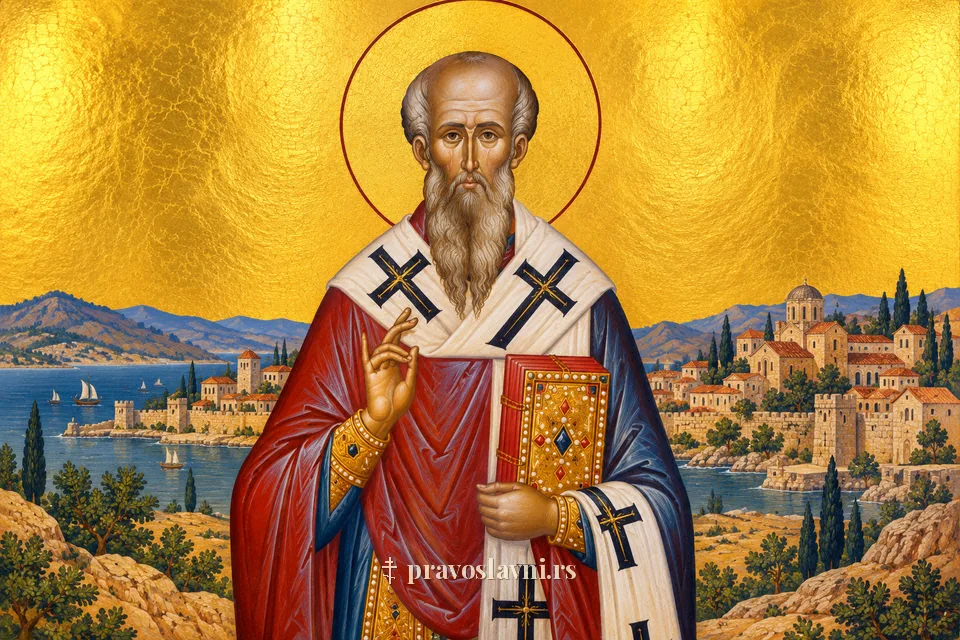
Saint of the day
Holy Apostle Carpus
What happenedWhen the Apostle Carpus lost patience with two sinners on Crete, the Lord appeared to him, ready to suffer again for the salvation of mankind.
Read the LifeOrthodox Calendar · 26 May according to the Julian calendar
Monday, 8 June 202626 May (according to the Julian calendar)What happenedWhen the Apostle Carpus lost patience with two sinners on Crete, the Lord appeared to him, ready to suffer again for the salvation of mankind.
Read the Life
No meat, dairy products, eggs, fish or oil — food cooked in water.
This is a recommendation — for your own fast, consult your priest or spiritual father.More about the fast →
Today the Church keeps the commemoration of a saint · Beginning of the Apostles' Fast.
More about the feast →
“For God did not send His Son into the world to condemn the world, but that the world through Him might be saved.”
— Jn 3:17With this day begins the Apostles' Fast, which is also called the Petrovdan Fast and the Apostolic Fast, or the Fast of the Holy Apostles. It falls immediately after the Sunday of All Saints and lasts until the eve of Petrovdan (the feast of the Holy Apostles Peter and Paul), and so it is named after that feast. In order it is the second longer fast of the church year. Its beginning depends on Pascha, while its end is fixed, so it lasts from eight days to six weeks.
The fast is dedicated to the foremost apostles Peter and Paul, but also to all the other apostles. It is a remembrance of them who, when they had received the Holy Spirit, met with fasting and prayer the moment to set out into the world with the Gospel, as the Acts of the Apostles bear witness.
The oldest testimony to it was left by St Athanasius the Great. In the first centuries, in the great churches of the East, such as those of Alexandria, Antioch and Jerusalem, the fast lasted only a week and was tied to the feast of Pentecost. So too the Apostolic Constitutions direct that after Pentecost one should feast for a week and then fast. In time it became a fast of preparation for the feast of the apostles.
The ancient fathers praised it too, among them Ambrose of Milan and Leo the Great. In the words of Leo the Great, this fast has a particular value, because it helps to cleanse the mind and to make a person ready to receive the gifts of the Holy Spirit. According to the Typikon, the Apostles' Fast is kept in the same way as the Nativity Fast, and there is more about fasting in the guide “Fasting — simply explained”.
When St Dionysius the Areopagite came to Crete, hospitality was offered to him by Carpus, one of the Seventy Apostles. According to the testimony of Dionysius, with Carpus a heavenly vision always came before the serving of the Divine Liturgy, and the Prologue adds that he described him as a man of pure soul, gentle and simple-hearted.
Carpus was a fellow worker of the Apostle Paul: his Life says that he carried his epistles and bore with him the hardships of preaching. Paul appointed him Bishop of Berea in Thrace, where, according to his Life, he brought many pagans into the Church and convinced some of the Jews that Jesus is true God. In the end the unbelieving Jews tortured and killed him, and at his tomb in Berea, as his Life records, the sick found healing.
One episode from the life of Carpus is especially remembered. When he lost patience with two sinners and asked God to punish them, the Lord appeared to him and said that He was ready to suffer once again for the salvation of men.
The Prologue draws a lesson from this: we pray for sinners, and do not wish punishment upon them, for God wants all to repent.
St Carpus once lost patience with two sinners and asked the Lord to punish them. The answer was not punishment but an appearance of the Lord, Who told him that He was ready to suffer once again so that people might be saved. The Life hands down those words in this way: “Go on tormenting Me, for I am ready to be crucified again for the salvation of men.” The Prologue records them somewhat differently, but the meaning is the same. The Life connects this episode with Crete, where Carpus also preached.
Carpus was one of the Seventy Apostles. The Prologue and his Life remember him as Paul's companion and helper, and the Life adds that he was the messenger who carried Paul's epistles to those to whom they were addressed, and that he shared with the Apostle the labours and hardships of preaching. Paul made him Bishop of Beroea in Thrace.
On Crete, where he also spread the Gospel, St Dionysius the Areopagite stayed in his house. Dionysius also recorded something about the way Carpus served: every Liturgy he celebrated was preceded by a heavenly vision. The Prologue adds that Dionysius remembered him as a man of rare inner purity, gentle and without guile, to whom the Lord would appear surrounded by angels.
In Beroea, according to the Life, he fulfilled his ministry as bishop by preaching: many pagans received Christ, and some of the Jews came to believe that the Crucified One is the true God. Trials did not pass him by, and both sources say that in the end he was tortured and killed by unbelieving Jews. The Christians of Beroea, as the Life says, laid his relics in a tomb in their city, and there many of the sick found healing.
The lesson of this day, as the Prologue sets it out, is that we should ask for the salvation of sinners and not for their ruin, because God desires the repentance of all (cf. 2 Pet 3:9).
The holy apostle Alphaeus was the father of two of the Twelve Apostles: James the son of Alphaeus and Matthew the Evangelist. His Life says that he was from the Galilean town of Capernaum. Where he preached the Gospel is, according to his Life, not reliably known. Both sources say that he reposed in peace.


