Saint of the day
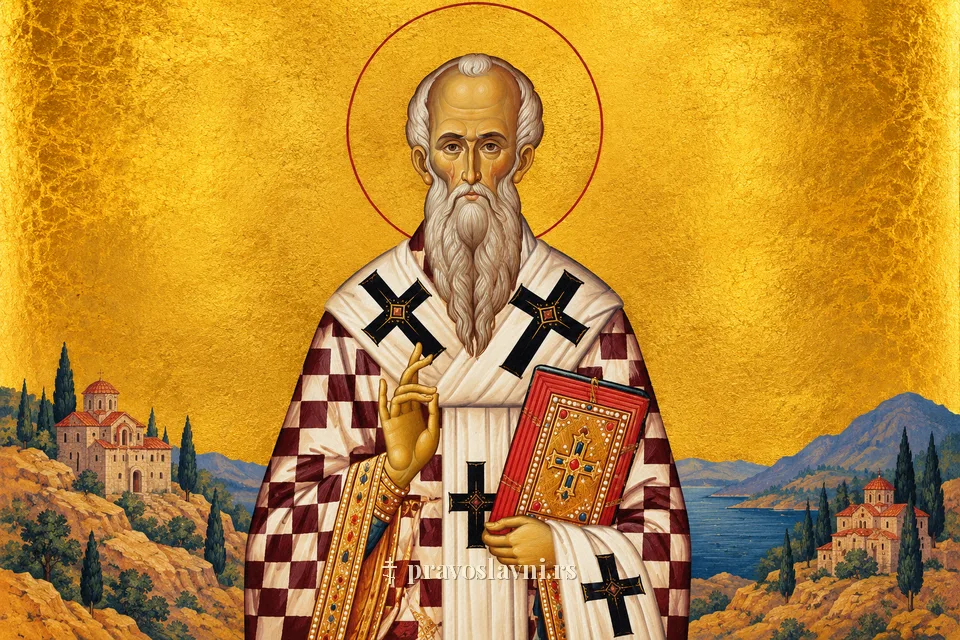
Hieromartyr Athenogenes
What happenedSt Athenogenes, Bishop of Sebaste in Armenia, was beheaded by the sword for Christ, together with his disciples, in the time of the Emperor Diocletian.
Read the LifeOrthodox Calendar · 16 July according to the Julian calendar
Wednesday, 29 July 202616 July (according to the Julian calendar)What happenedSt Athenogenes, Bishop of Sebaste in Armenia, was beheaded by the sword for Christ, together with his disciples, in the time of the Emperor Diocletian.
Read the Life
No meat, dairy products, eggs, fish or oil — food cooked in water.
This is a recommendation — for your own fast, consult your priest or spiritual father.More about the fast →
Today the Church keeps the commemoration of a saint · not a Red Letter day.
More about the feast →
“For if we live, we live to the Lord; and if we die, we die to the Lord. Therefore, whether we live or die, we are the Lord’s.”
— Rom 14:8St Athenogenes, Bishop of Sebaste in Armenia, bore witness that death for Christ is not a defeat. When many Christians had been killed in the time of Diocletian, and he was asked to offer sacrifice to the idols, he answered the persecutor Philomarchus that “those whom you call perished have not perished, but are in heaven and rejoice with the angels”.
He lived in a monastery near the city, with ten disciples. The Prologue also remembers the doe that he used to feed from his own hand: when she saw his suffering, she wept. The Prologue sees in this a reproach to men — a wild animal was more merciful towards the martyrs than the pagans were.
According to the Prologue, an angel of God lessened the pain of the martyrs. All of them were put to death by the sword: first his disciples — priests and fellow workers — and last of all the bishop. He suffered in the year 311.
In this way the shepherd followed Christ last, after he had sent his flock on before him.
The key to the life of St Athenogenes lies in the answer that he gave to his persecutor. After many Christians of Sebaste had already been killed, the bishop was required to offer sacrifice to the idols. He refused and said that “those whom you call perished have not perished, but are in heaven and rejoice with the angels”. Death for Christ was for him not the loss of life, but an entrance into heaven.
Athenogenes was Bishop of Sebaste in Armenia. He did not live in the city itself, but in a monastery close to it, where ten disciples lived with him. In the time of Diocletian there arrived in Sebaste Philomarchus, a man who persecuted Christians without mercy. He seized and put to death many of them, and then the bishop's turn came as well.
The Prologue also records one touching detail. Athenogenes had a doe which he used to feed from his own hand. In the hour of his trouble the animal came up to him and, when it saw how much he was suffering, it wept. The Prologue sees in this a reproach to men: the pagans were more cruel to the martyrs of Christ than the wild beasts of the mountains.
The tortures were severe, but, according to the Prologue, an angel of God lessened the martyrs' pain. In the end they were all put to death by the sword. First fell the disciples of Athenogenes — his priests and fellow workers — and last of all the bishop himself. This was in the year 311.
So Athenogenes did not leave his disciples even in death: he sent them on before him, and then went after them. The words that he had spoken to the persecutor about those who had suffered before him came true for him also.
Many miracles took place at the tomb of the holy martyr Julia, and one of them is preserved in the story of her church. When the faithful decided to build a new church in another place, the building material was returned to the old place during the night, and the night watch saw a radiant maiden who was carrying the material with white oxen; and so the church was built again where it had been before. Julia was a virgin from a distinguished family, a native of Carthage. When the city was conquered, she fell into slavery and was sold to a merchant in Syria. As a pagan, he often tried to turn her away from Christ; he did not succeed, but because of her faithful service he left her in peace. Once he took her with him on trading business to Corsica. While he was taking part in a festal sacrifice to the idols, Julia waited on the ship in tears. The pagans took her from the ship by force — according to her Life, although her master objected — tortured her and crucified her, and she gave up her spirit to God. This was in the sixth century. That she had suffered became known to the monks from Margarita, an island nearby, which is also called Gorgona: an angel brought them the news. They buried her body with reverence.


