Thursday30July 202617 July (according to the Julian calendar)‹›
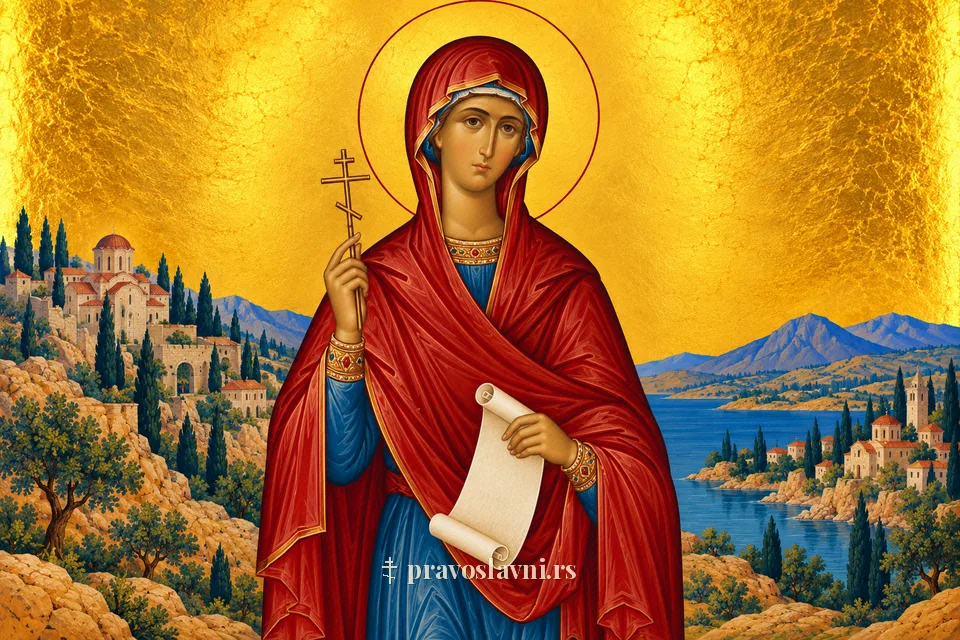
Illustration
Saint of the day
Ognjena Marija — Great Martyr Marina
Great Martyr Marina
What happenedThe holy Great Martyr Marina of Antioch in Pisidia confessed Christ as a young girl, overcame the devil by the sign of the cross and was beheaded by the sword.
Sung at the Slava (family patron saint's feast) and on the saint's feast day.
Thy lamb, O Jesus, Marina, crieth with a loud voice: Thee, O my Bridegroom, do I love, and seeking Thee I suffer, and am crucified and buried with Thee in Thy baptism, and I suffer for Thy sake, that I may reign in Thee; and I die for Thee, that I may also live with Thee. But as an unblemished sacrifice accept me, who with love have offered myself unto Thee. Through her prayers, since Thou art merciful, save our souls.
Ognjena Marija (“Fiery Mary”) is the folk name of the day on which the Church celebrates the Holy Great Martyr Marina. Many families celebrate this day as their Krsna slava (family patron saint's day). She did not yield before the authorities: she endured torture by fire and water and in the end, in the time of Diocletian, was beheaded.
By folk custom, Ognjena Marija, together with Blaga Marija (the day of St Mary Magdalene) and Trnova Petka (the day of the Venerable Martyr Paraskeva), is especially honoured, most of all among women. By folk custom, neither handwork nor field work is done on those days.
The holy Great Martyr Marina was born in Antioch of Pisidia, into a pagan family. At the age of twelve she learned about Christ and made a vow that she would not enter into marriage. Her father, who according to her Life was a priest of the idols, came to hate her because of her faith and disowned her.
The governor Olymbrius wanted first to take her as his wife, and then to force her to bow down to the idols. She refused both, and so he had her tortured and shut up in prison.
There, while she was praying, the devil came to her in the form of a serpent, but when Marina made the sign of the Cross the serpent burst and was no more. The prison was flooded with light from heaven, a shining cross appeared with a white dove, and a voice, as the Prologue records, greeted her: “rejoice, Marina, wise dove of Christ”. Her wounds were healed. She endured torture by fire and by water as though it did not concern her, and according to her Life many who saw this confessed Christ and suffered.
She was condemned to death by the sword; before her execution she saw the Lord Jesus surrounded by angels. She was beheaded in the time of Diocletian, and her passion, according to her Life, was written down by an eyewitness, Theotimus. According to the Prologue, her hand is kept at Vatopedi on the Holy Mountain (Mount Athos), and a part of her relics in her monastery above Lake Ohrid, where many miracles take place.
Full Life
Faith against her father's house
St Marina was born in Antioch of Pisidia, in a pagan family. Her Life says that she was of high birth, that her father Aedesius was a priest of the idols and that her mother died while she was still an infant, and so she grew up with a wet-nurse in a village near the city.
At the age of twelve she learned about Christ — according to her Life, from a certain man of God — and a great love for Him was born in her. She made a vow that she would not enter into marriage. Her father came to hate her because of her faith and disowned her.
The governor's two demands
According to her Life, she was fifteen years old when, as she was out tending her father's flock of sheep, the imperial governor Olymbrius noticed her and ordered her to be brought to him. At first he wanted her to be his wife. Since she refused this, he demanded that she bow down to the idols — and she would not agree to pay honour to dead statues without a soul. The governor therefore ordered her to be tortured, and, wounded as she was, they shut her up in prison.
The struggle in prison
While she was praying in prison, the devil came to her in the form of a terrifying serpent and coiled itself round her head. Marina made the sign of the cross, and the serpent burst and was no more; her Life says that the earth swallowed it up. Then a light from heaven lit up the prison. Marina saw a great shining cross, and on it a white dove, and she heard a voice speaking to her; the Prologue records the greeting: “rejoice, Marina, rational dove of Christ”. By the power of God all her wounds were healed.
A witness that moved others
On the next day, according to the Prologue, they tortured her with fire and with water, and she bore the pain as though it did not concern her. Her Life relates that they lowered her, bound, into a vessel of water, but the bonds came undone of themselves and she came out unharmed. That sight moved many men and women to confess Christ; according to her Life, the governor's soldiers put them to death, and the blood that they shed was their baptism.
The bride of Christ
The sentence was: death by the sword. Before her execution Marina saw the Lord Jesus surrounded by angels. According to her Life, she spoke to the assembled people and prayed for a long time, and the earth shook; her Life also records a voice from heaven: “Peace be to you, Marina, bride of Christ!” She was beheaded during the reign of Diocletian — according to her Life, on 17 July (according to the Julian calendar). As a witness of her suffering her Life names Theotimus, a servant of God, who wrote down what he saw.
According to the Prologue, one of her hands is in Vatopedi on the Holy Mountain (Mount Athos), and a part of her wonderworking relics is kept in her monastery on the mountain above Lake Ohrid, in Albania. The Prologue also says that many miracles take place there, to which Christians and Muslims bear witness, and that the Turks did not plunder that holy place, but respected it.