Saint of the day
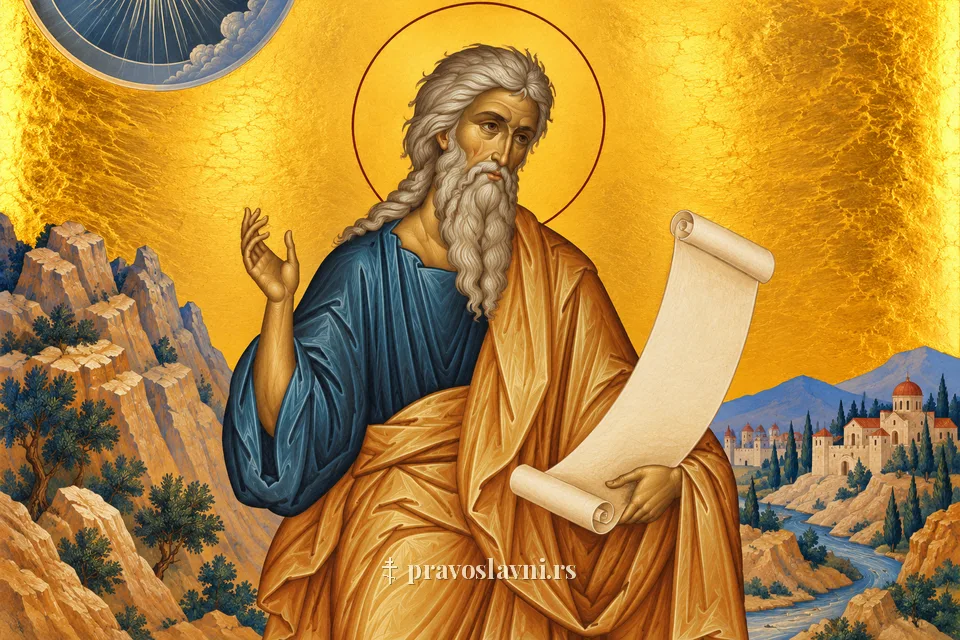
Holy Prophet Ezekiel
What happenedThe Holy Prophet Ezekiel prophesied among the Israelites in the Babylonian captivity, and in visions he beheld the glory of God and the resurrection of the dead.
Read the LifeOrthodox Calendar · 21 July according to the Julian calendar
Monday, 3 August 202621 July (according to the Julian calendar)What happenedThe Holy Prophet Ezekiel prophesied among the Israelites in the Babylonian captivity, and in visions he beheld the glory of God and the resurrection of the dead.
Read the Life
You may eat meat, eggs, milk and dairy products, as well as any other food — but try to be moderate.
More about the fast →
Today the Church keeps the commemoration of a saint · not a Red Letter day.
More about the feast →
“Son of man, I have made you a watchman for the house of Israel; therefore hear a word from My mouth, and give them warning from Me.”
— Ezek 3:17In a valley full of dry bones the Prophet Ezekiel saw how the bones come to life when the Spirit of God comes upon them (Ezek 37). That vision is an image of the resurrection of the dead.
Ezekiel was the son of a priest and came from the town of Sarira. Together with King Jeconiah and many Israelites he was led away into the Babylonian captivity and, as the Prologue says, he prophesied there for twenty-seven years. He was a contemporary of Jeremiah: the one preached in Jerusalem, the other in Babylon, and their prophecies confirmed each other.
By the river Chebar he saw the heavens opened and four living creatures with the face of a man, a lion, a calf and an eagle. He spoke to the people by deeds as well: according to his Life, he shaved his head and his beard and divided the hair into three parts, showing what awaited the people. According to his Life, God gave him a scroll to eat, sweet as honey, and set him as a watchman over the house of Israel. He also saw the destruction of Jerusalem, in which those were spared who had been marked on the forehead with the Greek letter tau, which resembles a cross. His Life, relying on trustworthy narrators, records that by prayer he parted the river Chebar and that in a time of famine he multiplied food.
He was killed because he rebuked his own countrymen, and he was buried in the tomb of Shem, the son of Noah, where, according to his Life, the Jews used to gather for prayer. His visions point to the Incarnation of Christ and to the resurrection of the dead.
Ezekiel preached far from his homeland. Together with King Jehoiachin and a multitude of Israelites he was led away to Babylon, according to his Life after the second fall of Jerusalem, and he settled in the land of the Chaldeans, by the river Chebar. The Prologue says that he prophesied there for twenty-seven years. He was the son of a priest, from the town of Sarir, and his Life adds that he was descended from the tribe of Levi.
His Life says that God gave him a scroll to eat, sweet as honey, and set him to keep watch over the house of Israel. He shared this ministry with Jeremiah: while the one admonished Jerusalem, the other spoke to the exiles in Babylon, and the words of the one confirmed the words of the other. Both of them suffered at the hands of a people who did not want to believe.
He received a great vision on the Chebar: the heavens opened, a cloud, fire and four living creatures, each with the face of a man, a lion, a calf and an eagle. His Life records that the prophet was then thirty years old, that it was the fifth year of Jehoiachin's captivity, and it describes the wheels, the crystal firmament and the sapphire throne, on which there was the likeness of a man.
According to the Prologue, in those four faces one can read the whole path of the Lord: His divinity, incarnation, sacrifice, resurrection and ascension. His Life starts from the interpretation of men wise in God, and in the likeness of a man on the throne it sees the incarnation of the Son of God from the Most Pure Virgin, in the sapphire throne a prefiguration of her, and in the four faces the four evangelists. His Life recognises the Most Pure Virgin also in the shut gate from the prophet's vision (Ezek 44:2).
The prophet gave signs by deed as well. According to his Life, he once shaved his head and beard and divided the hair: a third he burned, a third he cut up with a sword, and a third he scattered to the wind, so that the people might see what awaited them. In a vision, as his Life says, he was carried to the temple in Jerusalem, where he beheld idolatry and the glory of God departing from the temple. He also saw the destruction of Jerusalem, in which those were spared who bore on their foreheads the Greek letter tau, a sign resembling a cross.
After judgement came hope. In the valley of dry bones Ezekiel watched the bones come to life when the Spirit of God descended on them (Ezek 37), which is an image of the resurrection of the dead. His Life adds that he also saw Jerusalem measured out and the temple renewed and full of the glory of God, and that he foretold the return from Babylon.
Miracles too remained after Ezekiel. His Life records them on the testimony of trustworthy narrators: when the Chaldeans were pursuing the Jews, the prophet parted the Chebar by prayer, the Jews crossed over on dry ground, and the pursuers were drowned. In a time of famine he multiplied food. For this reason his Life compares him with Moses.
He rebuked his fellow countrymen to the end, and for this he was killed; according to his Life, he was killed by an elder who had given himself over to Chaldean idolatry. He was buried in the tomb of Shem, the son of Noah. His Life adds that the tomb was in the field of Maur, that Shem and Arphaxad, the forefathers of Abraham, rested in it, and that the Jews used to come there to pray.
According to the Prologue, two young men left their homes and their kinsfolk: Simeon his old mother, and John his young wife. They were tonsured as monks by Abbot Nikon in the monastery of St Gerasimus; then they went into the desert and there lived the ascetic life long and hard. John gave Simeon advice about guarding the heart and the mind, and Simeon kissed him and went out of the desert to live among people. The Prologue says of him: “He pretended to be mad before men.” In the streets he behaved like a madman, but he had spiritual gifts: he saw through hidden things, he healed those who were tormented by evil spirits and the sick, and he called sinners to repentance, sometimes even through dreams. Once he struck a young man who was living in fornication, and the young man was healed.
Separate page: Venerable Simeon the Fool-for-Christ and John →