Sung at the Slava (family patron saint's feast) and on the saint's feast day.
Christ, who for our sake was born of the Virgin, didst thou follow, O honoured Mary Magdalene, keeping His statutes and laws. Wherefore, celebrating today thine all-holy memory, we receive remission of sins through thy prayers.
Blaga Marija — St Mary Magdalene, Equal-to-the-Apostles
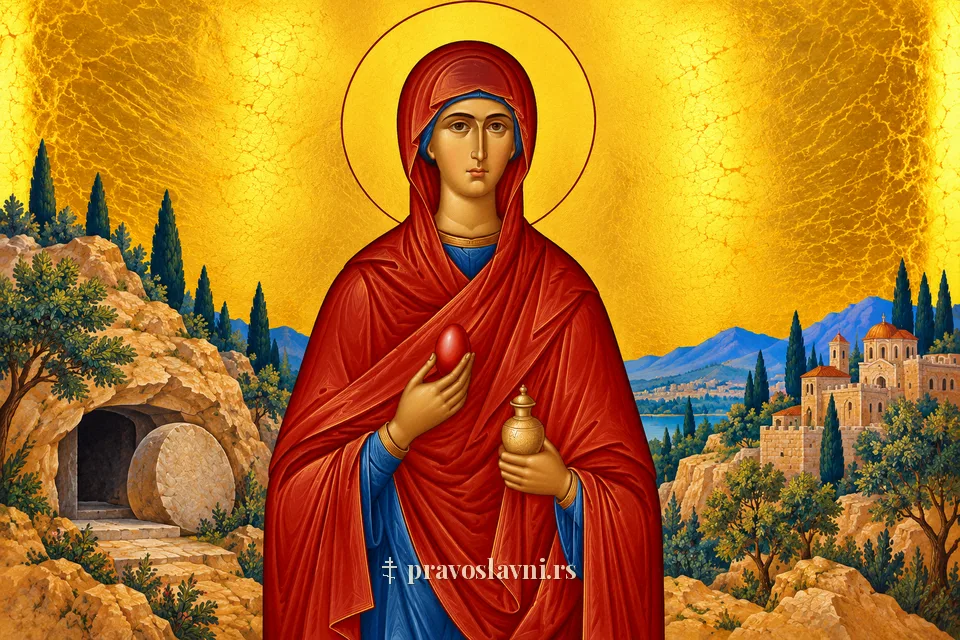
Blaga Marija (“Gentle Mary”) is the folk name of the day on which the Church celebrates St Mary Magdalene, Myrrh-bearer and Equal-to-the-Apostles. According to tradition, she also went to Rome, where she offered Emperor Tiberius a red egg as a sign of the resurrection.
By folk custom, Blaga Marija, together with Ognjena Marija (the day of the Great Martyr Marina) and Trnova Petka (the day of the Venerable Martyr Paraskeva), is especially honoured, most of all among women. By folk custom, neither handwork nor field work is done on that day.
When she stood before the Emperor Tiberius in Rome, Mary Magdalene brought him as a gift an egg of red colour and greeted him: “Christ is risen!” On that occasion she also spoke about Pilate, who had condemned the Lord though He was without guilt; after this the Emperor removed him to Gaul, where Pilate died in disgrace.
She was from Magdala, from which she takes her name. Seven evil spirits tormented her until the Lord Jesus delivered her. From then on she followed Him and served Him until His Passion and burial, and on Golgotha she stood beneath the Cross together with the Most Holy Theotokos.
After the Lord's death she came to the tomb three times, bringing myrrh. According to her Life, the first time she came while it was still dark, found the stone rolled away and told Peter and John of it. The second time she wept beside the tomb and took the risen Christ for the gardener, until He called her by name and sent her to the brethren. The third time she came with the other Myrrh-bearing Women, to whom an angel proclaimed the Resurrection. Her Life says that she was the first to see Him risen and the first to proclaim Him.
From Rome she went to Ephesus, to St John the Theologian, and helped him in his preaching, for which, according to her Life, she is called Equal-to-the-Apostles. It was in Ephesus that she ended her life in peace. The Prologue records the tradition that her tomb was the cave in which, much later, the Seven Youths would fall asleep. Her relics were later translated to Constantinople.
Her Life warns that she should not be confused with Mary of Bethany, nor with the sinful woman who washed Christ's feet. The Prologue, at her commemoration, teaches that there is no repentance without tears, and cites the counsel of St Macarius to the monks that they should weep while still in this world. The people call this feast Blaga Marija.
Full Life
From Magdala
Mary was from Magdala, which is why she is called Magdalene; the Prologue places that town by the Lake of Gennesaret. She was of the tribe of Issachar. Seven evil spirits tormented her. According to her Life, she heard of Christ, who casts out demons and heals the sick, and she came to Him in Galilee. The Lord Jesus freed her from the evil spirits and healed her; her Life says that He healed both her soul and her body and enlightened her to believe in Him as the Messiah.
Her Life rejects the opinion that she is Mary of Bethany, the sister of Lazarus, or the sinful woman who washed Christ's feet. The Church's books, as it says, distinguish these three women.
Faithful as far as Golgotha
From then on she was a faithful follower of Christ and ministered to Him, according to her Life together with the other holy women, right up to His Passion and burial. She stood beneath the cross on Golgotha with the Most Holy Theotokos.
After the Lord's death she came to the tomb three times; her Life says that she brought myrrh. The first time, according to her Life, she came while it was still dark, saw that the stone had been rolled away from the tomb, and ran to tell the apostles Peter and John. The second time she stayed to weep by the tomb. She saw two angels in white, and she took the risen Christ for the gardener, until He called her by name. He sent her to the brethren. The third time she came after sunrise, with the other myrrh-bearers. An angel announced the resurrection to them, and Christ met them, greeted them and sent them to His brethren.
According to the Prologue, she saw the risen Lord on two occasions, the first time alone, and then in the company of the other myrrh-bearers. Her Life stresses that she was the first to see the risen Lord and the first to proclaim Him. The woman whom Christ had freed from seven evil spirits thus became the first herald of His resurrection.
Before the emperor in Rome
According to her Life, she then preached Christ in many lands. Both sources say that she also came to Rome, before Emperor Tiberius. She brought him as a gift an egg of red colour, and the greeting she spoke was: “Christ is risen!”
She was not content with a greeting: before the emperor she also accused Pilate of having unjustly condemned the Lord. The emperor removed Pilate from Jerusalem and sent him to Gaul, where he died in disgrace and grave illness.
In Ephesus with John
From Rome she went to Ephesus, to St John the Theologian, and helped him in the preaching of the Gospel; her Life says that this is why she is called Equal-to-the-Apostles. In Ephesus she reposed in peace. She was buried in the cave in which the Seven Youths later slept; the Prologue gives this as a tradition. Her relics were later translated to Constantinople. Her Life says that they were incorrupt and that they were laid in the church of the monastery of St Lazarus. The Prologue also mentions the Russian church dedicated to her near the Garden of Gethsemane.
Tears of repentance
On her commemoration the Prologue speaks about tears. Without tears, says the Prologue, there is no true repentance; that is why St Macarius advised monks to shed tears while still in this world, before departing from it.
Mary Magdalene was healed by Christ and served Him faithfully. She stood beneath the cross, was the first to see the Risen One, and boldly preached Him, even before the emperor. The people call her feast Blaga Marija.
Other saints of the day
Hieromartyr Phocas
Today, according to the Prologue, we remember the translation of the relics of the holy Hieromartyr Phocas from Pontus to Constantinople, about the year 404; the Prologue gives his Life and suffering under 22 September (according to the Julian calendar). Here the Prologue also tells of a miracle. A certain man, who had been taken captive by the Arabs, was left on the ground to die, with his hands tied behind his back. Lying like this, he called upon the saint with the words: “Holy martyr Phocas, have mercy on me and save me!” He fell asleep, and St Phocas appeared to him in a dream, touched him and said that the Lord forgave him. When he woke up, he was freed from all his bonds. At home, from then on, he kept St Phocas as his Krsna slava (family patron saint's day).