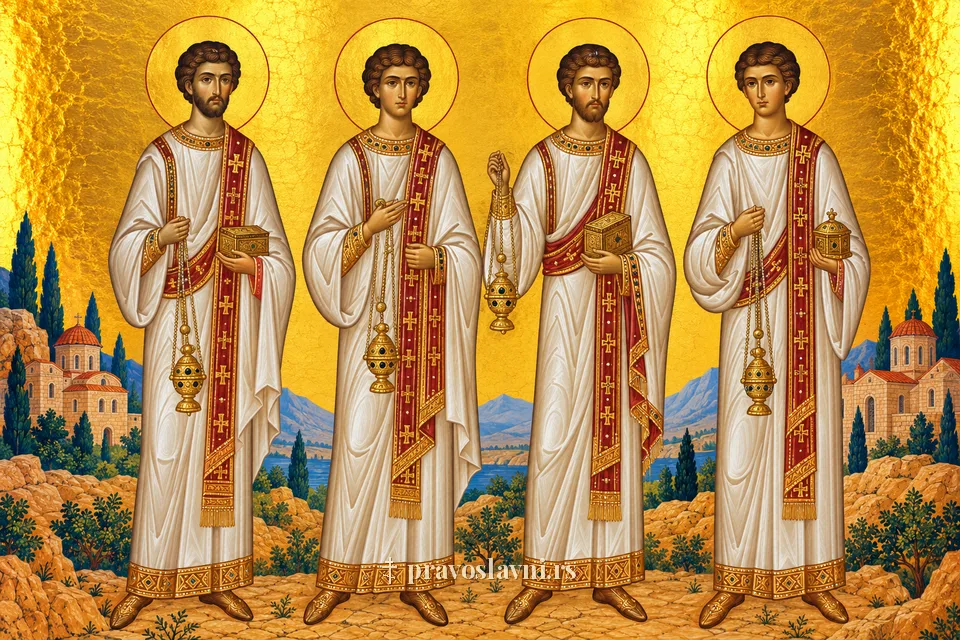
Saints of the day
Holy Apostles and Deacons Prochorus, Nicanor, Timon and Parmenas
What happenedThe Church celebrates together four of the first seven deacons, Prochorus, Nicanor, Timon and Parmenas, preachers of the Gospel.
Read the LifeOrthodox Calendar · 28 July according to the Julian calendar
Monday, 10 August 202628 July (according to the Julian calendar)What happenedThe Church celebrates together four of the first seven deacons, Prochorus, Nicanor, Timon and Parmenas, preachers of the Gospel.
Read the Life
You may eat meat, eggs, milk and dairy products, as well as any other food — but try to be moderate.
More about the fast →
Today the Church keeps the commemoration of a saint · not a Red Letter day.
More about the feast →
“Therefore, brethren, seek out from among you seven men of good reputation, full of the Holy Spirit and wisdom, whom we may appoint over this business.”
— Acts 6:3Prochorus, Nicanor, Timon and Parmenas were among the seven deacons whom the first Church in Jerusalem chose for service. The Apostles prayed for them and laid their hands on them (Acts 6:1–6), and the Prologue also numbers them among the Seventy Apostles. Since they have no separate feast days of their own, the Church celebrates them together, today.
Their service took them in different directions. Prochorus was with the Apostles Peter and John. Peter appointed him Bishop of Nicomedia, and with John he shared the exile on Patmos, where he wrote down the revelations which John dictated to him. Timon became a bishop in Arabia.
The ends of their lives were different too. Nicanor and the Archdeacon Stephen suffered in Jerusalem on the same day, and about two thousand other Christians also laid down their lives for the faith there. Prochorus, according to the Prologue, was killed by unbelievers in Antioch. Timon suffered for Christ on a cross, and their Life says that before this not even a fiery furnace had harmed him. Parmenas was seen off by the Apostles themselves: they were beside him when he died, they mourned him and, according to the Life, buried him with their own hands.
These four were chosen to serve in the first Church, and they became preachers of the Gospel and, for the most part, martyrs. In them humble service and apostolic witness go together.
After the Ascension of the Lord and the descent of the Holy Spirit, the number of the faithful in Jerusalem was growing. On the advice of the apostles, seven men full of the Holy Spirit and wisdom were chosen for the service of deacons, and the apostles prayed and laid their hands on them (Acts 6:1–6). Among them were Prochorus, Nicanor, Timon and Parmenas, whom the Prologue also numbers among the Seventy Apostles. They were chosen first of all to serve, and they became preachers as well.
Of the remaining three, Stephen is commemorated on 27 December and Philip on 11 October, both dates by the Julian calendar; Nicholas, because of heresy, is not numbered among the saints. Their Life says: “The other four have no separate feast days, but the holy Church celebrates them all together on this present day.” Although the Church honours them together, their Life notes that they did not die either at the same time or in the same place.
Prochorus was for a long time at the side of two apostles. According to their Life, he accompanied the Apostle Peter until the Dormition of the Most Holy Theotokos, and Peter, as the Prologue says, appointed him Bishop of Nicomedia; for this their Life refers to Symeon Metaphrastes. With the Evangelist John he shared, according to their Life, labours, journeys and persecutions, and even exile on Patmos. There John spoke the revelations, and Prochorus wrote them down.
When he found himself in Nicomedia again, whose first bishop he was according to their Life, he worked for the conversion of its inhabitants. He ended his life in Antioch, and the Prologue says of this: “He died a martyr's death in Antioch, where he was killed by unbelievers.”
Nicanor and Stephen, two of the seven, suffered in Jerusalem on the same day. About two thousand other Christians also laid down their lives for the faith there.
Timon, according to their Life, was appointed bishop in Bostra by the apostles, while the Prologue says that he was a bishop in Arabia. He endured much for preaching Christ, and their Life records that not even a fiery furnace harmed him. The Prologue says that he suffered on a cross, and their Life states the same, referring to the Roman Martyrology.
Of Parmenas the Prologue records: “Parmenas died before the eyes of the apostles, and by them he was mourned and buried.” Their Life remembers him as a zealous preacher, to whom the apostles entrusted the preaching, and adds that they buried him with their own hands.
These four were chosen first of all to serve in the early Church, and they became preachers of the Gospel and, for the most part, martyrs. Their example shows that humble service and apostolic witness go together.


