Saint of the day
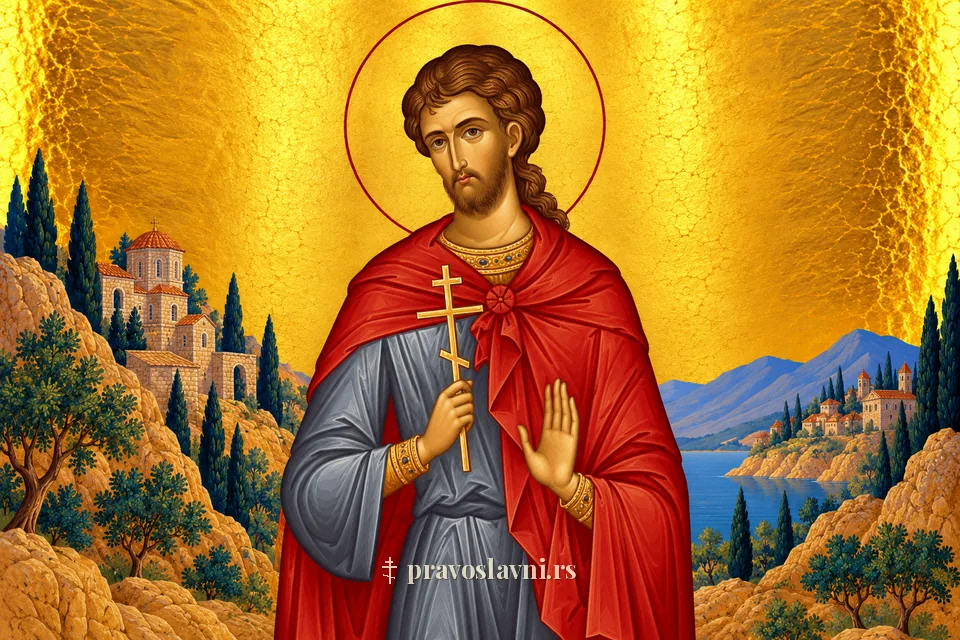
Holy Martyr Callinicus
What happenedThe Holy Martyr Callinicus, a preacher from Cilicia, on his way to death brought water out of a rock by prayer for his guards.
Read the LifeOrthodox Calendar · 29 July according to the Julian calendar
Tuesday, 11 August 202629 July (according to the Julian calendar)What happenedThe Holy Martyr Callinicus, a preacher from Cilicia, on his way to death brought water out of a rock by prayer for his guards.
Read the Life
You may eat meat, eggs, milk and dairy products, as well as any other food — but try to be moderate.
More about the fast →
Today the Church keeps the commemoration of a saint · not a Red Letter day.
More about the feast →
“For to you it has been granted on behalf of Christ, not only to believe in Him, but also to suffer for His sake.”
— Phil 1:29On the road to Gangra, where he was to be put to death, St Callinicus took pity on his guards: when their water ran out, he prayed and brought water out of a rock.
He was born in Cilicia and from childhood was brought up in Christian piety. He left everything for the sake of preaching the Gospel. In Ancyra they seized him and brought him before the pagan governor Sacerdon. The Prologue records that to the threats he answered: “to me every torment for my God is as welcome as bread to a hungry man”. According to his Life, he also said to him: “By threats you will not frighten a true servant of Christ.” They tortured him, but he remained unshaken. The governor hesitated to put him to death in Ancyra, where the patient endurance of Callinicus had converted many to the faith, and so he sent him, in his torments, to Gangra.
The miracle of the water took place on that road. The soldiers drank and glorified the God of the Christians, and the spring, according to his Life, went on flowing in memory of that miracle. Out of gratitude they did not want to put him to death, but, according to his Life, they were afraid of the governor. In Gangra, after a prayer of thanksgiving, he went into the red-hot furnace of his own accord. The flames died down, and his body remained whole, untouched by the fire, although he himself was dead. The Prologue says that he suffered around the year 250.
His example shows that suffering for God can be accepted with joy, and that even then mercy towards others is not lost.
Callinicus was born in Cilicia and was brought up from childhood in Christian piety. He left everything in order to preach the Gospel. His Life says that he grieved over those who bow down to idols and that he went round many towns and villages preaching. He stayed for a long time in Ancyra of Galatia and brought many to God.
In Ancyra they seized him and brought him before the pagan governor Sacerdos; according to his Life, he was accused of teaching the people not to offer sacrifices to the gods. The Prologue records that he answered the threats: “to me every torment for my God is as welcome as bread to a hungry man”. According to his Life, he also said: “You will not frighten a true servant of Christ with threats”. He answered calmly and, as his Life says, he wished to lead the governor himself out of darkness into light. Then they beat him and tortured him, but he remained unshaken.
According to the Prologue, the governor was reluctant to put him to death in Ancyra, where Callinicus' endurance had converted many to the faith. According to his Life, he wanted Callinicus to perish in Gangra, in order to frighten those whom he had converted there. And so, in chains and in torment, he was sent to Gangra.
His Life says that Gangra was about eighty stadia distant from Ancyra and that Callinicus, driven on by horsemen, ran ahead of their horses singing a psalm. On the way the soldiers ran out of water. At their request he prayed and brought water out of a rock. According to his Life, this happened at a place called Matrica, in July; he prayed that God would give water as He had given it to Moses in the wilderness. They all drank and glorified the God of the Christians, and the spring, according to his Life, went on flowing in memory of that miracle.
Out of gratitude the soldiers did not want to put him to death, but, according to his Life, they were afraid of the governor and they stoked the furnace.
In Gangra Callinicus prayed and gave thanks to God: “I thank You, heavenly Father, that You have made me worthy of this hour, in which I die for Your holy name”. Then he went into the red-hot furnace. The flames then died down. Callinicus was dead, but the fire had not touched his body, which remained whole. According to his Life, the faithful took the body and buried it with honour. The Prologue says that he suffered around the year 250.
Callinicus accepted suffering for God gladly, as he himself said before the governor. Even on the road to death he had mercy on his guards, and he thanked God for having counted him worthy to die for His name.
St Seraphima was a maiden from Antioch. Sabina, a senator's wife, in whose house Seraphima lived, became a Christian through Seraphima's efforts. The persecutor Berillus, according to her Life a governor, brought her to trial. Her Life says that the first time he let them both go home because of Sabina's distinguished family, and that after three days he summoned Seraphima again. She would not deny the faith and said: “I fear and serve the almighty God, Who created heaven and earth, and all that is in them.” Berillus then handed her over to two young men to dishonour her. While she was praying, the young men fell down powerless: according to the Prologue, an angel with a sword appeared at the door, and according to her Life, the young men said afterwards that a radiant youth had separated them from her. The next day she raised them up by prayer in the name of Christ, with the words: “In the name of our Lord Jesus Christ, stand up on your feet!” Berillus accused her of sorcery and handed her over to torture, and while they were beating her, a small piece of a rod struck him in the eye and he went blind, according to her Life for three days. At last she was beheaded. Sabina buried her with honour, according to her Life in her own new tomb. The Prologue says that healings began at her tomb and that she suffered in the time of Emperor Hadrian.


