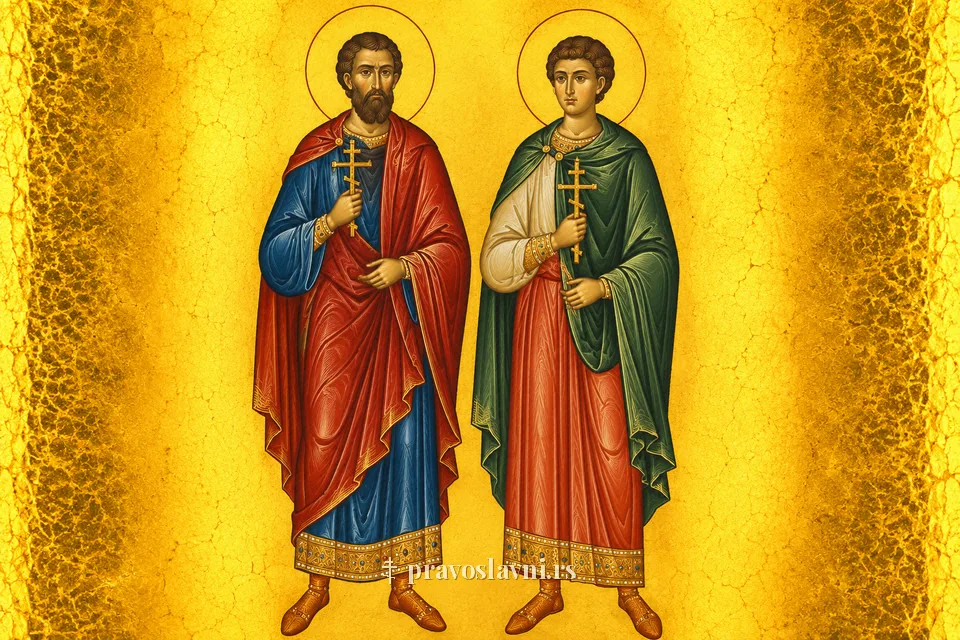
Saints of the day
Holy Martyrs Photius, Anicetus and those with them
What happenedSt Anicetus and his kinsman Photius were thrown into a burning furnace in Nicomedia, and a multitude of Christians followed them of their own free will.
Read the LifeOrthodox Calendar · 12 August according to the Julian calendar
Tuesday, 25 August 202612 August (according to the Julian calendar)What happenedSt Anicetus and his kinsman Photius were thrown into a burning furnace in Nicomedia, and a multitude of Christians followed them of their own free will.
Read the Life
No meat, dairy products, eggs, fish or oil — food cooked in water.
This is a recommendation — for your own fast, consult your priest or spiritual father.More about the fast →
Today the Church keeps the commemoration of a saint · not a Red Letter day.
More about the feast →
“Look!” he answered, “I see four men loose, walking in the midst of the fire; and they are not hurt, and the form of the fourth is like the Son of God.”
— Dan 3:92Sts Photius and Anicetus suffered in Nicomedia, where Emperor Diocletian had come in order to wipe out the Christians; according to the Life, he sent out orders throughout the whole empire that Christians were to be seized and killed. Anicetus, one of the first men of the city — according to the Prologue the city governor — confessed Christ before the emperor as the Son of God and as God, and called the idols deaf and dumb. Torture did not silence him: he did not cease to confess the faith. His kinsman Photius embraced him before everyone, called himself a Christian and rebuked the emperor; according to the Life, he flung at him the words: “Be ashamed, you idolater!”
God guarded them visibly. A lion let loose on Anicetus became tame, and at that time the temple of Hercules collapsed; the Life writes that at Anicetus's prayer the earth shook and both the temple and the idol fell. The sword raised against Photius turned against the executioner himself, and he died. The Life lists further miracles, among them a stone bath-house that was heated for three days, in which the guards found them alive and glorifying God.
Both of them spent three years in prison, and according to the Life they refused both the honours and the wealth which the emperor offered them. In the end they were thrown into a red-hot furnace, according to the Life an enormous one. After them, without anyone's compulsion, there entered a multitude of believers, not only men but also women and children, confessing the faith with the words: “We are Christians! we worship the one God!” Because of them this commemoration refers also to the others who suffered with them. According to the Prologue, they met a martyr's death in the flames, giving thanks to God. According to the Life, the martyrs were still alive in the furnace for three hours, and their bodies were taken out untouched by the fire, which brought many pagans to Christ. According to the Prologue, they suffered around the year 305.
The Church remembers them in the prayers of Holy Unction and of the Blessing of Water. Their endurance bears witness that a tyrant cannot overcome those whom God guards, and their example drew ordinary believers after them as well.
Emperor Diocletian came to Nicomedia, according to the Life in the region of Bithynia, determined to stamp out Christianity in that city. The Life adds that he set up instruments of torture in the middle of the city, and sent orders throughout the empire that Christians everywhere be seized and killed.
One of the foremost men of Nicomedia was Anicetus. The Prologue calls him the governor of the city, and the Life a nobleman and a distinguished dignitary.
Before the Emperor Anicetus bore witness that Christ is the true Son of God and God. Of the idols he said that they are deaf and dumb — the Prologue calls them stones, the Life speechless things — and that no torture would frighten the Christians. They tortured him, and according to the Life beat him cruelly as well, but he did not cease to confess the faith.
His kinsman Photius took his stand beside him. He went up to Anicetus, embraced him and kissed him, and then before everyone called himself a Christian and rebuked the Emperor. The Life says that he called Anicetus his father and protector, and flung at the Emperor the words: “Be ashamed, idolater!”
Both of them were then thrown into prison, where they spent three years in all. Not even offers could shake them. According to the Life, on the third day of their imprisonment the Emperor promised them honours and riches if they would offer sacrifice to the gods, and they refused. When, according to the Life, he later came to see them, they told him that it was he who had been defeated and put to shame, and not they.
God visibly guarded the lives of both. A lion let loose on Anicetus grew tame — according to the Prologue it fawned on him, according to the Life it wiped away his sweat with its paw. Then the temple of Hercules collapsed; the Life writes that at Anicetus's prayer the earth trembled, that the temple, the idol and a piece of the city wall fell, and that many pagans perished. When Photius was to be beheaded, the sword turned against the executioner himself and he died; according to the Prologue he struck himself, and according to the Life the blade turned on him in the soldier's hand.
The Life lists other miracles too. The executioner who raised his sword against Anicetus was suddenly deprived of his strength, and he fell down as if dead. When they bound him to a wheel over a fire, the bonds loosened, the wheel stopped, and the fire went out. In the cauldron of lead an angel was seen beside the martyr, and the lead grew cold. The wild horses to which both of them were tied stood still, and the martyrs remained unharmed. After three years of imprisonment they were shut in a public stone bath-house, which was heated for three days; at their prayer the walls cracked, a spring gushed forth, and when the guards went in, the martyrs were alive and singing praise to God.
At last they were thrown into a white-hot furnace; according to the Life it was enormous, raised on four iron pillars, and on that occasion the Emperor compared himself to Nebuchadnezzar. Then there happened that for which other martyrs too are honoured together with Photius and Anicetus. Without being forced by anyone, many of the faithful went into the flames after them, not only men but also women and children, confessing the faith; according to the Life, they said: “We are Christians! We honour the one God!”
According to the Prologue, they met a martyr's death giving thanks to God, and that voice of theirs was heard from the furnace. According to the Life, for three more hours the fire did not take their lives, and only then did they give up their souls to God. According to the Life, the fire harmed neither their bodies nor their hair, and that sight brought many pagans to Christ. According to the Prologue, they suffered around the year 305.
The Church commemorates Sts Photius and Anicetus in the prayers of Holy Unction and of the Blessing of Water. Their endurance showed that a tyrant cannot overcome those whom God protects, and their example led ordinary believers after them, even women and children.


