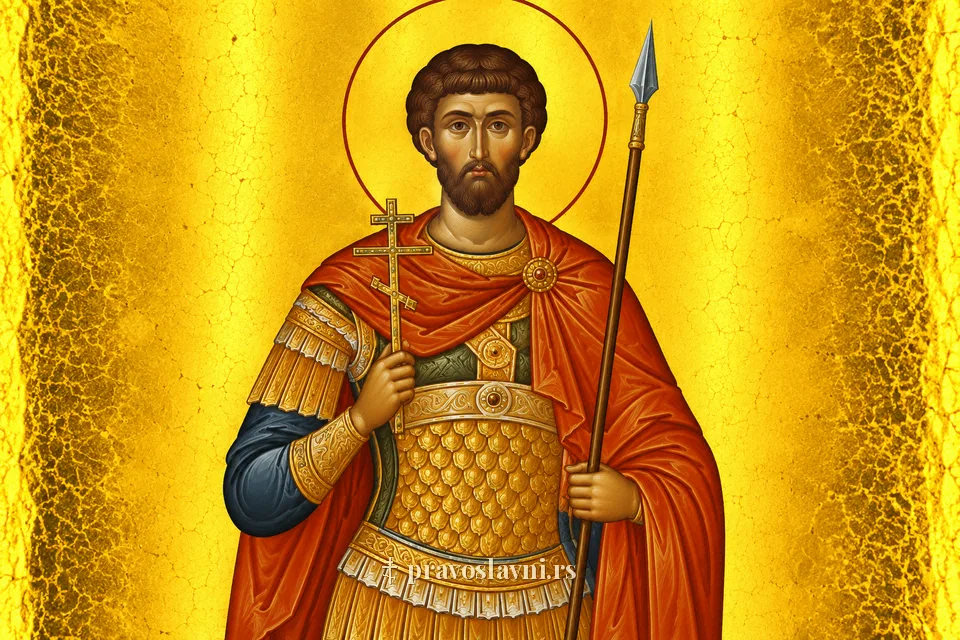
Saint of the day
Holy Martyr Hippolytus
What happenedSt Hippolytus, a Roman commander and gaoler who received the faith from his prisoner Lawrence, suffered together with all his household.
Read the LifeOrthodox Calendar · 13 August according to the Julian calendar
Wednesday, 26 August 202613 August (according to the Julian calendar)What happenedSt Hippolytus, a Roman commander and gaoler who received the faith from his prisoner Lawrence, suffered together with all his household.
Read the Life
No meat, dairy products, eggs, fish or oil — food cooked in water.
This is a recommendation — for your own fast, consult your priest or spiritual father.More about the fast →
Today the Church keeps the commemoration of a saint · Leavetaking of the Transfiguration..
More about the feast →
“For as many of you as were baptized into Christ have put on Christ.”
— Gal 3:27Hippolytus was a military commander and the overseer of a prison in Rome, according to the Prologue a pagan by birth and by upbringing. When Archdeacon Lawrence, who had been thrown into prison, was handed over to him to be guarded, the prisoner, according to the Life, became the teacher of his keeper. According to the Prologue, as he watched Lawrence open the eyes of the blind Lucillus and heal the sick, Hippolytus came to believe in Christ. Lawrence baptised him and his whole household, nineteen souls, among them the old nurse Concordia.
When Lawrence had suffered, Hippolytus took his body by night and buried it. According to the Life, on the third day he prayed with his household and received Holy Communion, and before they had sat down at table, soldiers arrested him and brought him before Emperor Decius. He would not renounce the faith even before the emperor. When they stripped him of his clothing, he said to the emperor: “you have not stripped me, but have begun to clothe me!” While they were torturing him, he kept repeating: “I am a Christian!” According to the Life, when he was reminded of his military rank he answered that he was a soldier of Christ, ready to die for Him.
According to the Life, the emperor ordered the prefect Valerian to take away his property and put him to death, and the property was confiscated that same day. The first to suffer was Concordia, who would not renounce the faith of her master, and Hippolytus rejoiced at her steadfastness. The other eighteen members of the household, according to the Life led out through the Tiburtine Gate, men and women of various ages, were beheaded before his eyes; according to the Life, he encouraged them on the way: “Brethren, do not be afraid!” At last Hippolytus himself, their master, was put to death. According to the Life, he suffered three days after Lawrence, and the presbyter Justin buried the bodies of the martyrs by night. According to the Life, the body of Concordia, which had been thrown into an unclean place, was found undefiled and was buried beside Hippolytus.
The gaoler became the disciple of his prisoner. Faithfulness to Christ was worth more to him than rank, property and life itself, and his whole household confessed Christ together, encouraging one another.
Hippolytus was a military commander and the head of the prison in Rome. According to the Prologue, he was born and brought up as a pagan. Archdeacon Lawrence, thrown into prison, was handed over to him to be guarded; the Life says that the prisoner became the teacher of his keeper.
According to the Prologue, Hippolytus watched as Lawrence opened the eyes of the blind Lucillus and healed other sick people as well, and this brought him to faith in Christ. According to the Prologue, he received Lawrence into his home. Lawrence baptised him and his whole household, nineteen souls, among them the old nurse Concordia.
Hippolytus did not abandon Lawrence's body: after the archdeacon's martyrdom he himself buried it by night, and according to the Prologue he first wrapped it in linen. According to the Life, on the third day he prayed at home with his household and received Holy Communion, and before they had sat down at table, soldiers arrested him.
He was brought before Emperor Decius. According to the Life, the Emperor mocked him as a sorcerer because he had carried away Lawrence's body, and Hippolytus answered that he was a Christian. He would not renounce the faith. They tortured him and stripped off his clothes, and he said to the Emperor: “you have not stripped me, but have begun to clothe me!” The Life puts the same thought in this way: he had put on Christ. While they were beating him, he kept repeating without ceasing: “I am a Christian!” According to the Life, when they reminded him of his military rank, he said that he was a soldier of Christ, ready to die for Him.
According to the Life, Decius ordered the prefect Valerian to take away his property and to put him to death, and the property was confiscated the same day. The first to suffer was Concordia. The Life says that she would not renounce the faith of her master and that she died under the blows. Hippolytus rejoiced at her steadfastness.
According to the Life, the members of the household were led out through the Tiburtine Gate, and on the way Hippolytus encouraged them: “Brethren, do not be afraid!” The other eighteen, men and women of various ages, were beheaded before his eyes. Then Hippolytus was put to death. According to the Life, he suffered on 13 August (according to the Julian calendar), three days after Lawrence.
The burial of the martyrs, according to the Life, was carried out by the presbyter Justin, who came by night for their bodies. The body of Concordia had been thrown into an unclean place; on the twentieth day it was found by Irenaeus and Abundius, undefiled, and Justin buried it beside Hippolytus. Because of this Irenaeus and Abundius themselves suffered too, and St Julian secretly buried them near the relics of Lawrence.
The gaoler became the disciple of his prisoner, and he who had guarded Christians in chains himself suffered for Christ. Rank, property and life itself were worth less to him than faithfulness to Christ. He did not suffer alone: his whole household confessed the faith together, encouraging one another to the end.
St Tikhon of Zadonsk, or of Voronezh, was born in 1724 in the village of Korotsko in the Novgorod governorate, into a poor peasant family. According to his Life, he lost his father early, his mother struggled to support the children, and in the world he was called Timothy. He studied at the Novgorod seminary, where even before finishing he taught Greek, and after finishing in 1754 he taught rhetoric as well. He became a monk at the age of thirty-four, according to his Life in 1758, and received the name Tikhon. In 1759, as an archimandrite, he became rector of the Tver seminary, and in 1761 he was consecrated as a vicar bishop of the Novgorod diocese. Then he became bishop in Voronezh and served for a little less than five years. Because of poor health he withdrew to the Zadonsk Monastery and lived there as an ascetic; according to his Life, it was there that he wrote spiritual books as a signpost to the Kingdom of God. His cell attendants left testimonies about his prayer, fasting, almsgiving and his forgiveness of those who insulted him. He reposed peacefully in Zadonsk in 1783, according to his Life on 13 August (according to the Julian calendar). His wonderworking relics rest in Zadonsk, and because of the miracles at them the people first venerated him as a saint, until the Church glorified him in 1861.


