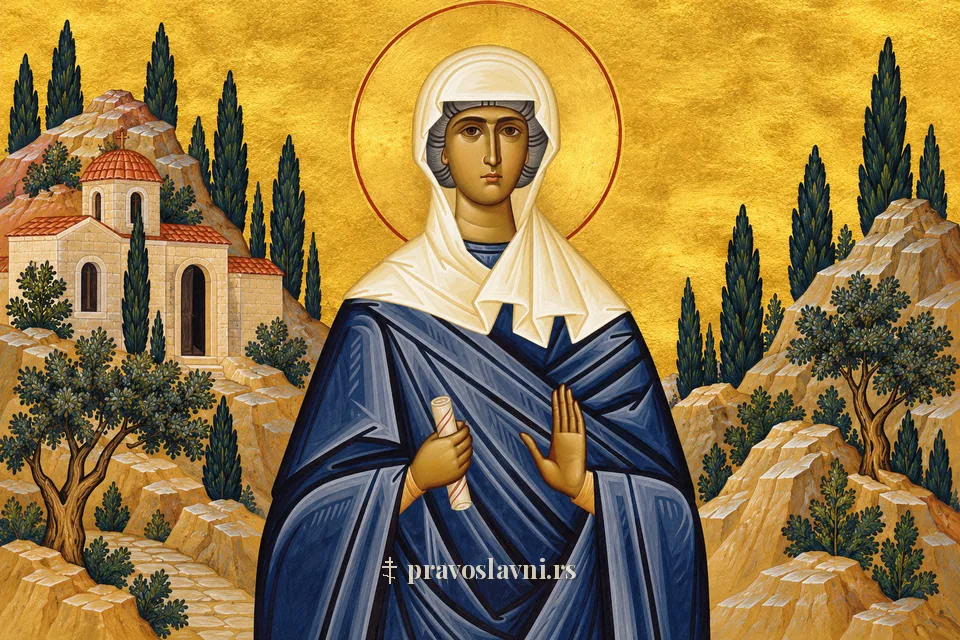
Saint of the day
Venerable Pelagia of Palestine
What happenedA sinful woman from Antioch who, on hearing a sermon about the Last Judgement, gave everything away and lived until her death as an unknown monk on the Mount of Olives.
Read the LifeOrthodox Calendar · 8 October according to the Julian calendar
Wednesday, 21 October 20268 October (according to the Julian calendar)What happenedA sinful woman from Antioch who, on hearing a sermon about the Last Judgement, gave everything away and lived until her death as an unknown monk on the Mount of Olives.
Read the Life
No meat, dairy products, eggs, fish or oil — food cooked in water.
This is a recommendation — for your own fast, consult your priest or spiritual father.More about the fast →
Today the Church keeps the commemoration of a saint · not a Red Letter day.
More about the feast →
“Create in me a clean heart, O God, And renew a steadfast spirit within me.”
— Ps 51:10In the fifth century Pelagia was the best-known woman in Antioch. Because of her jewellery they called her Margarita, and the Prologue says openly that she lived in sin and grew rich from it.
Once, according to her Life, she passed by the church of the holy martyr Julian, where eight bishops were listening to the elder Nonnus, Bishop of Heliopolis. All of them turned their eyes away, but Nonnus looked at her for a long time and wept. Both the Prologue and her Life remember what he then said to the brethren: he was ashamed that she took more trouble to please men than they did to prepare their own souls for Christ. That night he prayed for her.
The next day he preached on the Last Judgement. According to her Life, Pelagia entered a church for the first time then, and the Prologue says that this word brought her to repentance and tears. Her Life continues: she sent Nonnus a letter, and when he received her in the presence of the other bishops, she fell face down and begged for baptism. Not even the demand that she have a sponsor discouraged her. She remained on her knees until the archbishop gave her the deaconess Romana as godmother. So she was baptised, and from that day her life had only one direction.
She handed her wealth over to the bishop, and he saw to it that everything went into the hands of the needy. She kept nothing for herself. On the eighth day after her baptism, according to her Life, in coarse clothing and the old cloak of Nonnus, Pelagia left Antioch for ever.
The Prologue records that she went to Jerusalem and, under the name of the monk Pelagius, lived in an enclosed cell on the Mount of Olives. Three years later she was visited by James, the deacon of Nonnus. She recognised him, but he did not recognise her. When, according to her Life, he came again, he found her dead. Only when the monks and the Patriarch of Jerusalem came for the burial was it discovered that the renowned hermit had been a woman. She reposed around the year 461.
Pelagia's life bears witness that God does not write off a single human being. Whoever lets go of what binds him will find the door open, however far he may have gone before that.
This story was written down by the deacon James, the companion of St Nonnus. In the fifth century Nonnus was Bishop of Heliopolis, a man of holy life, who had come to the bishop's throne from the monastery of Tabennisi. The event in question took place in Antioch.
The Life says that eight bishops once gathered in the church of the holy martyr Julian to hear Nonnus's teaching. Just then Pelagia passed by the church doors, the best-known woman in the city, lavishly adorned and followed by a retinue. Because of the pearls she wore, they called her Margarita. The Prologue speaks of her without embellishment: she lived in sin and had grown rich from sin.
The bishops lowered their eyes. Nonnus, on the contrary, gazed after her until she disappeared, and then burst into tears. His words to the brethren, which both the Prologue and the Life remember, were not a condemnation, but a reproach addressed to himself. She puts so much effort into pleasing people, while we, who serve Christ, hardly take any trouble over our own souls. So a woman of ill repute, without even knowing it, became a lesson to a holy elder.
That night Nonnus prayed for her and for himself. The Life also mentions a dream in which he washed a soiled dove in water. The next day, on the Lord's day, the elder, at the archbishop's bidding, came out before the people with a sermon on the Last Judgement, simple and without ornament. Pelagia, according to the Life, found herself in church then for the first time. According to the Prologue, that hour was the turning point: Pelagia repented and began to weep over her life.
According to the Life, she sent Nonnus a letter and begged him to receive her, reminding him that Christ came for the sake of sinners. The elder agreed to see her, but only in the presence of the other bishops. She fell at his feet, asking for baptism. He cited to her the rule that she could not be baptised without a sponsor. She did not get up, but wept and would not give in. The archbishop then gave her the deaconess Romana as godmother, and Pelagia was baptised.
The Life records that the enemy did not let her go easily: at night he would come to remind her of the wealth she had left behind. She drove him away from herself with the Cross and by calling upon Christ. On the third day she sent all her wealth to Nonnus. Nonnus handed the money over to the church steward and adjured him not to keep a single coin for the church, but to let all of it go to those who needed it most. So the wealth from a sinful life found a pure use.
On the eighth day after her baptism, says the Life, the white robe of the newly baptised was exchanged for a hair shirt and Nonnus's old cloak. Then Pelagia vanished from Antioch. According to the Prologue, the road took her to Jerusalem. There, on the Mount of Olives, she lived in an enclosed cell, and the world knew her as the monk Pelagius.
After three years James set out on pilgrimage to the Holy Land, and Nonnus advised him to visit the monk Pelagius, for that, he said, was a true servant of Christ. According to the Life, the whole district around Jerusalem was talking about that hermit, yet nobody knew who was living in the cell. He found the cell and in it a hermit so wasted away that he did not recognise him, although the hermit knew at once who had come to him. When he came again on his way back, according to the Life, he knocked in vain for days and at last found him dead. Monks and the Patriarch of Jerusalem came to the burial, and then it was discovered that Pelagius had been a woman. The Prologue states that she reposed around the year 461.
Pelagia left everything at once: fame, wealth, her name, and even the city itself. She did not do it out of despair, but out of love. Whoever has once felt God's mercy can no longer live as before. God waits even for those who have strayed the furthest, and it is enough for a person to let go of what he is clutching so tightly.
Thais lived in Egypt and was well known for her beauty. The Prologue says that her own mother pushed her into a sinful life, and Thais then drew many others to ruin. Her Life adds that because of her men lost their estates and came into conflict with one another. Abba Paphnutius, a disciple of Anthony the Great, came to hear of her and, trusting in God, set out to rescue her. He came to her disguised as a layman, as one of her visitors, and when they were alone he warned her without mincing words where such a life was leading her soul. According to her Life, he was astonished that she knew of God and of the Judgement, and yet lived in such a way. His words awakened repentance and tears in her. According to the Prologue, she freed herself of her wealth by giving it to the poor. The elder then brought her among the nuns, to a sealed cell, where she spent three years in strict fasting, praying to God without ceasing for mercy. Then Paul the Simple, also a disciple of Anthony, learned in a vision that a place had been prepared in heaven for Thais. Soon afterwards, in the year 340, Thais fell ill and departed peacefully to the Lord. There is no sin that God does not forgive to the one who truly repents.


