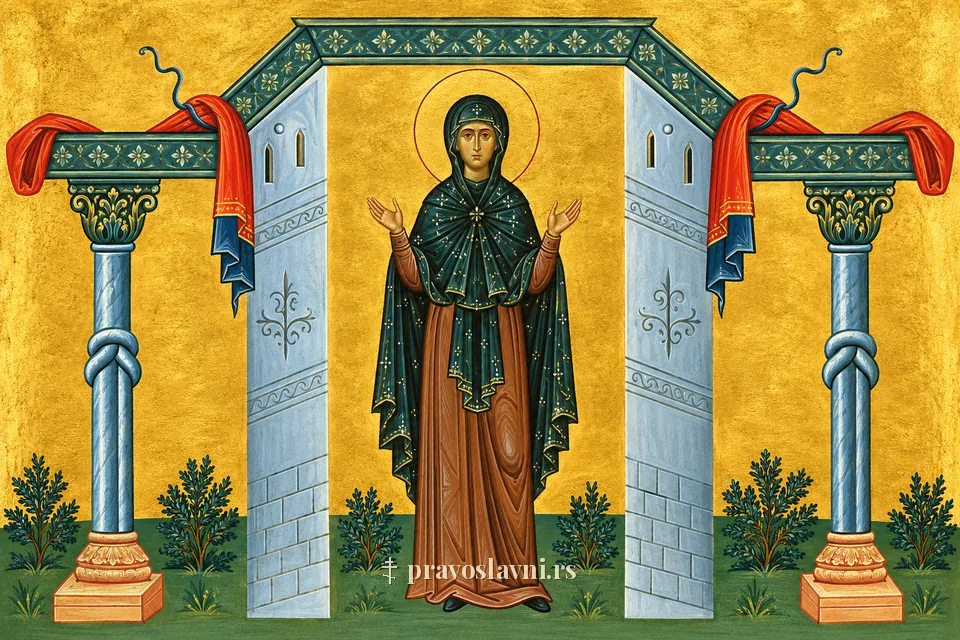
Saint of the day
Venerable Melania
What happenedThe wealthy Roman lady Melania gave away her vast estate to the poor and spent her life in fasting and prayer, founding monasteries and caring for the sisters like a mother.
Read the LifeOrthodox Calendar · 31 December according to the Julian calendar
Wednesday, 13 January 202731 December (according to the Julian calendar)What happenedThe wealthy Roman lady Melania gave away her vast estate to the poor and spent her life in fasting and prayer, founding monasteries and caring for the sisters like a mother.
Read the Life
You may eat meat, eggs, milk and dairy products, as well as any other food — but try to be moderate.
More about the fast →
Today the Church keeps the commemoration of a saint · not a Red Letter day.
More about the feast →
“Then Jesus, looking at him, loved him, and said to him, ”One thing you lack: Go your way, sell whatever you have and give to the poor, and you will have treasure in heaven; and come, take up the cross, and follow Me.”“
— Mk 10:21Melania was a Roman woman, the heiress of a great fortune and the daughter of a Christian household. She wished to live as a virgin, but her parents gave her in marriage against her will, to Apinianus. The two children who were born to them did not live, and the second childbirth was followed by her own grave illness. The Prologue and her Life connect her recovery with the vow Apinianus made to God that from then on they would be only brother and sister.
From then on the couple lived for others. The estates, which her Life lists across Italy, Sicily, Spain, Gaul and Britain, passed into other hands, and the money went to the poor in Mesopotamia, Syria, Egypt and Palestine, to guest-houses, to prisoners and slaves, and even to islands bought for monasteries. What had once come to belong to Christ, Melania no longer regarded as her own.
The Prologue follows them as travellers whose good works were remembered in every land through which they passed. In Africa, according to her Life, they built two monasteries; in Alexandria they were blessed by Patriarch Cyril, and in Egypt they sought counsel from renowned fathers. All the while Melania ate little, prayed much, and every year read the whole Bible through three times.
Then, on the Mount of Olives, she lived for fourteen years in solitude and prayer. After that she gathered sisters into a convent, served them herself and took care of them. When Apinianus died as a monk, she put the rest of her fortune into a monastery for men. Volusianus, a pagan whom the Prologue calls her kinsman and her Life her uncle, invited her to Constantinople. There she brought him to Christ; he was baptised and soon afterwards died. The Prologue adds that not even Blessed Augustine had managed to do this.
After that she returned to the Mount of Olives. Her Life records that in Bethlehem, at Božić (Christmas), she foretold her approaching end and that her last words were: “As it has pleased the Lord, so it has come to pass.” She reposed in the year 439, and she was buried, with honours, by monks and nuns.
Her life teaches that wealth is truly kept safe only when it passes through the poor to Christ, and that spiritual treasure outweighs every earthly one.
Melania was born in Rome, in a house in which faith and great wealth were joined together; her Life adds that both her father and her grandfather were senators. The girl desired virginity, but it was not she who decided about her marriage. According to her Life, at fourteen she was given to the seventeen-year-old Apinianus, a young man from a distinguished house. She offered her husband all her wealth in exchange for a life in purity, and he, as her Life relates, asked that they should first have an heir. The daughter who was born to them first Melania at once dedicated to God as a virgin. According to her Life, she kept her hair shirt, her fasting and her avoidance of the baths secret, and she even asked a kinswoman who discovered it to keep silent.
The second birth, according to her Life, came after a night which, around the day of St Laurence, she had spent in prayer and prostrations; the boy lived only long enough to be baptised. Melania was then overcome by a grave illness. The Prologue and her Life agree that healing came only with Apinianus's vow before God: from then on there would be only a brotherly fellowship between them. The daughter did not live long either.
From then on their aim was to rid themselves of all their property for the benefit of the poor. When Melania's father died, she being twenty and Apinianus twenty-four years old, they moved to an estate outside Rome. The sale took in possessions in Italy, Sicily, Spain, Gaul and Britain, and permission for it, according to her Life, was given to them by the Empress Verina. The same Empress protected them from Apinianus's brother Severus, who had seized part of their land; the couple, keeping to Christ's commandment about the other cheek, asked her to spare him. Nor did she accept the gift of the Empress's sister, for what had once come to belong to Christ, as she understood it, must not become hers again. Their almsgiving reached as far as Mesopotamia, Syria, Egypt and Palestine: guest-houses lived from it, prisoners and slaves received help, and they also bought islands on which there were to be monasteries.
Before the barbarians laid Rome waste, they set out with Melania's mother for Sicily, to Bishop Paulinus of Nola. In Thagaste, where the bishop was Augustine's friend Alypius, they made gifts to the church, and her Life also mentions two monasteries which they built there, with eighty monks and a hundred and thirty nuns. For seven years they lived in Carthage.
According to her Life, in the end she ate only on Saturdays and Sundays. She slept on the floor, for less than two hours, and the books which she copied she sold for the benefit of the poor. The Prologue and her Life record that every year she read the whole Bible through three times. Egypt was a school for them: in Alexandria they were blessed by Patriarch Cyril, and then they went round visiting the renowned desert-dwellers, from Lower to Upper Egypt, in order to learn from them.
In Jerusalem they venerated the tomb of Christ, and her mother built a house on the Mount of Olives. For fourteen years Melania did not go out of that house, but prayed and lived the ascetic life. After her mother's death, according to her Life, she spent one more year in a smaller cell than before. Then she founded a convent, in which, as her Life says, there were more than ninety maidens, and she also received repentant harlots. She herself served the sisters and took care of each one. She taught them watchfulness: “We must always keep watch, for we do not know at what hour the thief will come.” When Apinianus died as a monk, she buried him and, with what remained to her of her property, built a monastery for men.
She was called to Constantinople by the pagan Volusian, whom the Prologue calls her kinsman and a senator, and her Life her uncle. The Prologue adds that not even Blessed Augustine had managed to convert him; Melania brought him to baptism, after which he soon died. Her stay in the capital, according to her Life, brought her meetings with the Emperor Theodosius the Younger, the Empress Eudocia and Patriarch Proclus, and to many it brought a return from the heresy of Nestorius to Orthodoxy. The same Life also attributes three healings to her: of the Empress Eudocia, of a girl who was tormented by a demon, and of a woman who was unable to give birth.
She returned to the Mount of Olives. Her Life says that both in Bethlehem at Christmas and to the sisters on the day of St Stephen she hinted that her end was drawing near. Before her death she was given Holy Communion by the Bishop of Eleutheropolis, and the last thing she said was: “As it pleased the Lord, so it has come to pass.” She reposed in the year 439. The funeral was solemn, with a vigil and psalms, and monks and nuns from the monasteries around Jerusalem gathered for it.
Her Life draws from her life the lesson that treasure is safe only when it passes through the hands of the poor to Christ. Humility, patience, meekness, obedience, love and purity are more precious than any property.
St Dositej was born in Belgrade in 1878 and became a monk in 1898; he was educated in Kiev, Berlin, Leipzig, Paris and Geneva, and he spoke Russian, Czech, German and French. When the Balkan War broke out in the autumn of 1912, he returned to Serbia, and the following year he became Bishop of Niš. Even when the year 1915 came he did not abandon his clergy and people, and for that reason the Bulgarians interned him; before that, in the years when Niš was the wartime capital, he was a support to everyone who needed help. He took part in the negotiations on the unification of the Serbian Church and the restoration of the patriarchate, and he was its envoy in Czechoslovakia and Subcarpathian Rus. He became the first Metropolitan of Zagreb in 1932, and he organised the new metropolitanate from the very beginning. The Ustaše, together with the deacon Lazar Živadinović, deprived him of his freedom as early as 10 April 1941, the first day of the NDH (the Independent State of Croatia), and imprisoned him in Petrinjska Street; both in prison and in the hospital, to which he was carried gravely ill, he endured torture and humiliation. Božidar Cerovski, who at that time headed the Ustaša police, testified that Dositej was sent by train to Belgrade already on the verge of death; the German authorities took charge of him in Zemun and transferred him to the capital. His Life records that he reposed from the consequences of the ill-treatment in the Vavedenje Monastery on 13 January 1945 Because of all that he endured without departing from Orthodoxy, the Holy Synod of Bishops of the Serbian Church numbered him among the confessors in the Calendar of Saints (Imenoslov).


