Thursday14January 20271 January (according to the Julian calendar)‹›
Illustration
Great feast
New Year (Julian calendar)
Circumcision of the Lord Jesus Christ
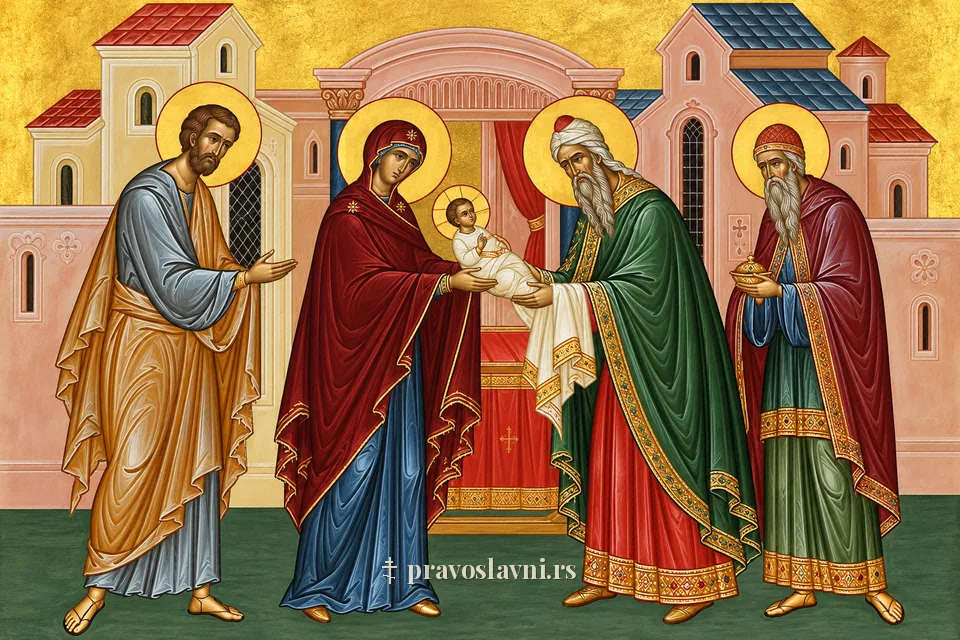
What happenedOn the eighth day after His birth Christ was circumcised according to the law in force since the time of Abraham, and He received the name Jesus, which the Archangel Gabriel had announced beforehand.
“And when eight days were completed for the circumcision of the Child, His name was called Jesus, the name given by the angel before He was conceived in the womb.”
Sung at the Slava (family patron saint's feast) and on the saint's feast day.
Thy sound hath gone forth into all the earth, which hath received thy word, whereby thou hast taught in a manner befitting God, hast made clear the nature of created things, and hast adorned the ways of men. O royal priesthood, venerable father, entreat Christ God that our souls be saved.
In the church calendar this day is entitled New Year. Among the people it is also called Mali Božić (Little Christmas), and it is known as the Serbian New Year as well, because by the old (Julian) calendar it is precisely with this day that the year begins. It should not be confused with the Church New Year, which has its own separate day in the calendar.
In church terms, this is the feast of the Circumcision of the Lord. On the same day St Basil the Great, Archbishop of Caesarea in Cappadocia, is celebrated, whom the Church calls “the bee of the Church of Christ”, and his Liturgy is served. Many families celebrate him as their Krsna slava (family patron saint's day). The change of the year which coincides with the feast of the Circumcision and of St Basil is not in itself a feast either, just as the new year in general is not, but the passage into the new year should nevertheless be marked with a moleben of thanksgiving.
By folk custom, the lady of the house kneads the vasilica, a bread named after St Basil, salty or sweet; in some regions it is made of maize flour, brushed with honey or marked with a cross. The most widespread belief is that one should not quarrel on that day, because the first day sets the tone for the whole year. The custom of seeing in the new year has also come to life again: families, together with guests, hold a festive dinner and wait for midnight, and in some places the celebration is organised in restaurants, hotels or halls. At midnight people kiss and wish one another a long and peaceful life, health and success, and the next day they go to church, and then to a festive lunch.
As for fasting, see more in the guide “Fasting — simply explained”.
On the eighth day after Božić (Christmas) the Church celebrates the Circumcision of the Lord, on 1 January according to the old calendar, that is, on 14 January according to the new calendar. The Evangelist Luke records that the Infant was then, as the law required, circumcised and named Jesus, the name which the angel had given Him before He was conceived. According to the Prologue, this took place in the temple, according to the law which Israel has kept since Abraham; the Life does not state the place. The Prologue adds that the feast has neither a forefeast nor an afterfeast.
The name, say the Prologue and the Life, was announced beforehand to the Most Holy Virgin by the Archangel Gabriel. The angel also told Joseph that the Child would save His people from their sins, and the Life sums this up: “For Jesus means salvation.” According to the Life, behind that name stands the decision of the Holy Trinity, and it was kept for the hour of the redemption of the human race.
Why does He who is without sin receive the rite? The Prologue and the Life stress above all obedience to the Law, in which not a single commandment was to be left aside, and the testimony to the real body of Christ, against those who would later see in Him only an appearance. The Life also cites the question of St Ephraim the Syrian: “If He was not flesh, whom then did Joseph circumcise?” According to the Life, by this Christ also set free those under the Law, then for the first time shed His blood for mankind, and humbled Himself so far that the Sinless One appears as a sinner. And the eighth day itself, says the Life, referring to St Gregory of Nyssa and St Stephen, the author of the festal canon, points to the age to come.
The Prologue sees in the old rite a foreshadowing of baptism. The Life explains that circumcision signified cleansing from ancestral sin, but did not bring it. Christ kept the old rite, and to the Church He gave baptism by water and the Spirit; that is why the Apostle Paul writes: “neither circumcision nor uncircumcision avails anything, but a new creation”.
The feast is therefore not merely the remembrance of an ancient rite. The Life calls us to a spiritual circumcision: to cut away pride, envy, anger and impurity. The outward sign has given way to inner renewal, and the name of Jesus we are to carry in our hearts and on our lips.
Full Life
The name that waited for the eighth day
The Evangelist Luke describes this event in a single sentence: when the time came for the Child to be circumcised, on the eighth day, He was called Jesus, the name which the angel had given Him before He was conceived. The Church celebrates that day on 1 January by the old calendar, that is, on 14 January by the new calendar. The Prologue adds one liturgical detail: neither a forefeast nor an afterfeast is joined to this feast.
The name was not chosen on that day. The Prologue and the Life say that the Archangel Gabriel announced it beforehand to the Most Holy Virgin, and the Life adds that he brought it from heaven even before the conception. Luke records the angel's words to Mary that she would bear a Son and call His name Jesus. Matthew records what the angel said to Joseph: the Child will be called Jesus, for He will save His people from their sins. The Life sums this up briefly: “For Jesus means salvation.” Behind that name, according to the Life, stands the decision of the Holy Trinity; it was kept for the hour of the redemption of mankind. Referring to the Song of Songs, the Life compares it to ointment poured forth and sees in it a treasure which the Christian carries in his heart and on his lips.
Where and who
The sources do not say the same thing about the rite itself. According to the Prologue, the Child was circumcised that day in the temple, for so the law required which Israel has kept since the days of Abraham. The Life does not give the place. Who performed the rite the sources do not say explicitly; the Life gives only the question of St Ephraim the Syrian, who attributes the circumcision to Joseph: “If He was not flesh, whom then did Joseph circumcise?” In one thing, however, both sources agree: on that day the Child received the name Jesus.
Why the sinless One receives the rite
The question naturally arises why the rite is received by Him Who is without sin. The Prologue and the Life put two things in the first place. The first is obedience: not a single commandment of the Law was to remain unfulfilled. The second concerns His body — the rite itself bears witness that it is real, and by this the later heresy about an apparent body was refuted in advance; Ephraim's question also aims at this.
The Life lists further reasons. Christ places Himself under the Law in order to set free those who live under it. Through the bodily circumcision He brings in the spiritual one. By shedding His first blood then, He begins His suffering for mankind. There is humility here too: the Sinless One consents to look like one of the sinful. Here the Life compares the Sinless One to the bronze serpent of Moses from the Book of Numbers. It had only the likeness of a serpent, with no venom in it; so too Christ receives the sign which is given to sinners, and yet has no sin.
Even the number of days has a meaning. According to the Life, which here refers to St Gregory of Nyssa and to St Stephen, the author of the festal canon, the eighth day points to the age to come.
Baptism in place of circumcision
The Prologue sees the Old Testament rite as a foreshadowing of baptism. The Life also explains why: circumcision signified cleansing from the ancestral sin, but did not bring it; it was a sign, and not the reality. True cleansing was brought only by baptism with water and the Spirit, which Christ gave to the Church after He had kept the old law to the end. The rite which only pointed to cleansing was replaced by the one which truly cleanses.
That is why the Apostle Paul writes to the Galatians: “neither circumcision nor uncircumcision avails anything, but a new creation”. The sign on the body, given in the time of Abraham, thus received its fulfilment in the renewal of the whole man in Christ.
The circumcision of the heart
The Life does not leave the feast in the distant past, but turns it into a call to everyone. Spiritual circumcision means to cut off from oneself pride, envy, anger and impurity.
Thus, according to the Life, the outward rite of the Old Law gives way to the inward renewal in Christ. Circumcision has been replaced by baptism, and from each one of us the circumcision of the heart is asked: to cut off sin and to keep the name of Jesus, which means salvation, in the heart and on the lips.
Other saints of the day
St Basil the Great
St Basil the Great was born in Cappadocia in the time of the Emperor Constantine, of his father Basil and his mother Emmelia, and among his brothers and sisters were Macrina, Gregory of Nyssa and Peter, later Bishop of Sebaste. While still unbaptised he devoted a decade and a half to secular learning in Athens, as the Prologue and his Life record; among his companions at school were Gregory the Theologian and the future Emperor Julian the Apostate. His Life tells that he left Athens in search of true wisdom and that he said to his former teacher Eubulus: “The essence of philosophy is the remembrance of death”; both of them received baptism in the Jordan. With Gregory the Theologian, in the wilderness of Pontus, he wrote rules for the monastic life, and then he was chosen as Archbishop of Caesarea in Cappadocia. He fought by word and pen against the Arians, and he was not afraid either of the Arian Emperor Valens or of the prefect Modestus, to whose threats he replied: “Tomorrow too I shall be the same.” His Life records that three times Valens failed to sign the decree of his banishment, because his pen kept breaking. The Emperor Valentinian sent him money, and Basil turned it into hospitals for the sick of his diocese. His Life says that he prayed for the grace to serve the Liturgy in his own words, and that, after Christ appeared to him in a vision with the apostles, he wrote the Liturgy that bears his name. The Prologue mentions that he left many writings behind him and that the hymns of the services call him the bee of the Church. He reposed on the first of January 379, and he was buried in Caesarea, in the church of the Martyr Eupsychius. He placed his great learning at the service of the Church, bravely defended Orthodoxy and cared for the poor and the sick.